

Forest investment is no longer reserved for the great Earth dynasties. In a context of volatility in financial markets and ecologically sensitive research, the forest is becoming a tangible asset class. Stable and disconnected from stock market indices, it offers a unique heritage diversification. However, acquiring hectares of wood requires the method. Between the specifics of forestry, tax systems and the challenges of sustainable management, it is necessary to understand the mechanisms of this investment in order to succeed in your acquisition.
Why choose the forest asset for its heritage?
Investing in the forest has a dual motivation: the search for security and the willingness to contribute to the preservation of the environment. Unlike an apartment or stock, the forest is a living asset that grows naturally, regardless of economic crises.
A secure value disconnected from markets
The price of the forest hectare in France shows a historical resilience. For several decades, the value of wood and forests has increased, driven by the scarcity of supply and demand for bio-sourced materials. By integrating forest plots into your portfolio, you reduce your exposure to financial cycles. It is an asset of Portfolio fund with low volatility compared to urban real estate or equity markets.
Taxation: the main driver of performance
This is the major argument for heavily taxed investors. The State shall encourage the holding of forests through exceptional arrangements. The device « Monichon » allows 75 % exemption on the taxable base of transfer rights (succession and donation). In addition, forest assets are exempt from 75% tax on Fortune Immobilier (IFI), subject to certified sustainable management. These benefits transform a modest gross yield into a long-term attractive net performance.
Direct purchase or group shares: what strategy should be adopted?
There are several entrance doors to become a forest owner. The choice depends on your budget, the time available for management and your need for liquidity.
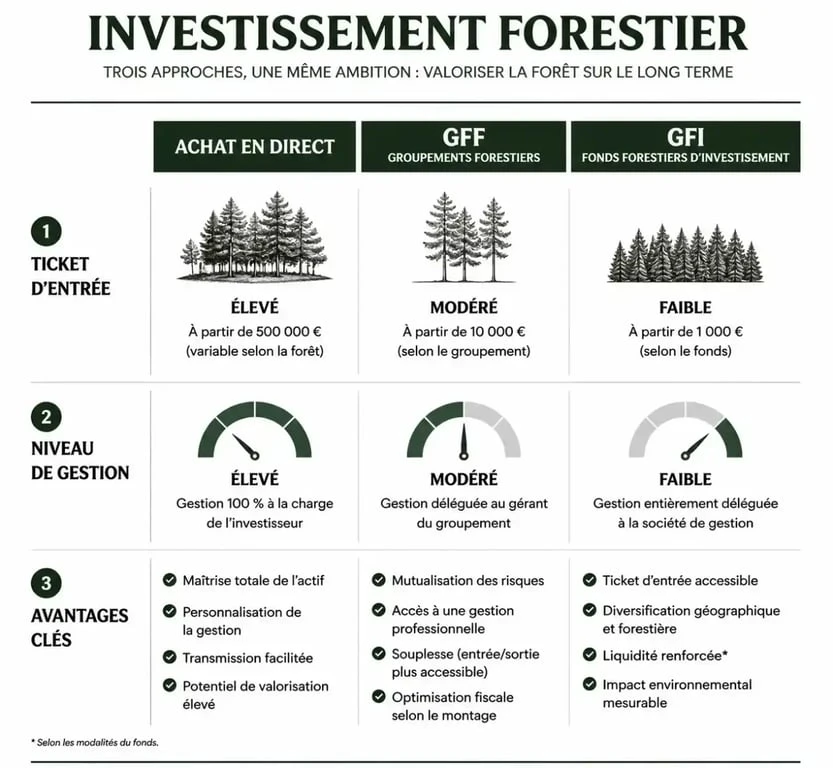
| Investment mode | Entry ticket | Management | Benefits |
|---|---|---|---|
| Online shopping | High (> 50,000) €) | Owner alone | Total freedom, pleasure use |
| GFF (Groupement Fondier Forestier) | Average (5,000 - 20,000) €) | Delegate | Risk sharing, taxation |
| GFI (Forestry Investment Group) | Low (1 000 – 5 000) €) | Professional | Boxed liquidity, diversification |
Live shopping for fun and control
Acquiring its own forest allows total control of forest management. You choose the essences, decide the cuts and physically enjoy your good. This is the ideal option for those looking for tangible assets. However, this requires expertise or support from Forest expert to monitor the health status of trees and organize timber sales. On-line management involves taking on the risks of storms, fires or pests alone.
Forest clusters for simplicity
For most savers, the Groupement Forestier d'Investissement (GFI) is the most relevant solution. By buying shares, you become the owner of a fraction of a forest park spread over several regions and composed of various species. This geographical diversification reduces the climate risk. The management company deals with everything: maintenance, cutting, reforestation and administrative procedures. You receive a share of the income from the sale of wood.
Essential criteria for assessing a parcel
Not all forests are worth it. Before signing, several technical indicators must be analysed to ensure the sustainability of your investment.
Soil quality and suitability of species
Soil is the capital of the forest. Its depth, water retention capacity and nutrient richness determine the rate of tree growth. Poor soil limits timber production. It must be verified that the species present are adapted to local climate and future projections. Unsuitable ground stands are rapidly depleted, making the plot vulnerable to diseases and climatic hazards.
Accessibility and forestry services
A beautiful but inaccessible forest has low economic value. For the operation to be profitable, forest machinery must have access to the plots and log trucks must be able to evacuate logs. The presence of forest trails in good condition is a major criterion of valuation. If you need to create these infrastructures, it will weigh on your initial profitability.
Health status and maturity
A forest composed solely of young plants will require investment for 20 or 30 years before returning. In contrast, a massive « mature » with large wood offers immediate liquidity but will require expensive reforestation after cutting. The ideal is to seek a balance of age classes to smooth income and expenditure.
Profitability and risk management: the reality of the figures
The financial performance of the forest is moderate. We invest in forests to protect our capital, not to speculate in the short term.
Moderate biological and financial yield
The average annual yield of a forest is between 1% and 3%. This figure is broken down into two parts: biological yield (growth of trees) and financial yield (sale of wood). To this is added the valorisation of the price of the hectare. With the tax benefits, the overall profitability for a heavily taxed taxpayer becomes competitive compared to other secure investments.
Anticipating climate and health risks
Zero risk does not exist in forestry. Climate change increases the frequency of extreme events. To protect themselves, the investor must:
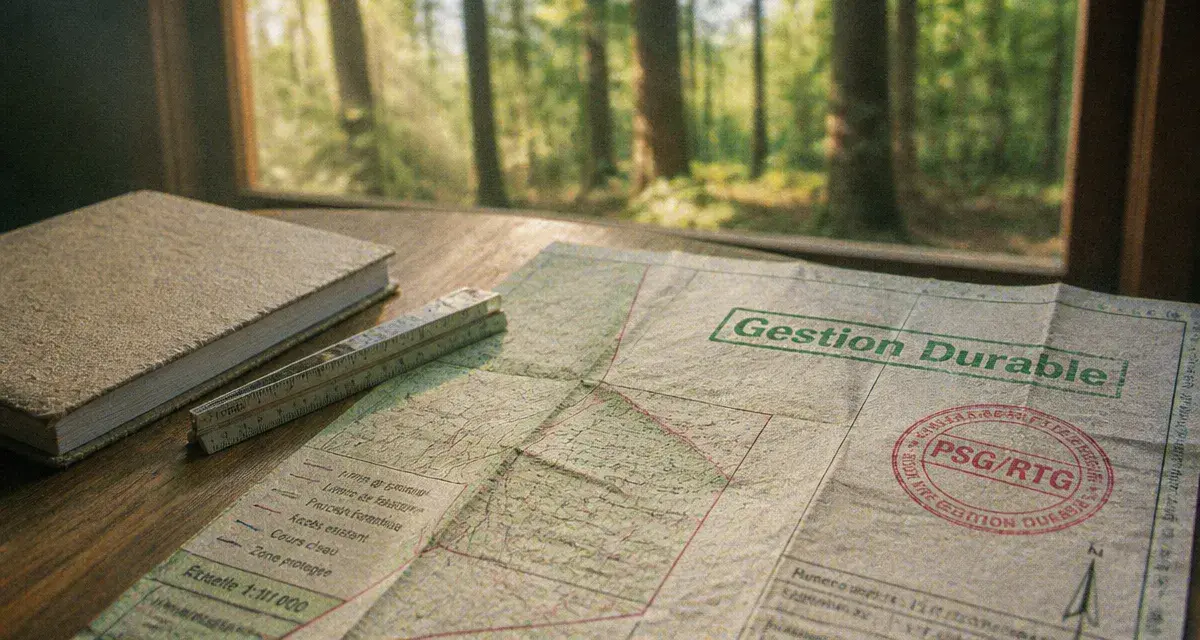
Enter a Specific insurance covering the fire and storm, often mandatory to receive state aid. Focus on mixed forests rather than monocultures, which are more fragile in the face of epidemics. Ensure that the forest has a Sustainable Management Document (PSG, RTG or CBPS) approved by the National Forest Property Centre.
The importance of PEFC and FSC labels
These certifications guarantee management according to strict environmental standards. These labels become essential for selling wood at the best price, as sawmills require certified wood to meet sustainable construction standards. An investment without a label may lose liquidity and value in the secondary market.