

Investing your money is a crucial step in building your financial security, but investment mistakes can permanently compromise your heritage goals. Whether you start investing or want to optimize your existing strategy, identifying and avoiding the most frequent pitfalls is a prerequisite for the success of your financial investments.
Why avoiding mistakes is crucial when investing money

Investing your money intelligently requires a methodical and thoughtful approach. Investment errors, even those that appear to be anodizing, can have dramatic consequences for the return on your long-term investments. A bad decision today can make you lose thousands of euro of potential gains over fifteen or twenty years.
The cumulative effect of investment errors is particularly devastating. For example, excessive charges of only 1% additional per year can reduce your final capital by more than 20% over a 30-year period. Similarly, inadequate asset allocation or emotional decisions can turn a promising investment into a financial disaster.
The financial stability of your home depends directly on your ability to avoid these pitfalls. The six errors that we will detail represent the main causes of failure among private and professional investors.
Error #1: investing without clear strategy
Investing your money without a defined strategy is like sailing without a compass. This fundamental error invariably leads to inconsistent and counterproductive decisions that compromise the overall performance of the portfolio.
An effective investment strategy is based on three essential pillars. First, the definition of precise and quantified objectives: saving 200,000 euros for retirement, contributing 50,000 euros for a real estate purchase, or generating 500 euros of monthly passive income. These objectives directly determine your allocation choices.
Second, the time horizon conditions the acceptable level of risk. A placement to finance your child's education in five years requires a more cautious approach than an investment in retirement in twenty-five years. Finally, your personal tolerance of risk influences the composition of your portfolio.
Without this clear strategy, you may give in to the emotions of the market, multiply expensive round-trips, or choose investments that are inappropriate for your real needs. The strategy serves as a guard against impulsive decisions.
Error #2: not sufficiently diversifying its portfolio
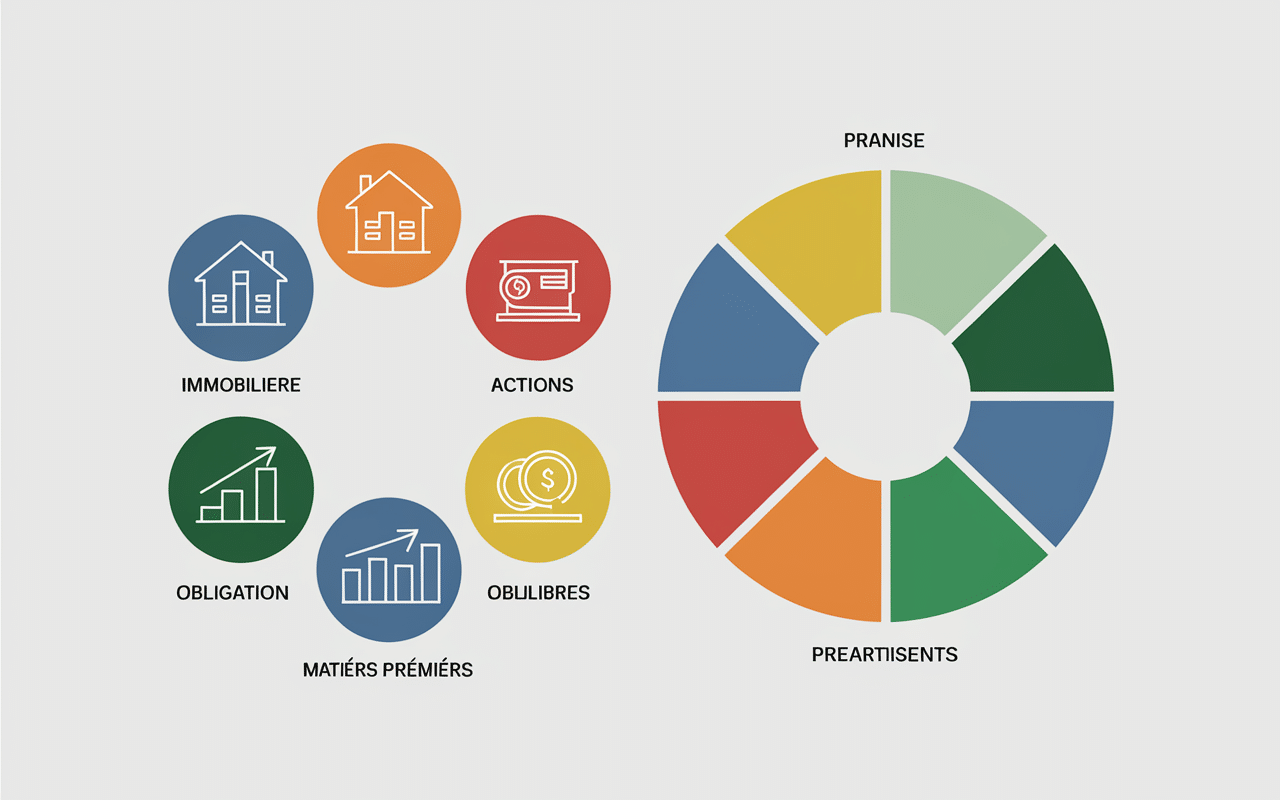
Diversification alone « free meal » in finance, according to the consecrated expression. Yet many investors neglect this fundamental principle and focus their investments on a few securities or sectors.
Effective diversification occurs at several levels. Diversification by asset classes consists of dividing your capital between shares, bonds, real estate and raw materials. Each class reacts differently to economic cycles, offering natural protection against volatility.
Sectoral diversification avoids concentration on a specific area of activity. Investing exclusively in technologies or energy poses significant sectoral risks. Geographical diversification makes it possible to benefit from global growth while limiting exposure to the political or economic risks of a single country.
| Type of diversification | Objective | Practical example |
|---|---|---|
| Active classes | Reduce correlation | 60% shares, 30% bonds, 10% real estate |
| Sector | Limiting sectoral risks | Technology, health, finance, industry |
| Geographical | Benefiting from global cycles | Europe, United States, emerging countries |
This approach optimizes the performance/risk ratio by smoothing performance over the long term.
Error #3: neglect its investor profile and financial capacity
Investing your money without considering your personal profile is a major mistake with potentially dramatic consequences. Your investor profile determines the types of investments that are compatible with your situation.
The prudent profile is suitable for investors who favour the preservation of capital. It generally corresponds to persons approaching retirement or in need of short-term liquidity. The balanced profile seeks a compromise between safety and performance, while the dynamic profile accepts significant volatility to maximize potential gains.
Your financial capacity is just as critical. Immobilizing all of your precautionary savings in non-liquid investments exposes you to major financial difficulties in case of unforeseen. The general rule recommends keeping three to six months of current expenses on a booklet before investing.
Age also influences your investment choices. A young asset can afford an aggressive allocation of shares, as it has the time to overcome the volatility phases. Conversely, a pensioner will favour regular income-generating investments.
Error #4: giving in to emotions and fashion effects in its investments
Emotions are the investor's worst enemy. Fear and greed push to buy at the highest level during euphorias and sell at the lowest level during panics, generating significant losses.
This error is particularly evident in speculative bubbles. The popularity of cryptocurrency in 2021, the Internet values in 2000, or more recently artificial intelligence, illustrates this destructive trend. Investors flock to these sectors when valuations reach unreasonable levels.
The economic press amplifies these phenomena by relaying exceptional success stories while minimizing failures. This overrepresentation distorts the perception of risk and encourages sheep farming behaviour.
To maintain a rational approach, establish strict investment rules and respect them under any circumstances. Use the cost averaging dollar technique to smooth your purchases over time. Limit your exposure to financial media during periods of high volatility.
Error #5: Do not consider fees and taxes
Fees are often neglected but crucial to investment performance. Investing your money without optimizing this tax and tariff dimension can significantly reduce your net earnings.
Annual management fees vary considerably depending on the medium. An active fund usually charges between 1.5% and 2.5% per year, compared with 0.1% to 0.5% for an ETF. This annual difference of 2% represents a huge loss of profits over long periods.
Let us take a concrete example: out of a capital of 100,000 euros invested for 20 years with a gross return of 7% annually, charges of 2% reduce the final capital from 320,000 euros to 245,000 euros, a loss of 75,000 euros.
To maximize your returns while minimizing risks, discover What to invest in in 2024: guide to optimize your savings without unnecessary risk taking.
To avoid frequent mistakes, discover our essential tips on how to start trading effectively.
To maximize your chances of financial success, discover our essential tips in this article dedicated to personal finance: how to invest 100,000€.
Taxation is another key optimisation lever. The Savings in Shares Plan exempts capital gains after five years of detention. Life insurance offers advantageous taxation on buybacks after eight years. The Retirement Savings Plan generates immediate tax deductions.
This tax optimization requires advance planning and updated knowledge of legislation. The support of a wealth management advisor can be cost-effective for large portfolios.
Error #6: lack of patience and discipline in its investment strategy
Impatience is one of the most costly defects for an investor. The temptation to constantly change its strategy or anticipate market movements systematically destroys long-term performance.
Academic studies show that private investors earn lower returns than benchmarks, mainly because of their inability to maintain their positions. This underperformance comes from untimely round trips and ineffective market timing.
Time is the most powerful ally of the investor thanks to compound interests. Albert Einstein described this force as « Eighth wonder of the world ». A placement of 10,000 euros to 7% annually reaches 76,000 euros after 30 years, demonstrating the crucial importance of patience.
Discipline involves resisting short-term temptations and maintaining its initial strategy. Annual periodic reviews are sufficient to adapt your allowance to changes in your personal situation. Between these deadlines, scrupulously respect your investment plan.
How to put in place an effective investment strategy and avoid these mistakes
The construction of a sound investment strategy requires a rigorous methodology that incorporates all the elements mentioned above. This structured approach protects you against the major errors identified.
Start by defining your financial goals, time horizon and risk tolerance. This preliminary analysis determines your investor profile and guides your allocation choices. Then build up your precautionary savings before investing the available surplus.
Prefer a diversified allowance adapted to your profile. Use inexpensive media such as ETFs to build the core of your portfolio. Optimize the tax envelope according to your objectives: PEA for European actions, life insurance for flexibility, PER for retirement.
- Analyze your financial situation and set your goals
- Determine your risk profile and investment horizon
- Choose a diversified asset allocation
- Select inexpensive investment media
- Set up a regular investment plan
- Review your strategy annually
Accompaniment by an independent asset management advisor can be valuable for complex situations or important assets. These professionals provide technical expertise and emotional objectivity. Investment is constantly evolving, requiring continuous training and regular adaptation of your strategy to new market opportunities.