
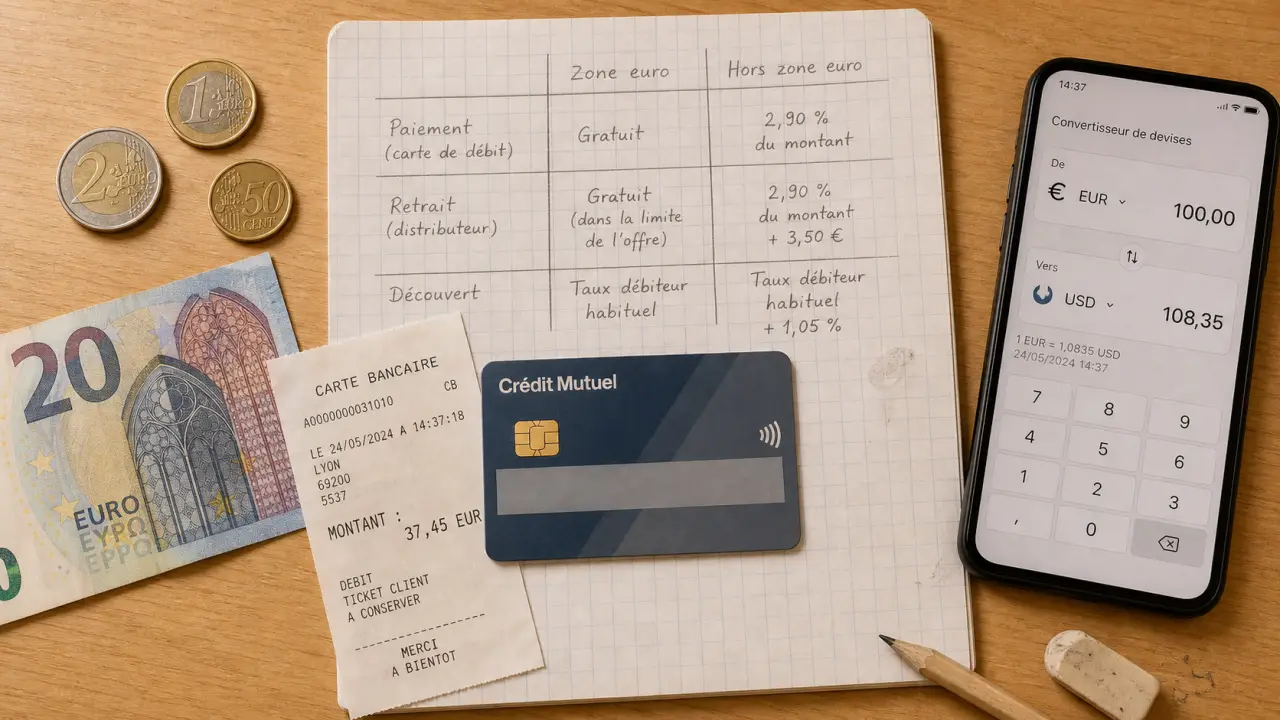

Paying with a Credit Mutuel card outside France may remain simple, but the cost depends mainly on three elements: the country where you pay, the offer associated with your account and the exchange rate applied at the time of the transaction. Before leaving, the right reflex is therefore to check whether your card provides for without charge, then clearly distinguish card payment, cash withdrawal and currency conversion.
What changes between euro and non-euro area
In euro area, a credit card payment is usually the simplest: you pay in the same currency as your account, without money conversion. The risk of bad surprise comes mainly from possible costs related to certain ancillary services or withdrawals, but not from an unfavourable exchange.
Payments and withdrawals without charge abroad with Mutual Credit · Discover the Mutual Credit banking option to make your payments and withdrawals abroad at no extra cost.
Outside the euro zone, logic changes. When you pay in pound sterling, dollar, Swiss franc, yen or other currency, the transaction must be converted into euros. This is where payment costs abroad may arise Credit Mutuel, a conversion commission or a trade margin integrated with the exchange rate. The final amount displayed on your account can therefore be slightly higher than the simple conversion calculated online at the time of purchase.
Payment by card or withdrawal: do not put them in the same basket
Payment at a merchant and cash withdrawal are not invoiced the same way. Payment by card is often more advantageous, especially if your offer provides for free payments abroad. The withdrawal can combine several costs: bank fees, local distributor fees, any fees charged by the corresponding bank and exchange rates with commercial margin.
One point to remember: a withdrawal at another place of business can cost 10 € by withdrawal. Some contracts, however, provide targeted benefits, such as 3 cash withdrawals offered abroad for Eurocompte Young or Connect Origin customers. These conditions remain to be confirmed in the tariff brochure of your caisse or with your advisor, as the rates may vary depending on the agency, as is also recalled by comparison like Wise.
| Situation | What can be billed | Useful reflex |
|---|---|---|
| Payment in euro area | Little or no conversion costs | Focus card on current expenditure |
| Payment outside the euro area | Conversion commission, exchange rate margin | Check the offer and refuse the conversion to euro proposed on site |
| Withdrawal from a distributor | Bank charges, local distributor fees, exchange | Limit the number of withdrawals and withdraw appropriate amounts |
| Withdrawal at the counter of another bank | Up to 10 € by withdrawal under conditions | To be avoided unless necessary |
Mutual Credit offers that can remove fees
Mutual Credit highlights free payments abroad according to the offer held. The idea is simple: some Consolidated offers or service formulas include removing fees on card payments, sometimes all over the world. This is precisely the point to check before a trip, as two Crédit Mutuel customers can have very different conditions with a card that seems similar.
In some ways, the promise is that 0 fresh anywhere in the world. In fact, the line-by-line conditions should be read. An offer may remove the bank commission charged by Crédit Mutuel on purchases abroad, but it does not necessarily make all transactions free in all cases. Any fees charged by a corresponding bank, fees charged by a distributor or a dynamic currency conversion proposed by a payment terminal may add to the rating.
The promise 0 fee: useful, but to read line by line
The dynamic conversion is common in tourist areas: the terminal offers to pay directly in euros rather than in local currency. This seems convenient, but the rate used is often less favourable. In most cases, it is best to choose the local currency and let the card network and your bank apply their conversion.
Payments must also be distinguished from withdrawals. A very interesting offer for purchases is not always for cash. If you already know that you will need liquid on site, it is better to check in advance the withdrawals included in your formula rather than discover the cost at the first distributor.
For whom are these options really profitable?
If you leave once a year in the euro area, an enhanced international option is not necessarily a priority. On the other hand, it becomes interesting for a student abroad, a border, a regular traveller, a family that reserves hotels and activities outside the euro area, or anyone who multiplies small payments in currency. In this case, the accumulation of commissions can quickly exceed the cost of a more suitable pooled offer.
The right calculation is to look at your habits: number of payments, average amount, countries visited, need for cash and frequency of travel. From there, an advisor can compare your current formula with an offer that includes more international services. The aim is not to pay for unnecessary options, but to avoid the costs that accrue to each stay.
Understand exchange rate before comparing fees
Many travellers only look at the "fresh" line on their statement. Yet the exchange rate can weigh as much, if not more, in the final cost. When a payment is made outside the euro area, the amount is converted. The rate used can include a trade margin, which explains the difference with the interbank rate displayed on online converters.
The right calculation is not to look at an isolated purchase, but the entire stay. A coffee, a taxi ride, two museum tickets and dinner seem inexpensive separately. Repeated several times, these payments end up weighing the total, especially if the exchange rate is unfavourable. Before leaving, list the probable expenses in local currency and plan a realistic envelope. You will see more quickly whether a free option is relevant or whether a simple conversion vigilance is enough.
Ten low-value payments with a low-cost rate can cost more than just one large, well anticipated purchase. This is why we must reason in total cost, not just unit costs. On a short trip, the question may seem secondary. On a longer stay, it quickly becomes visible on the survey.
Compare with an alternative: bank, specialized card or multicurrency account
Players such as Wise are often consulted to compare withdrawal costs abroad with the exchange rate. Their interest is to make visible the part related to conversion. This does not mean that an alternative is always better than a Credit Mutuel card: it depends on your need for security, your ceilings, your insurance, your advisor and your tolerance to manage multiple means of payment.
For an important trip, the most prudent approach is often mixed: keep your Credit Mutuel card as the main means, check the payment terms at no cost, and then provide a complementary solution if you go to a country where withdrawals are frequent or card payments are less accepted. This organization limits blockages while leaving a margin of security.
The steps to be taken before departure
A few checks avoid the majority of blockages and unforeseen costs. They are usually made from online customer space, mobile application or with the help of an advisor.
- See the tariff brochure of your caisse The conditions may vary depending on the agency and the offer held.
- Report your trip abroad This reduces the risk of an unusual transaction being interpreted as fraudulent.
- Set card ceilings : Adjust payment and withdrawal ceilings to your reservations, hotel guarantees or car rental.
- Check card validity : an expiration during the stay can become very complicated to manage.
- Enable notifications They can immediately identify a suspicious payment or double billing.
The role of Crédit Mutuel
Contacting an advisor before a departure is not only useful to know the fees. It is also an opportunity to check the guarantees of your international credit card: assistance, travel insurance, conditions of support, telephone numbers and possible limits. If you leave for a long time or at a risk destination, this verification may be as important as the subject matter of the commissions.
The advisor can also confirm whether and to what extent your form includes any payments without charge. This check avoids approximations. It also allows you to adjust the ceilings before departure, rather than discover a blockage when booking or making a major payment.
In case of loss, theft or blocking of a card abroad
Safety must be prepared before the problem. Save the opposition numbers in your phone and keep a copy offline, separated from your wallet. Procedureopposition card is accessible 24 hours a day, allowing fast blocking of payments in case of loss or theft.
If the card is swallowed by a distributor or refused for no apparent reason, start by checking the mobile application: ceiling reached, suspicious payment, geographical restriction or technical incident. Avoid increasing attempts, especially on an isolated automaton. Then contact Credit Mutuel or your advisor to confirm the cause of the blockage.
Finally, do not travel with a single payment method. A second card, a little cash in an easily exchangeable currency and access to your customer area can prevent a bank incident from ruining the stay. Fees abroad are controlled with a good offer, but also with a simple preparation: knowing its prices, choosing the local currency, limiting expensive withdrawals and securing its card before leaving.