
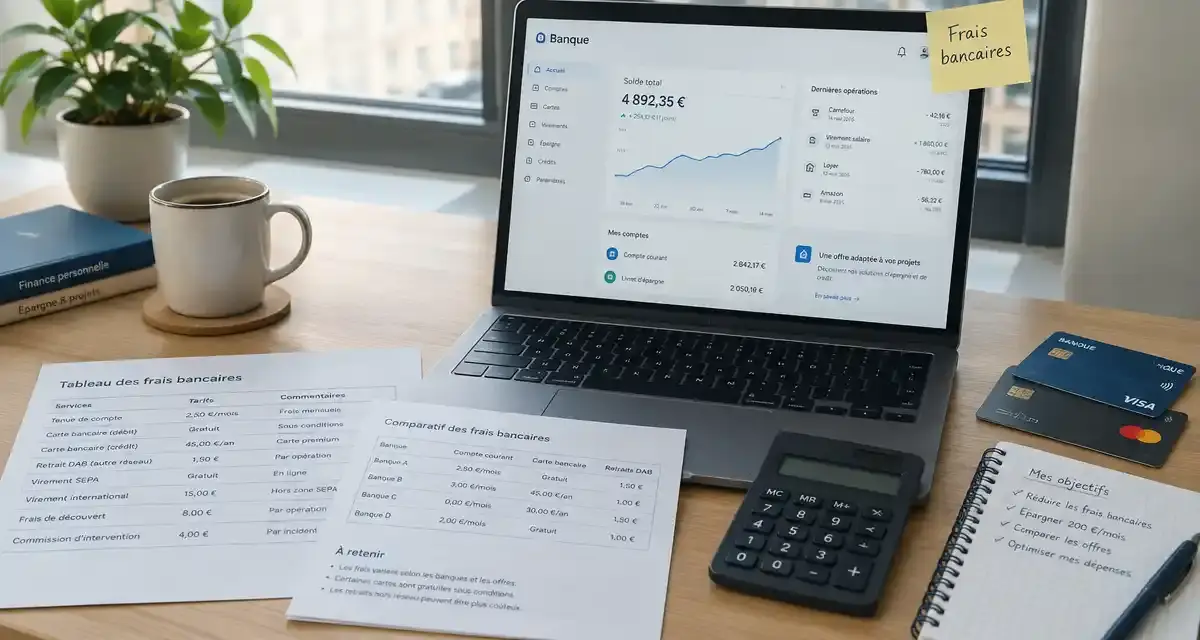

Opening an online account seems simple, but the associated fees are not limited to the displayed price of the card. To compare correctly online bank charges, it is necessary to start from its actual use: current payments, withdrawals, transfers, travel, possible overdraft and really useful services.
Start with your actual account usage

The correct comparison does not start with the tariff brochure, but with your habits. An account used only to receive salary and pay by card does not generate the same costs as an account used to travel, collect irregular revenues or manage multiple monthly transfers. Before studying an online bank account without charge, check the free conditions, the operations included and the costs which appear as soon as use is outside the framework provided.
Three profiles show the possible deviation. A very autonomous user, who consults his statements online and makes few withdrawals, can limit recurring costs. A person who often withdraws cash, especially off-grid or abroad, must monitor commissions. A client exposed to overdrafts or removals must first read the Incident costs, often more decisive than the monthly cost of the account.
The main online banking fees to be examined
Visible fees are rarely the only ones to count. Accounting, card, withdrawals and international transactions form the basis of comparison, but incident costs and options can significantly change the final cost.
| Type of fee | Point to be checked | Why it's important |
|---|---|---|
| Accountancy | Free or charged in accordance with conditions | It weighs even without any particular operation. |
| Carte bancaire | Immediate debit, deferred, range, insurance included | The price often depends on the level of service. |
| Withdrawals | Number included, geographical area, distributors concerned | Repeated small amounts can be expensive. |
| Payments abroad | Commission fixed, percentage, rate applied | A trip may reveal expenses that are not visible to the public. |
| Incidents | Rejection, discovery, intervention, newsletter | These are high-impact costs in case of cash flow. |
Map, withdrawals and operations outside the usual area
A card presented as included may depend on a minimum number of transactions, income level or regular use. It is also necessary to distinguish payment and withdrawal: payment by card can be included, while withdrawing cash becomes paid beyond a threshold. For operations abroad, look separately at the payments, the withdrawals and the exchange rate applied, as these lines do not always meet the same tariff rule.
Payment Incidents and Indirect Costs
The incidents do not only concern people who are regularly exposed. A levy presented too early, a delayed transfer or a card used before the arrival of a salary may trigger fees. The costs of rejection, intervention or information must be read carefully, as must the conditions for authorization of overdraft. An inexpensive daily account can become less suitable if your cash flow varies greatly from one month to the next.
Free conditions: the detail that changes everything

The free announcement attracts attention, but the real cost often depends on several conditions combined. Free card subject to use, limited withdrawals, pay alerts, card replacement, document sending or specific support: each line counts. The right reflex consists in simulating an ordinary month, then a less favorable month with a displacement, an oblivion, a low pay or an exceptional operation. This scenario reveals the Latent fresh better than just reading the main rate.
Optional services deserve the same consideration. SMS alerts, average payment insurance, virtual card, checkbook, cheque delivery, instant transfer or proof-of-consignment edition can be included, limited or billed per bill. None of these services is useless in principle; The key is whether you will use them enough to justify their cost, or whether their ad hoc billing will remain marginal.
Checks to be done before comparing
Before choosing an offer, gather your last three months of transactions and simply classify them: card payments, withdrawals, transfers, levies, international transactions, possible incidents. This method avoids comparing offers on theoretical criteria.
- Check ceilings payment and withdrawal, especially if you plan to make major purchases.
- Read them Contractual conditions related to the card, free of charge and services included.
- Find them fee per act, often less visible than monthly fees.
- Anticipate rare uses: travel, card loss, urgent transfer, one-off discovery.
- Compare the full cost on your actual behavior, not just on the call rate.
A good choice is therefore not necessarily the cheapest offer in appearance, but one whose price structure remains consistent with your way of using the account. This practical reading makes it possible to compare online banking charges with lucidity, without overestimating unnecessary services or underestimating exceptional costs.