
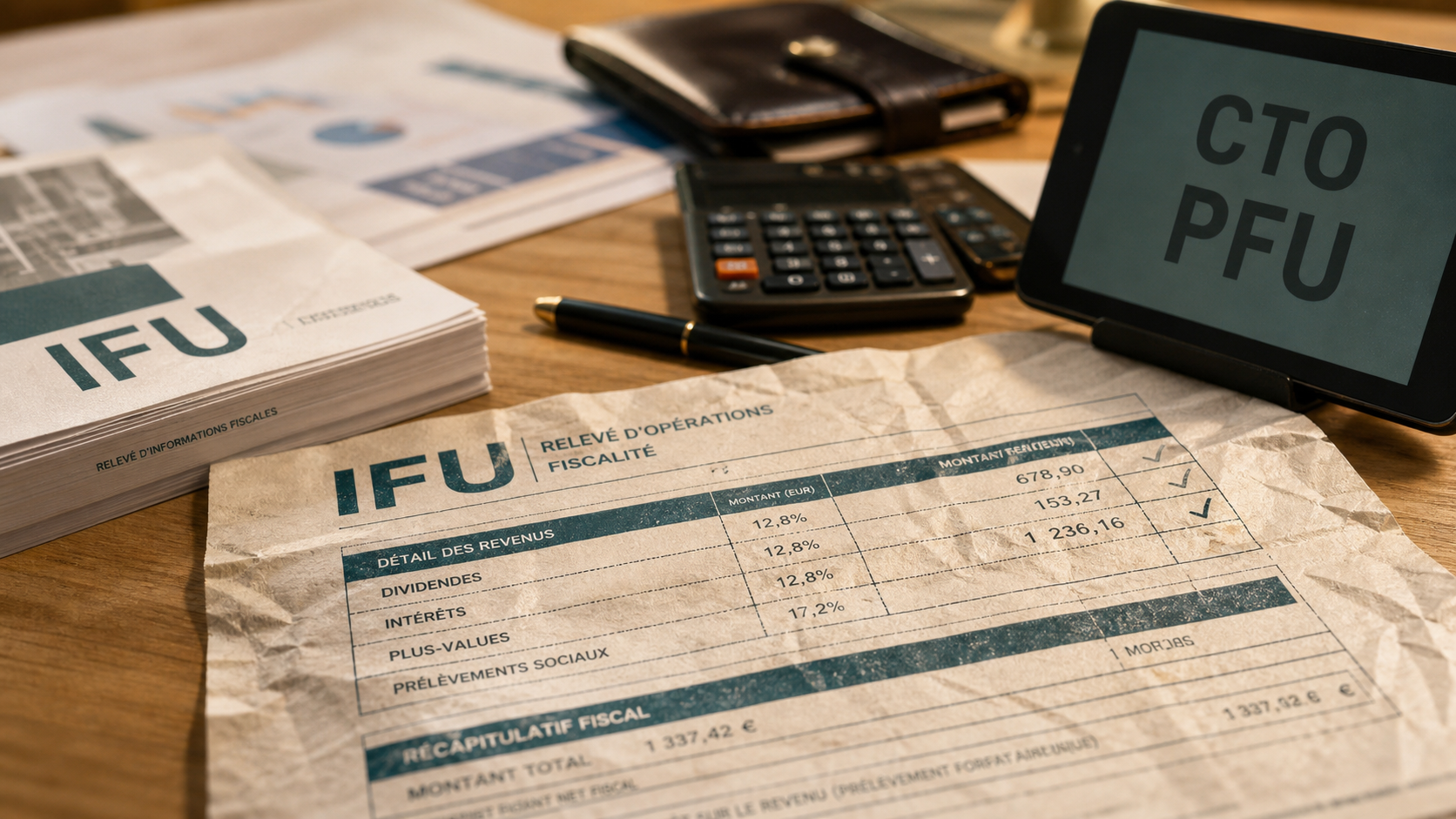

CTO taxation seems simple at first glance. In practice, the choice of PFU, progressive scale, asset management and reporting of personal income can significantly change the net return of a portfolio.
The ordinary securities account remains the most flexible envelope for investing in shares, bonds, ETFs, UCITS or foreign securities. This freedom has a counterpart: unlike the PEA or life insurance, the CTO does not benefit from a specific tax advantage related to the length of detention. We must therefore reason operation by operation, income by income.
What the CTO really allows, and what the tax looks at
An ordinary securities account allows you to house a wide variety of financial instruments: French and international shares, ETF, bonds, funds, products listed more complex according to the broker. There is no ceiling for payment and the investor may open several CTOs, alone or in joint account, depending on the institutions.
On the tax side, the administration does not tax simply holding securities. She mainly looks at three categories of earnings: dividends, the interest and gains on disposal. As long as a share acquires value without being sold, surplus value remains latent and is not imposed. On the other hand, a dividend paid into the cash account or a gain sale triggers taxation.
Dividends, interest, capital gains: three flows to distinguish
The dividends are income distributed by companies. The interest certain bond or monetary products. The capital gains appear when you sell a security more expensive than its purchase price, after taking into account the costs directly related to the transaction.
This distinction is important because the tax calendar is not the same. Dividends and interest are generally the subject of deposit Source tax, often at 12.8 per cent for the income tax share, plus social contributions. Capital gains are reported once a year, with the possibility of imputing capital losses.
PFU or progressive scale: the choice that structures taxation
By default, the CTO's income and earnings fall under single flat-rate levy, often called PFU or flat tax. Its standard rate is 30 %, composed of 12.8% of income tax and 17.2% of social contributions. This is the most legible scheme: the rate does not depend on your marginal tax bracket.
The other option is to opt for progressive income tax scheme, via box 2OP of the declaration. In this case, the earnings concerned are added to the other household income and are taxed according to the bands of the scale, the marginal rate of which may vary from 0 to 45 %, plus social contributions.
| Tax system | Principle | Profile often concerned |
|---|---|---|
| 30 % PPU | 12.8% tax + 17.2% social levies | Homes imposed in medium or high slices |
| Progressive scale | Taxation by household group, plus social contributions | Low or no taxes, depending on the type of income |
When the PFU is generally more comfortable
The UFP is often relevant when your marginal tax bracket exceeds 12.8%. It prevents dividends, interest and capital gains from significantly increasing your taxable income. It also provides good visibility: you can quickly estimate the net return of an arbitration or expected dividend.
However, it must be borne in mind that some high-income taxpayers may be affected by the exceptional contribution on high incomes. In this case, the rate actually supported may exceed the simple reading of the PPU. A simulation becomes useful, especially if CTO represents a significant part of the financial assets.
When the scale can become interesting
The option for the progressive scale can be advantageous for a non-taxable or low-tax home. It may also allow dividends to benefit from mechanisms specific to the scheme of the scale, subject to conditions. But this option is global for the relevant year's income from movable capital and capital gains: the PFU is not chosen for one line and the scale for another according to its interest.
Before checking box 2OP, it is therefore necessary to compare the effect on the entire declaration, not only on the CTO. The right reflex is to do two simulations: one with the PPU, one with the scale. The difference may be small in some cases, but very significant when household income is high.
Report CTO revenues without bad surprise
Most banks and brokers transmit a Single tax printing, IFU, which summarizes dividends, interest, capital gains, losses and levies already made. This document serves as the basis for reporting, but does not exempt the verification of amounts, such as transfers of securities, foreign brokers or complex transactions.
Income from movable capital may appear pre-filled in the return. Capital gains must be carefully controlled: purchase price, sale price, brokerage fees and possible securities transactions may change the calculation. An error in the cost price may lead to too much tax or, conversely, to underreporting a gain.
The dividend and interest deposit is not always the final tax
When a dividend or interest is paid, a deposit of 12.8% may be levied at source on income tax, in addition to social contributions. This deposit is not necessarily discretionary if you then opt for the progressive scale. It is then charged on the tax calculated on the annual return.
Some taxpayers may request deposit exemption where their income meets the conditions laid down. This request is usually made to the account's content institution within the time limits indicated by the account. It does not remove tax: it only avoids a cash advance.
Optimizing CTO taxation: the real levers
The optimisation of a CTO does not consist of seeking a tax loophole, but of organizing arbitrations, envelopes and calendar in a coherent way. The first lever is the management of losses. A realized loss of value may be imputed on similar gains and, if not used immediately, be carried forward for 10 years.
In concrete terms, selling a lost line can neutralize all or part of a surplus value realized in the same year. This choice must remain compatible with your investment strategy: selling only for tax purposes, without property reasons, can cost more if you buy in bad conditions or if you leave a good asset.
Taxation must also be integrated into real performance. Before tax, there is the entry price, brokerage fees, exchange fees, internal charges of an ETF or fund, and then only the tax levy. Two portfolios with the same gross performance can produce a very different net result if one multiplies costly small operations and the other limits friction. The real question is, therefore, how much of the performance achieves wealth after all cost strata.
Arbitrator between CTO, PEA and life insurance
CTO is rarely the only relevant envelope. The PEA can be preferred for European actions or certain eligible ETFs, as it offers a more favourable fiscal framework after several years of detention. LLife insurance, it may be suitable for diversifying media and organising transmission, with specific taxation depending on the length of the contract and the buy-backs.
However, the CTO retains a simple asset: no ceiling and a great international openness. It is often used to access non-EAP securities, invest in bonds, diversify into global ETFs or host more flexible strategies. The optimisation therefore involves placing each asset in the most suitable envelope, rather than looking for a perfect single envelope.
| Envelope | Main asset | Limit to know |
|---|---|---|
| CTO | Large freedom of investment, no ceiling | Immediate taxation on income and realized gains |
| PEA | Beneficial tax framework on terms of duration | Smaller investment universe |
| Life insurance | Heritage Flexibility and Transmission | Choice dependent on contract and cost |
Special cases to anticipate before investing massively
CTO taxation can become more complex in several situations. The foreign dividends may be subject to withholding tax in the country of origin, sometimes partially offset by a tax credit according to tax treaties. Non-residents must reason with their country of tax residence and the rules applicable in France.
In the event of a succession, the securities held on CTO are included in the estate. Their value is valued at the time of transmission according to the applicable rules, which can change the tax cost price for the heirs. This is an important point for old portfolios with large latent gains.
Finally, the CTO may be held by a legal person, with taxation different from that of an individual. Corporations must incorporate financial gains into their own taxable income, according to their plan. For a meaningful portfolio, a simulation or exchange with a tax advisor avoids threshold effects, misreporting and adverse arbitration.
The right approach is not to choose your CTO only on brokerage fees. The quality of the IFU, the processing of foreign securities, the clarity of cost price history and the ease of exportation of transactions also count. Well-followed taxation often starts with own, verifiable and time-retained data.