
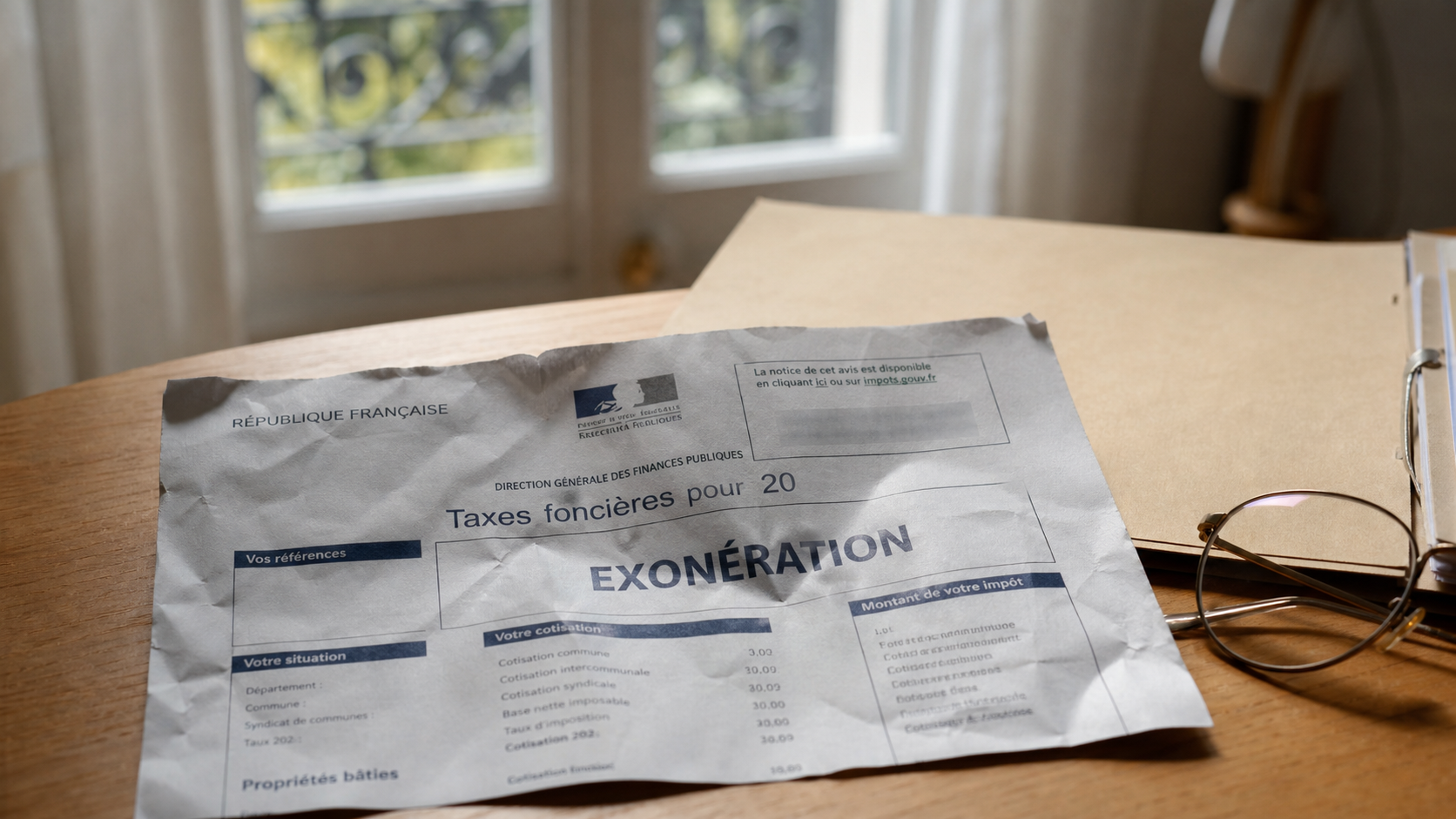

The modest income tax exemption can significantly reduce the owner's budget. However, it depends on several criteria: reference tax incomethe composition of the household, age, sometimes an allowance, and the nature of the housing. In many cases, when the administration already has the right information, the advantage is automatically applied.
Exemption, reduction, discount: do not confuse the three mechanisms
Before checking your situation, you must distinguish the devices. They do not have the same effect on the property tax notice and do not meet the same conditions.
Understanding the land tax exemption
| Device | Effect on property tax | Profiles or situations |
|---|---|---|
| Exemption: | Total or partial abolition of the tax concerned | Some beneficiaries of allowances, elderly or disabled under conditions |
| Lump-sum reduction | Fixed reduction in the amount payable | Persons aged 65 to 75 under income conditions, with a reduction of 100 € |
| Discount | Cancellation or reduction granted after taking into account a particular situation | Accommodation availability, tax error, income cap |
| Ceiling | Limitation of tax according to income | Small homes not necessarily covered by total exemption |
The property tax on built properties remains payable by the owner or usufructuary of the property on January 1. It is calculated from the cadastral rental value, then the rates voted by the local authorities and, as the case may be, by EPCI. Income-related aid does not alter this basis. They then intervene to reduce, cap or eliminate the amount to be paid.
The audit is not based solely on a monthly income received. The administration also looks at all the tax elements of the home. Two persons with the same pension or salary may receive a different answer if one lives alone, if the other shares his or her tax home, if a child is attached or if an allowance gives rise to a particular right. To avoid an error, we must therefore reason with the same benchmarks as taxes: tax notice, reference tax income, number of shares, residence concerned and situation on 1 January.
Who can benefit from a property tax exemption with modest incomes?
The modest income tax exemption applies mainly to owners who occupy their principal residence and fall into a category covered by the tax rules. Income alone is not always enough. They must often be associated with an age, benefit or disability.
All about land tax exemptions and rebates · Discover the official conditions to benefit from a total or partial exemption from your property tax on your principal residence.
Beneficiaries of certain allowances
A total exemption may apply to beneficiaries of the Old Age Solidarity Allowance (ASPA), the Supplementary Disability Allowance (ASI) or the Adult Disability Allowance (AAH), subject to the conditions provided for. These situations are generally already known to the tax administration, which explains why the exemption can be applied without a specific approach in most cases.
It remains useful to check the notice received. A recent change in the situation, a newly allocated allowance or a tax connection error may prevent the immediate application of the scheme. In this case, a complaint from the personal tax department allows to request correction.
Persons over 75
Owners over 75 years of age may benefit from a total income tax exemption. Age is assessed according to the applicable tax rules, and the household's reference tax income remains decisive. This exemption applies to persons whose resources make it more difficult to absorb an annual local charge.
When conditions are met and known to the administration, the advantage is in principle automatic. However, care must be taken when moving, changing family circumstances or the property concerned is not clearly identified as principal residence.
Persons aged 65 to 75
Between 65 and 75 years, the scheme often takes the form of a flat-rate reduction of 100 €, always subject to income. It is therefore not a total exemption, but a direct reduction in the amount payable. The difference counts: if your property tax is high, the 100 € reduce the bill, without deleting it.
This reduction may be useful for a household whose income is just above a total exemption threshold or whose situation does not correspond to the most protective categories. It must appear on the property tax notice if it has been taken into account.
Low income: what the administration actually verifies
The central criterion is reference tax income, not net salary, monthly pension or bank balance. This amount is included in the income tax notice. It is used to compare your situation to the applicable ceilings, which vary according to the composition of the tax home.
Reference tax income and household shares
An income ceiling is not the same for a single person, a couple or a household with a dependant. The thresholds are therefore adjusted according to the number of tax shares. The more shares the household has, the more the reference threshold can evolve. To know if you are within the limits, you need to cross-check two data: your benchmark tax income and your number of shares.
As the ceilings can be updated, the safest reflex is to consult your latest tax notice and published information on impots.gouv.fr. You can also check your particular space if your situation is close to the threshold or difficult to interpret.
Principal residence, cohabitation and change of situation
Age, disability or benefit exemptions generally apply to the principal residence. If you own a secondary residence, rented accommodation or estate property, the rules may be different. Co-habitation also plays a role: the presence of other people in housing, their fiscal connection or their level of income may alter the analysis as appropriate.
A change in the situation must be reported as soon as possible: death of the spouse, entry into the institution, removal, divorce, allocation of an allowance or modification of the tax home. The administration has a lot of information, but it does not always immediately restore a complex personal situation.
Steps: when exemption is automatic and when to act
In the majority of cases, the exemption or reduction is automatically applied when the tax administration knows your age, your reference tax income and the allowances that qualify for the scheme. This avoids the need for low-income households to build a full file every year.
Check your opinion before paying
The first check is to read the property tax notice line by line. Look for exemption, discount, cap or reduction. If you think you are meeting the conditions but nothing appears, don't conclude too quickly that you don't have any rights: it may be an information lag or an unrecognized situation.
- Compare the taxed property with your real principal residence.
- Check the reference tax income used.
- Check the number of tax shares retained.
- Find out if the 100 reduction € appears when you are between 65 and 75 and meet the conditions.
- Keep proof of allowance, pension or disability if your file needs to be reviewed.
Make a claim if the benefit has not been applied
If the expected exemption does not appear, you can contact your personal tax department from your secure email on impots.gouv.fr or by mail. Explain your situation simply: age, allowance received, principal residence, reference tax income and reference of the opinion concerned. Attach the supporting documentation if the administration does not already have it.
The claim does not need to be formal or lengthy. The most effective way is to present the specific tax elements and request a review of your right to exemption, reduction or relief. A clear message facilitates processing.
Special cases to know before giving up your rights
Some situations do not directly fall under the modest income tax exemption, but they may still reduce the amount to be paid. It is often at this point that owners let a relief pass.
Vacant or unexploited housing
A discount may be considered when the dwelling normally intended for rental remains vacant regardless of the owner's wishes, or when a building used by the taxpayer becomes untapped under certain conditions. It is not an age- or income-related aid, but a mechanism based on the impossibility of using the property.
In this case, the approach is rarely automatic. It is necessary to document the situation: duration of vacancy, relocation procedures, work preventing occupation, evidence that the occupation is not voluntary. The evidence counts more than just the statement of intent.
Ceiling for modest non-exempt households
An owner may not fall into the categories of total exemption while having modest incomes. The ceiling may then limit the weight of the property tax in relation to household resources. This mechanism is useful for persons who slightly exceed certain thresholds or who do not receive allowances eligible for automatic exemption.
If your tax seems disproportionate to your income, check the cap, and not just the exemption. This check avoids a frequent error: stop any process because it does not match the profile "over 75 years" or "beneficiaries of ASPA, ASI or AAH".
Payment and dematerialisation threshold
Where the fee remains due, the method of payment may also be important. The 300 threshold € imposes the dematerialised payment. This does not reduce the amount, but avoids practical difficulties or penalties related to a bad way of settling. If you have requested a correction, check the administration's messages to see if you need to pay, wait for a new notification or only pay the remaining balance.
The right reflex is to check the notice as soon as it is received, compare it to your actual situation and contact the taxes if a right seems forgotten. For modest households, the exemption from property tax is not an exceptional favour. It is a tax law designed to adapt local taxes to situations of vulnerability, age or disability.