

For many households, putting money aside is a reflex of caution, a necessity to finance a project or simply a way to prepare for the future. In the face of global figures, a question comes up: am I in the norm? In France, saving is an institution, but the reality of numbers hides marked contrasts. Between the average amount that each Frenchman manages to isolate each month and the accumulated financial assets, the differences increase according to age, geographical location or socio-occupational category. Understanding these mechanics allows you to situate and adjust your own financial strategy.
Key savings figures: between monthly flows and accumulated stocks
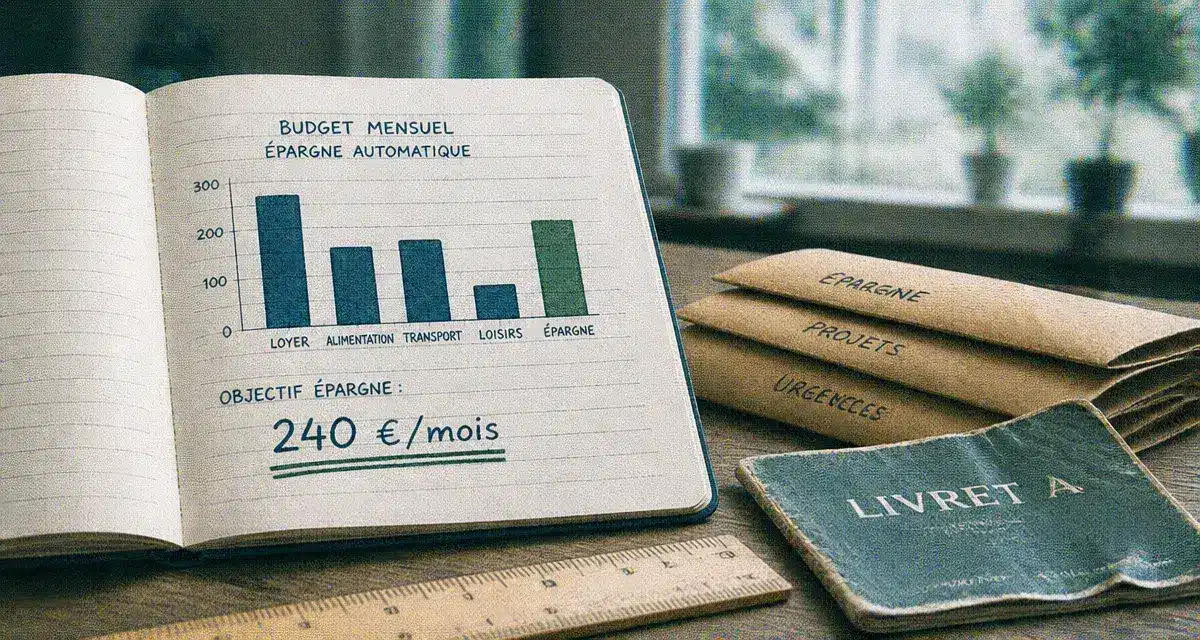
It is necessary to distinguish two concepts: the flow, what is set aside each month, and the stock, the total amount held in the accounts. According to data from INSEE and the Banque de France, on average a French household saves about EUR 240 per month. This figure corresponds to a saving rate of around 18% of gross disposable income.
The average financial asset is higher because it includes years of accumulation. Annual savings are around 5,650 € for active households. However, the average is drawn upwards by high incomes. The Median, which divides the population into two equal parts, is more representative of the reality experienced by the majority of citizens, generally below these arithmetic averages.
The distribution of investments remains conservative. Booklet A and LDDS remain the pillars of theprecautionary savings, concentrating a massive share of deposits thanks to their liquidity and lack of taxation. Then come life insurance and housing savings products like the ELP.
The influence of age on financial assets
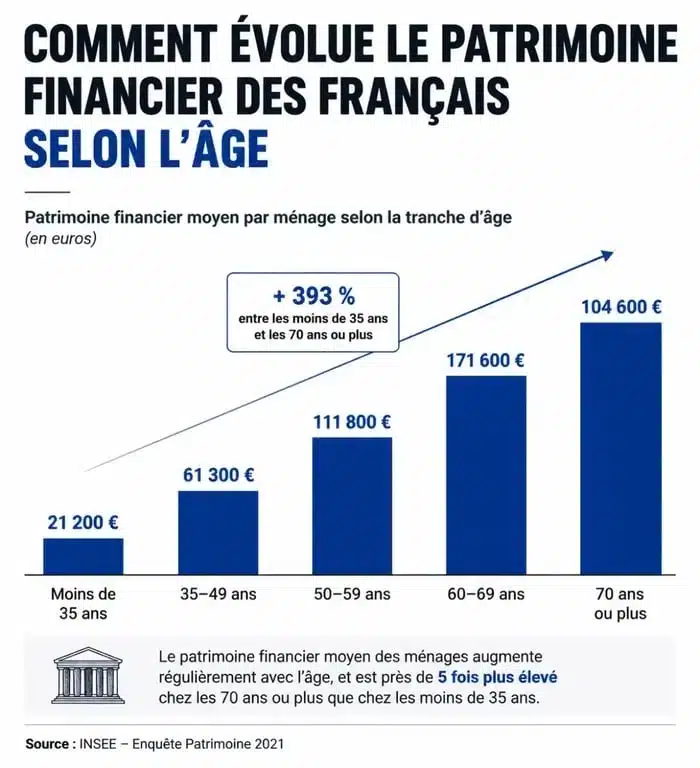
The life cycle plays a role in saving capacity. We do not save the same way at age 25 as at age 55, and INSEE statistics illustrate this rise in wealth over the decades.
The constitution phase: 20 to 40 years
For those under 30, the average saving is modest, amounting to about 38 500 € by including the first contributions for a real estate purchase. At this age, efforts are made to create a precautionary savings to deal with unforeseen events. Between 30 and 39 years, the average amount climbs to about 129 200 €. This is the time when careers progress, but also the time when family burdens increase.
The peak of savings: 50 to 70 years
The peak in financial assets is generally pre-retirement, in the 50-59 age group, with an average of over 299 000 €. At this stage, mortgages are often repaid and business income is at its maximum. This is the age when the strategy shifts towards the transmission and preparation of the drop in income associated with the end of work.
For a young asset, savings are an adjustment variable. For the senior, it becomes an annuity structure. This progression follows a logic where each stage of the career allows access to more complex financial products, less liquid, but potentially more remunerative. One moves from a flow savings, suffered or opportunistic, to a strategic stock management, where diversification protects accumulated capital.
Regional and social disparities: a heterogeneous landscape
The place of residence has a direct impact on the ability to put money aside. The cost of living, particularly housing, eats the disposable income differently in different territories.
In Île-de-France, annual savings are highest, with about 7,500 € per household, due to higher wages despite higher cost of living. The Auvergne-Rhône-Alpes region stands just behind with an average of 6,800 € per year. There is a gap between large towns and rural areas. On average, savings in metropolitan areas are 70% higher than in remote rural areas, where incomes are lower and career opportunities are more limited.
Beyond geography, the socio-professional category (CSP) remains the first predictor of savings. An executive saves on average four to five times more than a worker or employee. This difference is explained by a propensity to save that increases with income: the higher the income, the smaller the proportion devoted to primary needs, leaving a wider space for financial investment.
How to position and optimize your savings effort?
Comparing its situation with the national average is a useful exercise, but it must be done with discernment. The important thing is to ensure that financial resilience personal. There are several steps to improve the situation.
Establish precautionary savings
Before investing in complex products, the priority is to build a safety mattress. It is recommended that an amount equivalent to 3 to 6 months of current expenditure be available. This sum must remain available immediately, on a Booklet A or LDDS. This base makes it possible not to pee in its long-term investments in case of a hard blow.
The 50/30/20 Rule
To find a balance, the budget method 50/30/20 is an effective benchmark: 50% of income for needs, 30% for desires and 20% for savings and debt repayment. If you maintain this course, you will be above the national average, which is a strong indicator of financial health.
Diversification to counter inflation
Leaving all of his savings on regulated books is a common mistake. If the rate of Book A is protective, it rarely offers a meaningful real return once inflation is deducted. To optimize its assets, it is advisable to divide its assets:
| Type of placement | Objective | Availability |
|---|---|---|
| Booklet A / LDDS | Precautionary saving | Immediate |
| Life insurance (Euro funds) | Security and transmission | A few days/week |
| PEA / Units of account | Long-term performance | Variable |
| RIP (Retirement Savings Plan) | Retirement preparation | Blocked until retirement |
Automation remains the most powerful lever to increase its savings. Putting in place a permanent transfer upon payment of the salary allows saving to be treated as a fixed charge rather than as a balance at the end of the month. This simple discipline often separates passive savers from heritage builders.