
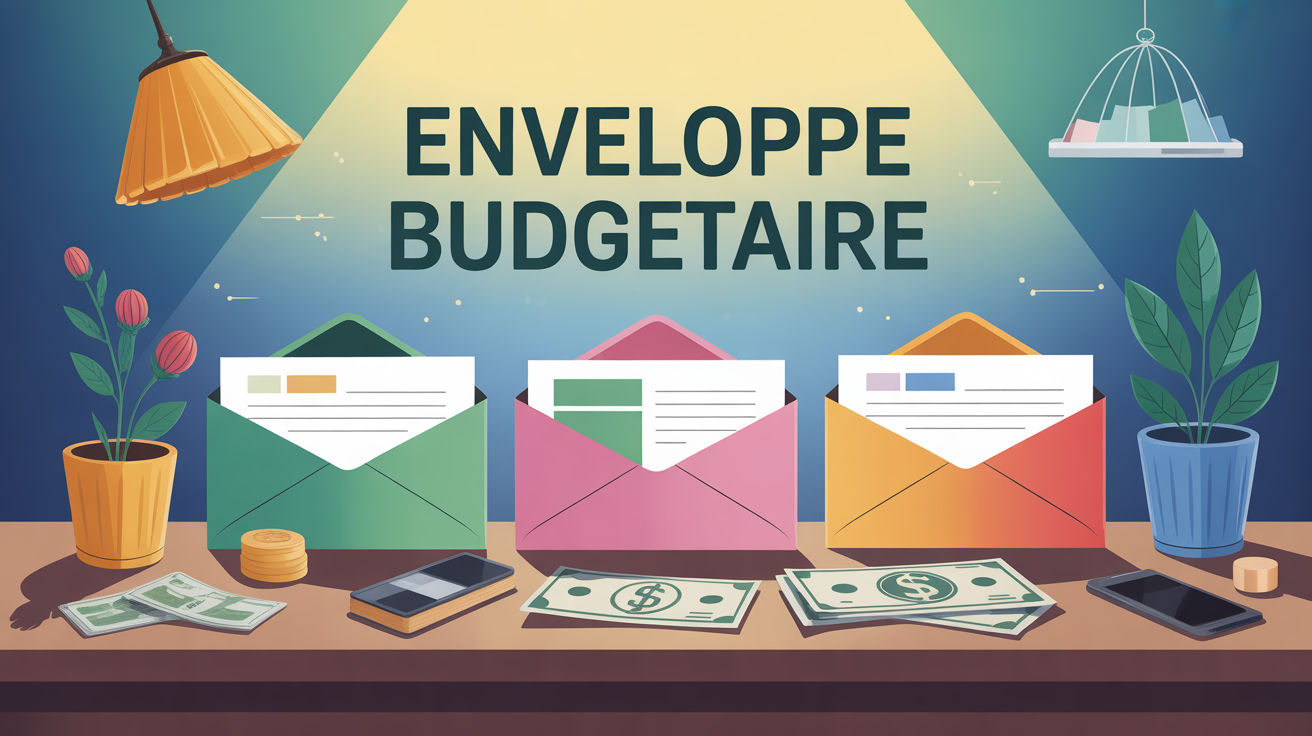

Set up a budget allows you to have immediate control over your expenses, whether it's to run a project, run a business or secure the family budget, especially in times of inflation. This system, adopted by about one in three Frenchmen, organizes financial management in well-defined items and effectively limits the risks of overruns, thereby facilitating the analysis and adjustment of each category of expenses over the months.
What is a budget envelope?

Looking for a concrete option to take over your expenses, whether for a professional project, a construction site or a personal budget? The budget envelope is simply to allocate a sum of money to a specific item or use, defined in advance. This technique, adopted by between 30 and 35% of French Under CSA 2023, proposes to allocate the general budget in « pouches » (physical or virtual), each for a type of expenditure: rent, shopping, material inflation, leisure or savings. Behind its vintage look, the method is increasingly attracting the digital age: mobile applications and downloadable templates have become very popular recently.
The budget envelope differs from the forecast budget which anticipates everything but does not necessarily isolate the amounts not to be exceeded or from the provision, which is merely an accounting reserve. The objective here remains to mentally or physically associate a ceiling amount with each item, and then to ban it. Some professionals explain that we immediately identify problematic positions: if the envelope « Outputs » is exhausted, there is no need to go and look further.
Budget envelope: simple definition and main uses
In practice, creating a budget is tantamount to allocating a « pactole » to a specific expenditure item or project: for example, allocate 300 € feeding, 50 € at exits, 60 € to travel over the month... This system works as a benchmark: it indicates when the limit is approaching or crossed. In enterprises or in the construction sector, the envelope allows to frame construction costs (materials, subcontracting, unforeseen), and in everyday life it facilitates the management of the family or personal budget, whether paper or digital.
The concept of a budget envelope is also common in project management, in associations or in the self-employed: one must never exceed an amount without prior arbitration, which avoids many fears at the end of the quarter. Sometimes a user reports better serenity when closing accounts.
Envelope, forecast budget, provision: what difference?
Not obvious to find yourself among these terms sometimes too technical! To clarify: budget is a sum actually dedicated, which cannot be exceeded without seeing; on estimated budget is an estimate on paper or computer; the provision means an accounting reserve, useful in the event of an incident or unforeseen charge.
| Concept | Function | Concrete limit? |
|---|---|---|
| Budget envelope | Amount allocated for specific use, strict monitoring | YES |
| Estimated budget | Anticipation tool, global estimate or by post | NO |
| Provision | Reserve to cover future/uncertain expenses | NO (except regulated exception) |
This distinction really helps to choose the right tool depending on the situation of the moment: family, SME, construction site... without getting lost in the jargon. One trainer suggested that many novices confuse the terms, resulting in common management errors.
How to structure your budget in envelopes?
Effectively structure a budget envelope based on a few tested steps, which most web guides present in five or six clear actions. This progressive organization seduces both novices, but also overcrowded families or entrepreneurs looking for more instant control. Is it really hard to get there? Reading the stories, the grip is quite fluid.
Step 1: Categorize its spending items
Before any distribution, it is best to separate your budget into coherent categories, adapted to your personal or professional dynamics: food, housing, leisure, supplies, unforeseen... The more relevant the list, the more natural it seems. A family quoted on My Money Questions starts with 4 main envelopes then refines over the months, according to changing needs.
Little advice: too many categories end up making everything more complex. Preferred 4 to 7 envelopes Depending on your needs and the pace of your spending, effective monitoring is possible without overloading management.
Step 2: Determine and allocate a ceiling amount
For each envelope, review your recent statements to identify the average useful budget by post. This avoids undervaluation or overvaluation, at the risk of creating a « hole » the second week. Some professionals believe that 80% of users adjust their amounts after the first month. This suggests that initial adaptation is very common: it is not perfect in the first trial.
Step 3: Choose your format: paper, digital or hybrid?
Cash stuffing (liquid in envelopes), sub-accounts in a bank application, home spreadsheet: all options exist. Paper models reassure by their tangible and responsible appearance; digital tools appeal to those who prefer to follow live on their smartphone (Budget Diary lists more than 500 PDF kits downloaded, for example). Many users alternate according to the nature of the expenses: cash for small purchases, digital for the rest. Some testify to having regained the pleasure of simply managing their money.
Step 4: Regular monitoring and adjustments
Over the weeks or months, collect your proofs and note (or scan) each expense. If an envelope reaches zero, two solutions: to wait or to arbitrate, ensuring that it does not "pike elsewhere" without an explicit decision. This rule, often taken up in the formations, greatly alters the relationship with money. The more the system is adjusted, the more it fits your real habits. Sometimes a user discovers that an unexpected envelope quickly becomes his favorite.
Concrete example: a monthly envelope in action
Let's imagine: beginning of the month, 1200 € Family budget. The distribution shall be as follows: 350 € food, 150 € leisure, 90 € fuel, 200 € health/mutual, 110 € unforeseen, 300 € Housing. Every week, with a simple look, we know where we are. If « leisure » is exhausted on the 20th of the month... No exit until next allocation. This avoids unpleasant surprises at the end of the period. An expert in personal finance noted that this example spoke very well to starting families.
What are the benefits of the method?
The budget envelope has seen a veritable increase recently, in particular because it responds to several widespread blockages: difficulty to see where the money goes, fear of exceeding, stress in the face of unforeseen events. Client returns and institutional guides stress the psychological dimension of this method, in addition to its rapid effects on finances.
Perfect visibility and immediate accountability
Any envelope serves as a beacon: while the money is there, the ceiling is not crossed. Number of users report spending 15 to 20 % less on average after 2-3 months of testing. It is regularly observed that the visualization of the « outstanding » acts like a natural brake. Some parents say they have much less impulsive purchases through the method.
Controlling, anticipating and combating impulsive spending
To structure its finances in this way is to anticipate both regular charges and hard blows. No more panic in the face of an unexpected: with an envelope, the financial shock simmered. Those who follow the « savings challenge » by envelope manage to build up a reserve much faster than with simple account tracking. One training expert suggested that many trainees regain some peace of mind by adopting this logic.
Stress reduction and rapid adoption
Most of the families or professionals interviewed rated the method as above 4,5/5 (on more than 23 opinions, statements on certain portfolios or applications). Why such a success? It is simple, concrete, and we quickly notice the improvement on serenity. There is nothing worse than "blind juggling": envelopes, paper or digital, restore confidence, even among the most skeptical. Sometimes a very reluctant person finds the system "unsuspected but effective".
Digital tools, templates and solutions
Want to try? The web offers a multitude of resources to start with. Paper, digital or mixed version, the range of accessible tools has multiplied: mobile applications, print sheets, « Planners » ready to use or organizing kits, with an entry price around 8,90 € for portfolios in promotion.
Templates and envelope kits for printing
Sites such as Budget Diary offer easy to download kits: colorful envelopes, fact sheets « balance », allocation tables, tracking checklists. Another point: a handful of downloads identified for flagship models, showing real interest and strong reassurance. Some users share their experiences on the forums: "I tested the kit, it helped structure my budget in two weeks".
Note: some beginner packs cost between 25.99 € and 34.99 €, but there are free versions, ideal for running safely. A family economics expert regularly advises you to test the free version before investing in a more elaborate kit.
Digital applications and solutions
If you prefer digital integer, a mobile application dedicated to envelope management facilitates the creation of virtual sub-accounts, sending alerts and real-time viewing of sales. Practical for those who do not want to handle cash or want to track their budget as a couple or as a project team. A management trainer often cited the value of collaborative tools.
A regularly mentioned tip: start by testing a free version before choosing an advanced kit or option. This makes it possible to adjust the method to its profile and quickly observe the real effects without prior commitment.
Comparative FAQ and Adaptation Tips
Do you still hesitate or block on a concrete question? This section brings together the most frequent requests identified during the analysis of guides and forums. In practice, a few doubts arise systematically...
What is the difference between the budget and the budget?
The forecast budget is used to anticipate all expenditure, but leaves the possibility of exceeding it. The budget envelope, on the other hand, imposes a strict limit – real or virtual: only this method prohibits (or at least reports) any exceedance without arbitration. Ultimately, it is the guarantee of solid monitoring, which reassures users.
How do I calculate an envelope tailored to my needs?
Use your past records (usually 1 to 3 months) to estimate a real average. Add a margin of safety: it is regularly recommended that unexpected positions be slightly overstated. Then adjust over the weeks, depending on the deviations identified. A family budget specialist reports that this step saves time over the long term.
Can an envelope be adjusted during the month/project?
Yes, even if the principle remains to do so voluntarily: if you choose to transfer part of the envelope « leisure » To « car », write it down. This avoids blind management, simply. Some users say that a monthly adjustment has allowed them to reduce family tensions.
Who defines the budget envelopes?
As a family or solo, it is the user who sets the categories. In undertaking or project, the financial management or project manager shall determine each amount from the time of scoping, taking into account internal or regulatory constraints.
How to avoid the risk of overtaking?
Regular monitoring (weekly or monthly) is recommended. Anticipate the peaks of activity (school entry, construction period...), create a « emergency envelope » and never plan to draw from it without precise arbitration. This requires a little discipline, but it is quickly seen that it is simpler than one initially imagines.
Want to start without taking a risk? Download a free template of envelopes and test it over a month: Recent studies show that more than one third of users definitely adopt the method, a telling proof of its effectiveness.