
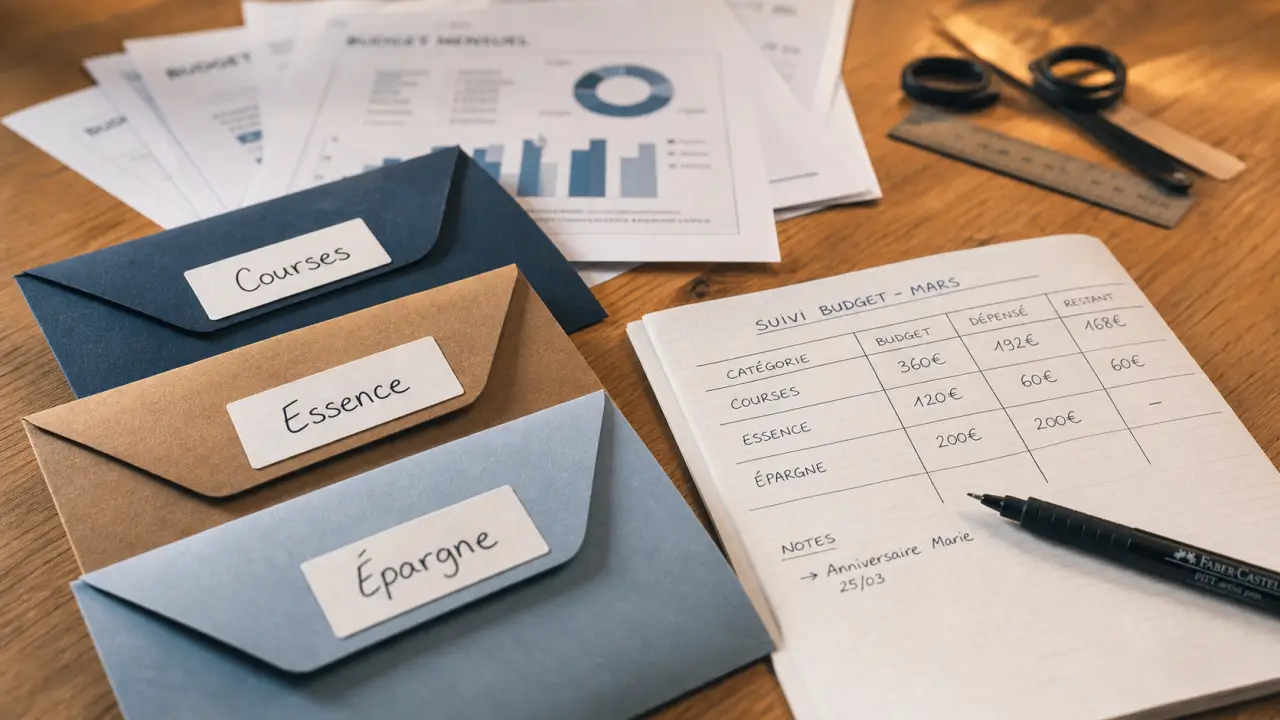

A budget envelope to print allows you to allocate your money by category of expenses, then see at a glance what remains. The principle is simple, concrete and reassuring. You download a PDF file, you print, cut, fold, then each envelope sets a clear limit for shopping, essence, leisure, gifts, outings, saving or unforeseen.
This method, often called cash stuffing, please because she makes money visible. Instead of finding too late that a series of small expenses unbalanced the month, we know immediately what category is slowing down. The idea is not to deprive oneself, but to decide in advance where each euro goes.
What is a printable budget envelope for?
The operation is deliberately basic: each envelope corresponds to a category of expenditure. You set an amount at the beginning of the month, the 15th or the week, and then you only use that amount for the category concerned. When the envelope is empty, you must adjust, defer or transfer from another category in a thoughtful way.
A printable budget envelope may contain cash, but it can also serve as a visual marker if you pay mostly by card. In this case, you note the expenses on a expenditure tracker Slided into the envelope or printed separately. The paper form then becomes a small dashboard, more tangible than a line in a bank application.
The most useful categories to start
To avoid creating 20 envelopes from day one, it is better to start with variable expenses, those that change easily from month to month. Fixed expenses such as rent, insurance or subscriptions can be monitored on a separate budget sheet, as they are often deducted automatically.
- Grocery and daily meals
- Fuel or transport
- Leisure, cafes, restaurants and outings
- Clothing and beauty
- Gifts and events
- Unreimbursed or small-scale health
- Savings project : holidays, works, permits, equipment
This division helps to distinguish the actual needs from the usual expenses. It becomes easier to see that too low a leisure budget creates frustration, or that too vague a race budget absorbs everything else. With clear categories, follow-up is simpler and arbitrations are faster.
Free, paid, minimalist or decorated: which model to choose?
There are many models of envelopes to print free of charge, including blogs, designer shops, visual platforms and budget-specific biner sites. Paid templates often add a more neat layout, multiple formats, matching trackers, budget binder pages or already ready categories.
On Pinterest, the interest in this type of support is visible through very recorded sets of ideas, with for example 61 Pins on 6mo, 27 Pins on 1w, 19 Pins on 1mo or 13 Pins on 1w. This shows one thing above all: many people are looking for visual models, but not all need the same level of detail.
| Model type | Ideal for | Highlights | Possible limits |
|---|---|---|---|
| PDF free simple | Start free of charge | Quick to print, easy to test | Little customization, sometimes basic design |
| Full pay package | Creating a sustainable system | Envelopes, trackers, budget sheet, assorted pages | Needless if you only want to test the method |
| Customizable blank model | Adapting its own categories | Very flexible, compatible with all budgets | Ask for some preparation |
| Budget file format | Centralize everything in the same place | Clear organization with interlayers and trackers | More bulky than an envelope alone |
The right format is not always the prettiest
A highly decorated model can motivate at first, but it must remain legible. Important areas are the name of the category, the expected amount, the remaining balance and, if necessary, a small line to record withdrawals or payments. If the envelope is too loaded, you may not use it again after a few days.
For a first try, choose a PDF with editable categories or blank titles. You can test for a month, then print a more aesthetic version if the method suits you. The most useful is often the model that reads quickly and lasts.
Print and prepare envelopes without wasting paper or time
The success of the method also depends on material preparation. A poorly cut, too fragile or illegible envelope often ends at the bottom of a drawer. Conversely, a nice support to handle makes you want to keep it at hand.
Paper, printing and cutting: practical settings
A standard paper may be enough to test, but a slightly thicker paper offers a better hold, especially if you often handle the envelopes. Before printing a whole pack, launch a single page by checking that the print is in real size and not in automatic adjustment, otherwise the folding lines can shift.
- Download the PDF file and open it in a reliable reader.
- Print a test page in full size.
- Cut cleanly by following the markers.
- Mark the folds with a ruler to get clear edges.
- Paste the flaps, then let dry before filling.
- Note the category and departure amount before first use.
If you use a budget binder, perforating the envelopes or dragging them into transparent pouches can extend their service life. For nomadic use, prefer a few priority envelopes in a closed pouch rather than your entire system in your bag. This avoids transport more than necessary.
Safety detail to be taken into account
Transporting all its envelopes filled with cash is not essential. You can keep the large amounts at home, in a secure place, and take only the useful envelope for the planned exit. For card payments, simply enter the expense on the tracker on your return or keep the ticket until the evening budget point.
This precaution remains useful even with a very simple system. It limits unnecessary manipulations and keeps your method legible. The goal is not to have everything in hand, but to have the right amount at the right time.
Use daily without giving up after a week
The classic trap is to want a perfect system from the start. A good budgetary method must remain viable. The envelopes are used to clarify your choices, not to make you feel guilty about each purchase.
Start with a short period
If your budget varies a lot, start on a week rather than a whole month. For example, instead of placing the entire monthly racing budget in a single envelope, divide it into four weekly amounts. This rate reduces the risk of spending everything too quickly and facilitates adjustments.
At the end of each period, make a simple point: how much remains, what envelope has overflowed, what category was too broad or too strict? These observations are better than a perfect theoretical budget. They give you a real basis for the following month and avoid going back on the same mistakes.
Think of your envelopes as a bridge between two shores, on one side your often abstract income, deposited into an account, on the other side your daily gestures, sometimes tiny but repeated. Paper creates a visible crossing between these two worlds. Each ticket moved, each amount barred, each balance recalculated supports the following decision. This image helps to understand why the method works for many people: it does not replace the bank, it links the bank statement to the concrete reality of the basket, the full quantity or the gift to buy.
Linking paper and digital tools
Budget allocations are not opposed to applications. You can very well use a bank application to check the levies and keep your envelopes printed for variable expenses. This duo is often more realistic than a 100% liquid or 100% digital system.
A good routine is to provide a fixed budget point, for example on Sunday evening or payday. You reload the envelopes, update the expense trackers, then adjust the amounts according to upcoming events: anniversary, vacation, school year, technical check-up, family meal. The method remains flexible as long as it follows your real pace.
Customize envelopes to hold for the duration
Customization is not only decorative. It makes your system more logical for your real life. A family will not have the same categories as a student, an independent person or a person who wants to repay a debt. The titles must therefore speak your language.
You can add a color code: green for savings, red for expenses to watch, blue for regular loads, yellow for pleasures. You can also provide a "remain to be distributed" envelope for small amounts not used at the end of the period. This surplus can join a project envelope or fund a pleasure expense without unbalanced budget. The important thing is to keep a system legible and practical.
For a more motivating result, combine each savings envelope with a concrete objective: "weekend to the sea" is often more stimulating than "leisure savings". "Car repair" is clearer than "unforeseen". The more precise the destination of money, the easier it becomes to resist automatic shopping.
Finally, agree to change your envelopes. If a category is never used, delete it. If an envelope overflows every month, analyze it instead of blaming you: the amount may be unrealistic. The budget envelope method is effective when it reflects your daily life, not when it copies another person's model.