
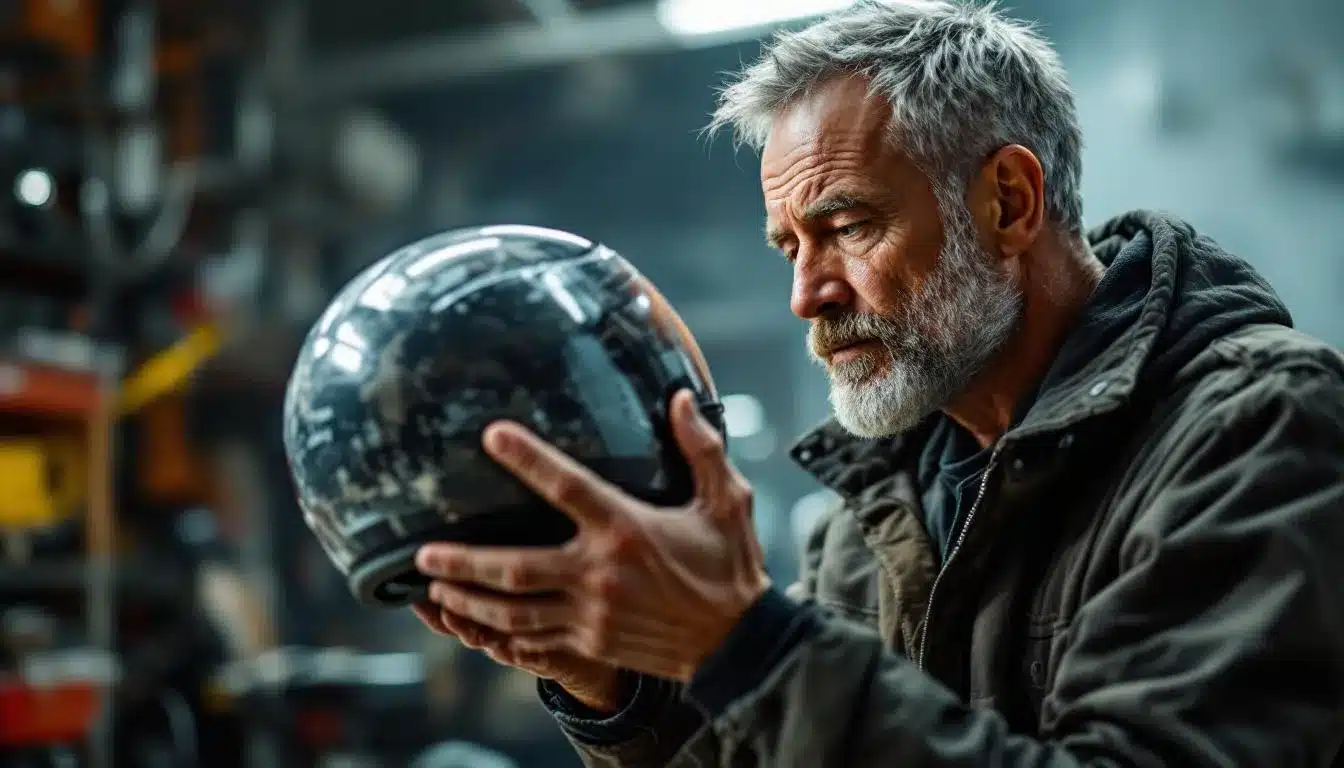

Marc, a real bike enthusiast, is active all week and is looking forward to the weekend to get in touch with his machine. At 35, his main concern remains to drive safely, while enjoying every exit.
After several years of using the same head covering, he is now questioning the reliability of his equipment. Desiring to combine protection and pleasure, Marc is looking for practical advice to determine when and why to renew his equipment.
In the following lines, we share how to appreciate the lifespan of its motorcycle helmet and recognize the signs ofwear and tear. You will leave with concrete solutions to ride the serene mind and guard yourself on the road.
Summary of key points
- ✅ Anticipating tax and estate processes
- ✅ Formalize any occupation to avoid disputes
- ✅ Consult a notary to secure the transmission
Life of a motorcycle helmet and safety – what you need to know
All bikers sooner or later wonder about the real reliability of their protection. Little anecdote: Marc, after a serious fall, thought he could keep his helmet, until a friend warned him. This helps to clarify the frequent doubts to ride with confidence and stack the chances on its side.
As soon as we exchange with experienced users or consult with safety trainers, it becomes clear that it is sometimes wise to step back: the perception of danger changes with the experience, environment and environment of each motorcyclist.
Official recommendations on the life of a motorcycle helmet
The vast majority of manufacturers, including Shoei and Shark, recommend changing their protection every five years or so. Other brands, such as Arai or HJC, in addition to some certification laboratories, temper this figure, depending in particular on the intensity of use and the climate in which it is driven.
This period covers routine use and takes into account the aging of materials. Ultimately, it is primarily about preserving your safety: too old a helmet usually loses efficiency, as it seems.
Good to know
I recommend you always check the advice of your helmet manufacturer, as some offer a post-shock analysis service to ensure your safety.
Standard ECE 22.06 – Is there an expiry date imposed?
There are no European or French regulations which require a new helmet after a certain number of years.
The ECE standard establishes rigorous test criteria, but there is no formal validity deadline. Moreover, some neighbouring countries are implementing different recommendations, while in France everything is based mainly on the observed condition of the equipment. Indeed, it is better to rely on the condition of its equipment over the days rather than on simple legislation.
Recognize the signs of wear and age of his motorcycle helmet
Sometimes the damage escapes from the naked eye, but minimal detail can transform the situation.
Identifying the signs of fatigue in its protection means avoiding inconvenience at the worst moment. An accessory apparently in good condition the day before can suddenly have a critical defect just before taking the road.
What elements control to ensure the safety of your helmet?
Frequently inspect the outer envelope for cracks, deep scratches or deformations.
Also consider examining inner polystyrene (EPS) as well as the jugular: their compaction or hardening often reduces protection. Many users stress the importance of ventilation control, solar visor or integrated Bluetooth kit: a simple malfunction, or a tired attachment, can reveal advanced wear. Too marked a screen or damaged joints also indicate an aging that may alter the reliability of your equipment.
Shock or fall – should your helmet be replaced even if it looks intact?
Any helmets that have received a shock should be replaced, even if the hull appears to be free from external damage.
As Mark has experienced, internal damage may not occur instantly. According to many workshops or prevention days conducted by experts, this precaution is widespread. Anticipate: Efficacy in the event of an accident could be seriously questioned.
Why can the inner foam become a silent threat?
Over time, it is not uncommon for mosses to crush or harden, changing their adaptation to the size of the biker. This lack of grip increases the risk of shock.
As soon as an element « fleet » or causes a strange impression, it would be prudent to watch or even renew your helmet quickly. Sometimes a curious smell warns the user before even a defect is visible: a sign that the rider's intuition also comes into play for prevention.
Optimize maintenance and storage to extend motorcycle helmet life
Take care of your equipment, your peace of mind will only be better.
Good storage and regular maintenance of your "second skin" guarantee long-lasting efficiency – while keeping your biker budget safe. A careful user often finds himself free from bad surprises after the cold season.
What obvious actions are taken to increase the life of the helmet?
Always store your helmet in its cover, away from UV rays or wet areas. Clean it at regular intervals with suitable products and let it dry naturally in the air.
For maintenance, prefer a soft, non-abrasive fabric, check that the pads are repositioned well after washing, and ban too strong solvents that can damage the materials. Small trick from the workshop: sometimes remove the solar visor or accessories (micro, intercom kit) to check the precise state of each element. Careful attention reduces the appearance of bad odours and slows the aging of the helmet.
Storage – why does a dry and temperate room change everything?
Yes! Displaying your helmet with heat, extreme cold or humidity accelerates the degradation of polycarbonate or fiber.
A ventilated and shaded place is usually enough to maintain the life and performance of your accessory. Also pay attention to the presence of solvents in some garages: their emanation can deteriorate foams and soft elements without any notice.
The observations of the field prove this: a well-stocked helmet can provide you with several years of tranquility. According to several returns, a carefully maintained helmet remains reliable between 5 and 7 years, sometimes more.
To ensure optimal protection, it is essential to know the lifespan of your equipment, as for other devices, in the image of this guide on the lifetime charcoal washing machine: complete guide to extend your appliance.
To ensure safe driving and control every curve, discover our motorcycle fear band: complete guide to understand and control your turn safely.
For Marc and all bikers who are concerned about their safety, choosing the right equipment is often accompanied by a reflection on the best coverage: discover this comparison 2025 between bikers' mutual and AMV to choose the best motorcycle insurance.
Motorcycle helmet change: when to act for safety and insurance
Is there an ideal time to replace his protection? More than the age of the helmet, it is the real state and experience of the equipment that matter.
Before deciding, it is useful to recall some simple principles to avoid bad choices. Safety specialists repeat this: the culture of renewal varies greatly according to the profiles, and some probably expect... a little too much.
Can we rely on the manufacturer warranty to estimate the lifespan?
The majority of major brands offer a 5-year warranty, which corresponds to the duration generally recommended in Quebec for example.
This does not mean that a replacement must occur systematically at maturity, but this milestone encourages vigilance, especially when signs of wear and tear occur. As soon as a doubt arises, it is safer to inspect the inside and outside of the cap, examine the padding for any signs of settlement or deformation, and monitor the screens to detect any scratches or cracks: these gestures remain essential for your safety.
Note that some high-end manufacturers, such as Arai or HJC, sometimes provide specific recommendations or make available a post-shock analysis service in their kit.
Used helmets – why is caution particularly necessary?
A second hand helmet seems attractive, but it remains risky.
Ignoring his real history, or ignoring whether he has suffered shocks or dragged in bad conditions, makes any certainty about his safety illusory. Best to choose new purchase, or turn to certified motorcycle equipment to drive peacefully. Some specialized sites now offer reconditioned helmets labeled, but caution always prevails: even laboratory testing cannot guarantee anything if the past use of the helmet remains uncertain.
Road safety experts sometimes recall this: prevention is better than cure.
A new helmet provides the best protection, without any uncertainty as to its previous course.
And on the insurance side, what consequences in case of seniority or wear of the helmet?
In the event of a disaster, using used or unapproved equipment may complicate or even prevent compensation. According to several insurers, some refuse to take over damage if the helmet is no longer considered compliant or sufficiently safe. This is still a good reason to act quickly from the slightest doubt.
After an accident, the analyses show that the perception of danger differs greatly according to the user... It's a point that often comes back.
Few motorcyclists expect their insurance to be challenged simply because of too old an accessory. Be sure to monitor the condition of your helmet, this is probably the best way to keep your mind quiet while travelling. Sometimes small details – a scratched visor, a failing Bluetooth kit – are enough to change the result of expertise.