
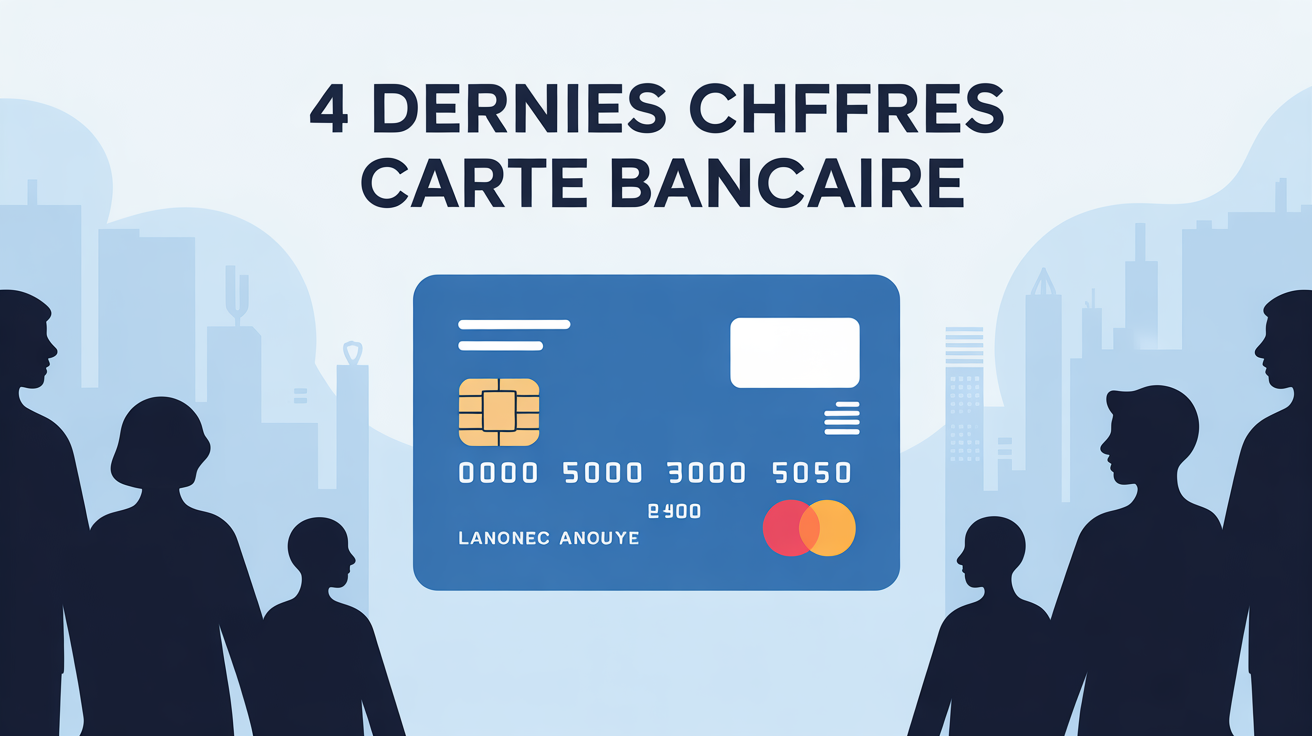

Communicate Last 4 digits of his credit card often seems to have no consequences, but it is better to keep a certain caution in the face of the growing ingenuity of fraud. In practice, these figures will never be sufficient to authorize payment. However, any unusual demand should be a source of mistrust: exchange your information only on secure channels, and if the process starts well with you. The security of your data rests above all on your ability to perceive the warning signals a cybersecurity expert recently recalled that a small doubt is better than a great disillusionment.
The immediate verdict: Is it risky to give the last 4 digits of his credit card?
The most frank answer: providing the last 4 digits of your credit card does not allow payment or withdrawal, as long as the application remains in an official framework or the initiative comes from you. These figures mainly identify a map, nothing more. But be careful: the simplicity of this question sometimes hides elaborate fraud manoeuvres. If a doubt persists, it is more prudent to hang up directly or close your page and call your own bank (national number opposition map: 09 69 39 71 97).
Reminder to keep in mind: cannot make a payment without the full number, expiration date, and cryptogram. Let's add that a lot of scams just start with "check" requests or reassuring pretexts, intended to lure you. Some customers report being approached by usurpators using this technique. Let's keep the right reflexes to differentiate the plausible statement from the scam.
The last 4 digits – what do they allow?
Rumors and opinions abound about security about these numbers... But their mission remains simple: partial identifier, in no case payment tool. All you need is a technical reminder: the last 4 digits alone are not used to debit an account the remaining number is missing (16 digits in total), plus the expiration date and visual cryptogram (CVV). Since the establishment of the Directive DSP2any transaction exceeding 30 euros requires double authentication.
So why are these figures moving on toll side or bank agency? It is used to find or check a file there is nothing smarter than to identify "your card ending with 4567" in a dispute over a purchase, for example. If an advisor or website claims to be able to enter into a transaction with these 4 digits only... Big alert: it has no legal or technical basis.
Actual function and safety limits
In a card number, the first 6 digits (called BIN) point to the establishment (e.g. BNP, Crédit Agricole...). The last four designate your card in particular. One can see this as giving the 4 final letters of a registration plate: simple search criteria in a database, absolutely inoperative to seize a vehicle... Or your money!
Let us take a concrete note: Of the 100 fraud attempts recorded in 2023 by the Bank of France, none resulted only from the last 4 figures. In reality, the scam often starts with this "innocent" demand. Many professionals agree that caution is necessary as soon as any astonishment occurs.
School case: payment and identification, nothing to see
In customer service, these figures are sometimes necessary to resume a file. For a settlement? Impossible. It is not uncommon for a SNCF user to say "my card ends with 4567" to pick up a ticket. But if you are invited to enter these numbers to pay... Move away immediately: neither the law nor the banking tools allow it.
If the mistrust hits you at that time, nothing abnormal: it is always better to check once too much than to fall into the panel. Moreover, a bank trainer recently recalled that the question "Why now?" is regularly enough to destabilize fraudsters.
When are they requested and by whom?
At any unexpected call or email, doubt quickly settles. It is quite easy to distinguish in which cases the demand for these figures is justified, and when it must arouse suspicion. Better to train to spot the difference in a blink of an eye.
The only really safe contexts
You can be asked to communicate the last 4 digits of the map in these situations only:
- If you yourself have requested contact : call to the official number of a bank, customer service of the toll after ticket loss, etc.
- Entering in a secure customer space (authenticated site or bank application, in HTTPS).
- When it comes to canceling an operation, find a folder or to file a claim on a subscribed service (energy supplier, streaming platform...).
SNCF, Netflix or Orange users report this request in support, but always at their request never at the initiative of the service. Same thing on tolls, where you never ask for the cryptogram.
After case law and recommendations Bank of Franceany other applicant should be considered suspect from the outset.
Concrete examples: legitimate or at risk? (marking table)
A quick picture, to be found globally in practice:
| Situation | Self? | Risk signal |
|---|---|---|
| Calling your bank, you dialed the number on your CB | ✅ Yes | None (if standard check) |
| Unknown SMS asking the 4 digits for "security" | ❌ No | Emergency, clickable link |
| Motorway fishing, ticket loss, last 4 digits request | ✅ Yes | Procedure displayed, never cryptogram |
| Customer service that reminds you when you did not ask for anything | ❌ No | Unsolicited outgoing call, tone of urgency |
| Email "Your account is at risk", request 4 digits | ❌ No | Suspicious address, spelling errors |
Nothing sure? Before any transmission, pick up your hand: remember the official contact or log in to your bank application.
Snails and red signals: what to spot
The limit between legitimate and attempted fraud is not always determined. Yet, some clues are not wrong. Finding these signs is regularly the best parade, especially if it is kept in mind that crooks constantly refine their methods.
Common scenarios: false calls, SMS, emails
Some consumers receive messages like: "Your access is suspended, now send the last 4 digits for verification." But as we can see, never a real bank does that. The parade of the fraudsters consists of panicking the victim, saving time, and then gradually reaping other elements (recently, an Orange subscriber saw close to 840 € taken in this way). Some lawyers stress the importance of relying on his feelings in cases of sudden emergency.
Remember: no institution asks for this information via email or SMS, or invites you to click on questionable links or attachments.
Quick checklist to detect scam
Some reflexes to adopt without delay:
- The call or the message was not asked? DANGER
- Your interlocutor insists on urgency or press you? DANGER
- The person asks for other elements (cryptogram, expiration, full name)? Run!
- Cannot easily verify the contact number or address? DANGER
The golden rule: Hang up, exit the suspicious support and get back in touch via the website or official number!
Practical advice and anti-fraud options
On a daily basis, it is a simple gesture that makes the difference: a check or notification, and you avoid many pitfalls. Here is the popular approach (retained in the main guides and by the specialists of the sector) to keep the spirit serene.
5 reflexes to stay serene (checklist to print)
Keep this short checklist at hand: it can, one day, save you heavy financial consequences.
- Always initiate the exchange yourself in any application related to the card number.
- Ensure the origin of the URL or number : always validated by your app, never received via a third party link.
- Avoid any transmission of banking information via pop-up, email or SMS.
- Enable, if possible, notifications in real time on the banking application this allows to be immediately alerted to any unexpected transaction.
- Use the virtual map for online purchases when the option is offered by your bank.
In case of doubt: don't hesitate to freeze the card temporarily from the app, contact the 09 69 39 71 97, then check your history over the last month. The bank advisors confirm that this three-part guarantee in nine out of ten cases.
Tools, guides, and reporting
– Solutions such as Online Banks, Paylib, Apple Pay or Google Pay offer effective ways to generate virtual cards, activate enhanced security or oppose in just a few clicks (recommended from 2024).
– In case of suspicion, the alert is made directly on SignalConso or via Public Service.
– For any objection: 09 69 39 71 97.
Frequently Asked Questions and Resources for Rapid Response (FAQ)
Specialized agencies regularly observe that in answering these questions, 75 to 85% of potentially risky situations are avoided.
Mini-FAQ: concrete cases and quick answers
Q: Are the last 4 digits sufficient for an Internet payment?
Absolutely not. The whole number, the expiry date and the CVV are indispensable.
Q: Can the toll ask me the last 4 digits?
Yes, when it is a formal search or challenge procedure, the application is quite classic.
Q: What about my bank?
Only if the communication comes from you. Otherwise: mandatory caution.
Q: I am asked these numbers by SMS/email: what to do?
Cut short and signal quickly via SignalConso; in case of doubt, contact the opposition.
Q: How do I scan a site or a suspicious call?
Check the presence of the https protocol, the official address or number, and navigate directly from the bank application (never from a link). Some note that fake platforms even simulate official sites: a few minutes of verification are sometimes worth saving.
Official anti-fraud resources
- Practical guide Juristsdfuture.fr
- Step by step decryption Maison-Initiative.org
- Analysis Allianz-Entrepros.fr
- Public Service Sheet: opposition card
- Opposition number: 09 69 39 71 97
To remember (box to print at home!)
The last 4 digits of a card are only used to identify it, and remain inoperable for any operation as long as they remain isolated. Refuse any transmission following an unexpected message or contact, systematically check the context, and always prefer direct communication with the official service in case of doubt: this precaution remains the best assurance.