
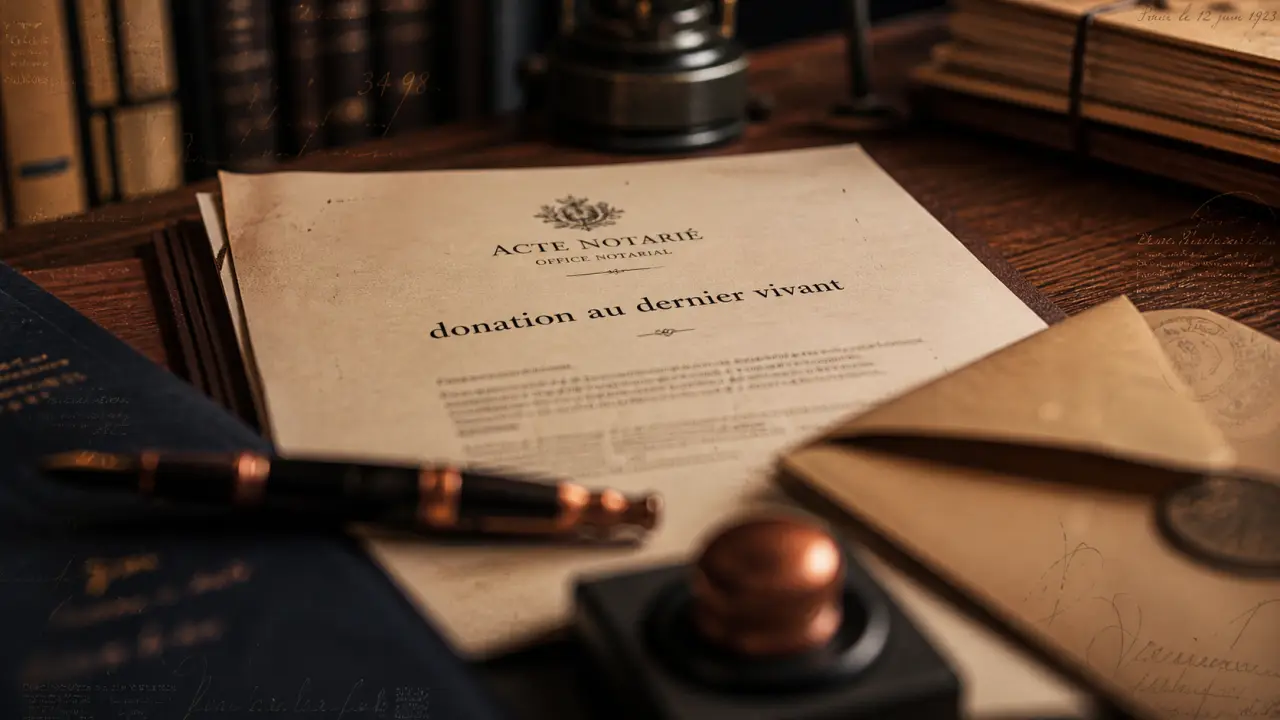

The price of a donation to the last living person remains moderate in view of the stake, protecting the spouse at the time of succession. The costs of the notarial act, often included between 150 € and 600 €, to which additional registration fees are added 125 €. The exact amount depends on the study, the formalities and the family situation.
What a donation actually funds to the last living
The donation to the last living, also called a donation between spouses, is a instrument signed before notary by which one spouse increases the inheritance rights of the other. She doesn't pass on the goods right away. It shall take effect on the death of the first spouse. His interest is therefore less to give today than to open up more options to the surviving spouse later.
Divorce: What is the fate of your spousal donations? · Discover the legal consequences of divorce on your gifts of present property, donations to the last living and matrimonial benefits.
It is reserved for married couples. ACAP partners and partners cannot use this mechanism, even if they have other solutions, such as the will or certain heritage arrangements. For a married couple, the gift to the last living person can be set up regardless of the matrimonial regime, including the separation of property.
A notarial act, not a mere declaration
Visiting the notary is mandatory. This explains the existence of fees, but it is also what secures the process. The notary verifies the identity of the spouses, their ability to consent, the exact scope of the act and the consequences for the heirs. It may also adapt the wording to a recomposed familythe presence of non-common children or a heritage that combines principal residence, placements and professional property.
The donation may be made by one spouse to the other, or by both spouses to the other. In practice, many couples sign two cross-gifts so that each protects the other under the same conditions. This may influence the total amount invoiced, hence the interest in asking for a clear estimate before signing.
Donation to the last living: prices, notary fees and entitlements
The cost consists mainly of fees and fees related to the act, the formalities performed by the study and the registration fees. The amounts observed are often between 150 € and 600 € for notary fees, with a registration fee of 125 € for the donation to the last living.
| Cost item | Amount generally recognized | What does that mean? |
|---|---|---|
| Notary fees | Between 150 € and 600 € | Drafting, advising, formalities and retention |
| Registration fees | 125 € | Tax formalities attached to the act |
| Supplementary Heritage Council | Variable | In-depth analysis of complex assets or recomposed families |
Why price varies from couple to couple
A simple situation, with two spouses, common children and a traditional heritage, requires less analysis than a case with children from a previous union, undivided property, family society or residence abroad. The price does not therefore pay only a form. It also covers advice that avoids inappropriate drafting.
The notary may, in particular, draw attention to the effects of the donation if the surviving spouse chooses the usufruct, the full ownership of part of the property, or the amount available. This counselling stage is very important because the choice of death has concrete consequences for the use of housing, income, transmission to children and family balance.
Are there inheritance rights for the spouse?
Donation to the last living person does not in itself create additional inheritance rights for the surviving spouse. The married spouse is exempt from inheritance duties. The interest of the scheme is therefore primarily civil and property: it increases or relaxes the rights of the survivor, without turning the spouse into a heavily taxed heir.
On the other hand, the rights of children remain protected by the hereditary reserve. Donation does not disinherit them. If an award exceeds what is legally possible, reserve heirs may request a reduction, sometimes in the form of a reduction allowance. This is precisely one of the points that the notary anticipates when writing.
What the surviving spouse can choose on death
The great advantage of donating to the last living is to leave several options to the surviving spouse. Instead of being confined to a single distribution, it can choose the solution most suited to its real situation at the time of death, its age, its income, its need to maintain housing and the level of wealth.
| Possible option | Effect on surviving spouse | Situation where it may be relevant |
|---|---|---|
| 100% usufruct | Use or collect property | Maintain housing and secure its standard of living |
| 1/4 fully owned + 3/4 usufruct | Owning a share while maintaining the use of the rest | Combine heritage autonomy and daily protection |
| Available in full ownership | Receive the maximum available share according to the number of children | Strengthening spouse ownership by family composition |
The amount available depends on the number of children
When the spouse chooses the quota available in full ownership, the share varies according to the number of children: 1/2 in the presence of a child, 1/3 with two children, 1/4 with three or more children. These limits reflect the balance between the protection of the spouse and the reserve rights of descendants.
You have to reason like with a heritage balance. On the one hand, the surviving spouse's need to keep air, income and sometimes the family home. On the other hand, the vocation of children to receive their part without feeling deviction. A good donation to the last living not only seeks to give the spouse the maximum, it sets the center of gravity of the succession. Sometimes, total usufruct appeases more than full, more conflicting property, because everyone knows what it retains, use for one, future property for others.
Benefits, limitations and situations to be monitored
The first advantage is simple: surviving spouse, particularly when a large part of the heritage is concentrated in the principal residence. Without anticipation, the survivor may find himself in an uncomfortable situation, with limited rights or decisions to be shared quickly with other heirs.
Donation to the last living person also reduces the risk of family blockage, as it sets a legal framework before death. It does not prevent all disagreements, but it clarifies options and gives the spouse a stronger legitimacy at the time of death.
Common children, non-common children: impact is real
In the presence of common children, the donation allows mainly to broaden the choices of the surviving spouse. In a recomposed family, its interest is often even greater, as the legal rights of the spouse may be less comfortable when non-common children intervene in the succession. The notary must then verify that the protection of the spouse does not create an excessive tension with the rights of children in the first bed.
Donation to the last living therefore does not replace family reflection. It must be coordinated with the matrimonial regime, the beneficiary life insurance clauses, any wills and the exact composition of the assets.
Revocation, divorce and marriage contract
Donation to the last living is in principle revocableexcept when incorporated into a marriage contract. This flexibility is important. A couple can adapt their choices after birth, remarriage, real estate acquisition or changes in wealth.
In case of divorce, revocation is automatic. It remains prudent, however, to take stock with his notary after a separation or change of situation, in order to verify all the estate provisions still in place, including wills or life insurance clauses.
Steps to be foreseen before signing at the notary
The procedure is simple, but it deserves preparation. The most effective way is to make an appointment with a notary by clearly setting out your goal: to protect the surviving spouse, to organize a recomposed family, to secure housing or to avoid tensions between heirs.
- Identification of spouses;
- Family booklet and marriage certificate;
- Marriage contract if it exists;
- Information on common and non-common children;
- Main assets: housing, accounts, investments, professional property;
- Arrangements already made: will, previous donation, life insurance.
After the exchange of advice, the notary drafts the act, makes it sign and then completes the necessary formalities. It may also provide for the registration or retention of the disposition at the time of death, in particular via the Central file of last wishes provisions where a provision is to be made.
Compare with a will or other donation
The will may also protect the spouse, but it does not always offer the same security or mechanics as the gift between spouses. It is often more flexible to write, but it can be forgotten, poorly formulated or challenged if it has not been prepared rigorously.
Traditional donations, such as donation-sharing or manual donation, respond to another logic: they transmit goods during his lifetime, often to children. The donation to the last living person is primarily for the protection of the spouse upon death. Its relatively high price, often between 150 € and 600 € plus 125 € of registration rights, makes it an accessible heritage tool, provided it is not mechanically chosen. The right reflex is to ask the notary not only the rate, but also the concrete effect of each option on the succession.