


In the face of often inadequate mandatory schemes, many assets are considering several contracts to protect their income. The question then arises: is it possible, and above all useful, to hold two insurances maintaining wages? If the law does not prohibit the cumulation of provident contracts, it strictly regulates compensation arrangements in order to avoid unjust enrichment. You can multiply contributions, but you will never get more than your usual salary.
The legality of cumulation: what the Insurance Code says
It is legal to enter into two wage maintenance insurance contracts, whether through your company or in your personal capacity. This approach is common among professionals or professionals wishing to fill gaps in their social protection. However, this freedom of contract is in conflict with the principle of compensation.
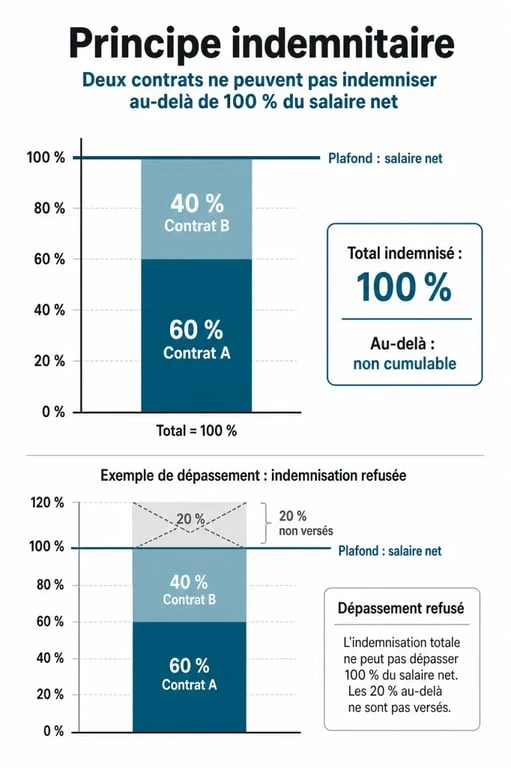
Under this principle, insurance compensates for damage suffered and does not allow the insured to realize a financial benefit following a claim. In the event of termination of work, the sum of the daily allowances paid by the Social Security and by your various insurers may not exceed the amount of your net income from work. If the total sum exceeds your salary, the compensation of the second contract is reduced proportionately to meet this 100% ceiling.
The special case of lump-sum contracts
A nuance exists between so-called contracts « Compensation » and contracts « flat-rate ». In a lump sum contract, the benefit is fixed on signature, regardless of the actual injury. If your two contracts are of a flat-rate nature, full cumulation can theoretically apply. However, virtually all current wage maintenance contracts include real income-based limitation clauses to avoid drifts.
Why choose to double its cover?
If one cannot earn more by being sick than by working, the interest of paying two contributions lies in the complementarity of the guarantees and the finesse of the protection.
Filling an employer contract deficiency: Compulsory collective contracts are sometimes limited in terms of duration or amount, especially for high incomes whose variable wage share is not always taken into account.
Reduce franchises: A first contract may have a 30-day deductible, while a second individual contract may take place from the 3rd day, ensuring an immediate financial link.
Benefit from extended assistance services: Double contracts sometimes allow access to more comprehensive home help or child care services, with each insurer having its own partners.
By multiplying the sources of protection, the insured ensures that even if an exclusion clause strikes one of the contracts, the second, often more flexible, takes over. It is a risk diversification strategy that protects the life course over the long term, ensuring that financial flows are never interrupted by health hazards.
Transparency obligation: an imperative for compensation
Underwriting two retention insurance policies without informing insurers is a strategic mistake. Article L121-4 of the Insurance Code requires the insured to inform each insurer of the existence of other policies covering the same risk.
Risks of non-reporting
If you fail to declare a second contract, you are subject to sanctions. In the event of a claim, the insurer may rely on the nullity of the contract I'm sorry. Not only will you not be compensated, but the premiums paid remain with the insurer. Even without intent to fraud, a simple omission can result in a proportional reduction in compensation, making your investment unnecessary when you need it most.
How to declare your contracts?
The declaration must be made at the time of subscription of the second contract. If you are already covered, send a registered letter with acknowledgment of receipt to your two insurers specifying the references of the contracts and the guarantees subscribed. This transparency allows insurers to coordinate the settlement of daily allowances, often via a system of subrogation or pro rata temporis distribution.
Comparison of situations according to occupational profile
The issues of cumulative wage maintenance insurance differ depending on whether you are a private employee or a self-employed person.
| Profile | Recommended cumulation type | Main advantage | Point of vigilance |
|---|---|---|---|
| Employee | Collective + Individual | Coverage of variable wage | Overall ceiling of 100% |
| TNS (Independent) | Madelin Law + Planning | Tax deductibility | Cross waiting periods |
| Liberal Profession | Pension Fund + Private | Maintenance of the standard of living | Coordination compulsory scheme |
The specific case of Unemployed Worker (TNS)
For an independent person, cumulation is often a necessity, since the compulsory regime is notoriously insufficient. Utilization wants us to sign a contract Madelin law to benefit from tax benefits, while supplementing it with a Life Accident Guarantee (LAG) or specific insurance for the company's fixed costs. In this case, cumulation is not intended to increase personal income, but to dissociate household income from fixed occupational burdens which continue to run during the stoppage.
The reflexes to adopt before multiplying contracts
Before signing a second contract, a precise analysis of your current coverage is essential. It is not about collecting fonts, but about optimizing every euro invested.
Analyze the information package: Many employees are unaware of the details of their business plan. Check the retention rate, often between 60% and 80% of the gross, and the duration of the payment.
Calculate the rest at charge: Make the sum of your incompressible charges such as real estate credit or invoices. If your current contract leaves a financial gap of more than 15%, a second contract is relevant.
Focus on modular guarantees: Instead of taking over a full contract, look for options « reinforcement » that only target the weaknesses of your main protection.
Check coordination clauses: Make sure that the new contract explicitly provides for payment arrangements in case of multiple insurers to avoid administrative blockages.
In short, having two wage maintenance insurances is a legitimate strategy to secure your income, provided you respect the obligation of transparency and do not aim at illegal enrichment. The key to successful protection lies in the balance between the cost of contributions and the reality of the financial need in the event of a risk of life.