
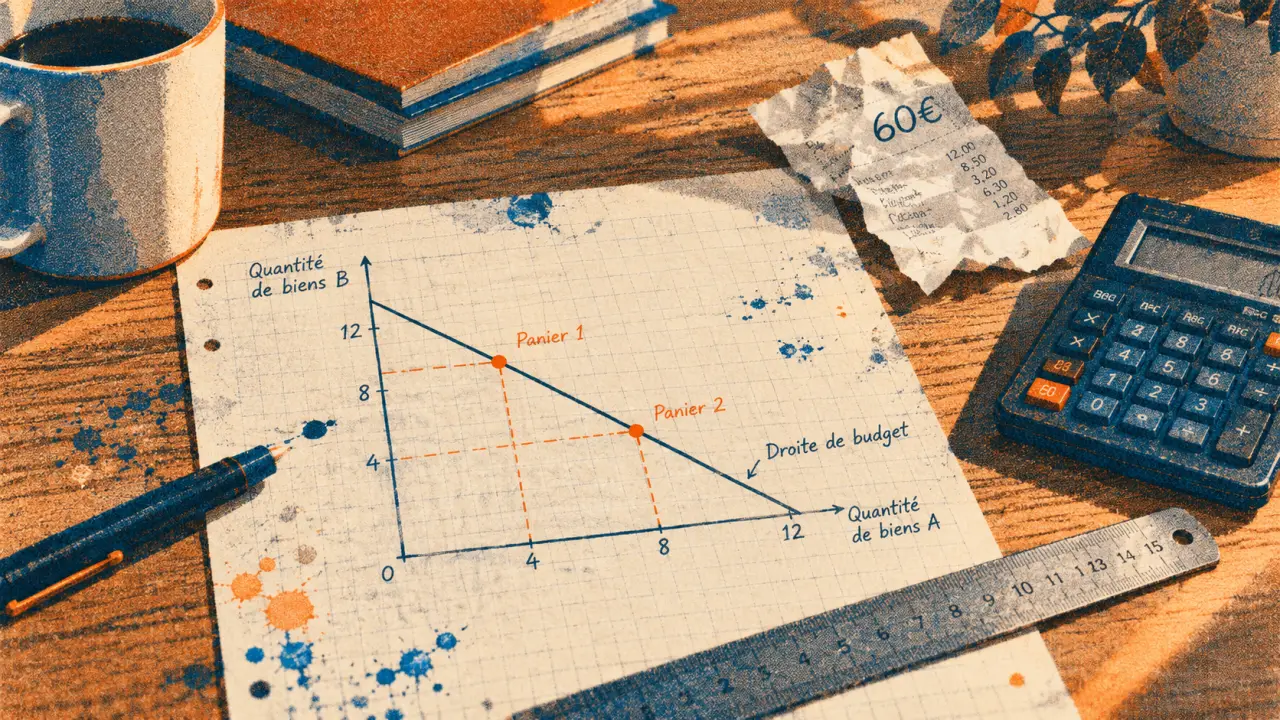

The budgetary constraint expresses a simple reality: with a given income and price, it is impossible to buy anything that one wishes. In economics, this concept is used to understand consumer choices, to calculate accessible purchasing combinations and to visualize the effects of variation in income or prices.
Understanding budgetary constraint in one sentence
One budgetary constraint is the limit imposed on expenditures by available resources. For a household, it depends mainly on the disposable income, i.e. the sum actually available after the compulsory levies and the income received. The prices of goods and services are equally important: the same budget does not allow the same products to be bought when prices rise.
Calculate budgetary constraint
Analyze what a budget allows to buy according to the prices of X and Y.
Maximum quantity of X
If the budget is allocated to X only.
Maximum quantity of Y
If the budget is spent only on Y.
Expenditure of seized basket
Status of the basket
—Equation of the budget line
The slope indicates the quantity of Y abandoned for an additional unit of X.
Slot
Formula: -Px/Py
The quantities shall be considered divisible. Empty values for X or Y are counted as zero in the input basket.
In economic theory, one often imagines a consumer choosing between two goods. If it has a budget of R, that the first good costs Px and the second PyIts expenditure must respect the following inequality: Px × quantity of X + Py × quantity of Y ≤ R. The sign « less than or equal to » is important: the consumer can spend the entire budget or keep a portion of it.
This rule does not say what a person is must Buy. It only indicates what it is can Buy. Then, tastes, needs, habits and priorities are used to determine the options available. All baskets that meet this limit form the possible consumption set.
From Budget to Choices: Why We Need to Arbitrate
The scarcity of resources requires arbitration. Buying more of a product often means giving up a part of another product, an exit, savings or a future project. Budgetary constraints therefore transform general preferences into concrete decisions.
Usefulness helps to choose from possible options
In microeconomics, the consumer is said to seek maximize its usefulness Under budgetary constraints. Usefulness refers to satisfaction with a basket of goods and services. It is not the same for everyone: one person can favour transport, another leisure and a third equipment of housing.
The optimal choice is the accessible basket that gives the greatest satisfaction according to the individual's preferences. In a simple model, this basket is often on the budget limit. If an amount remains unused while it could improve satisfaction, the consumer may have an interest in spending it on a purchase or savings, depending on what brings the greatest value.
Thinking about it « opportunity cost » makes arbitration clearer
Each expenditure has one opportunity cost This is what people give up using their money otherwise. With a monthly budget of 1,500 €, devote 300 € a subscription, meals delivered or unplanned purchases mechanically reduces the margin available for other items. The challenge is not to judge the expense, but to see clearly what it replaces.
One can imagine the budget as a rope between two points: the income on one side and the indispensable expenditure on the other. The more fixed charges take place, the more the share actually available for arbitration decreases. This image helps distinguish compressible expenditures from hard-to-change commitments. It also avoids believing that an effort on small purchases will always be sufficient to solve a structural imbalance.
Read and draw a budget line without getting lost in the graph
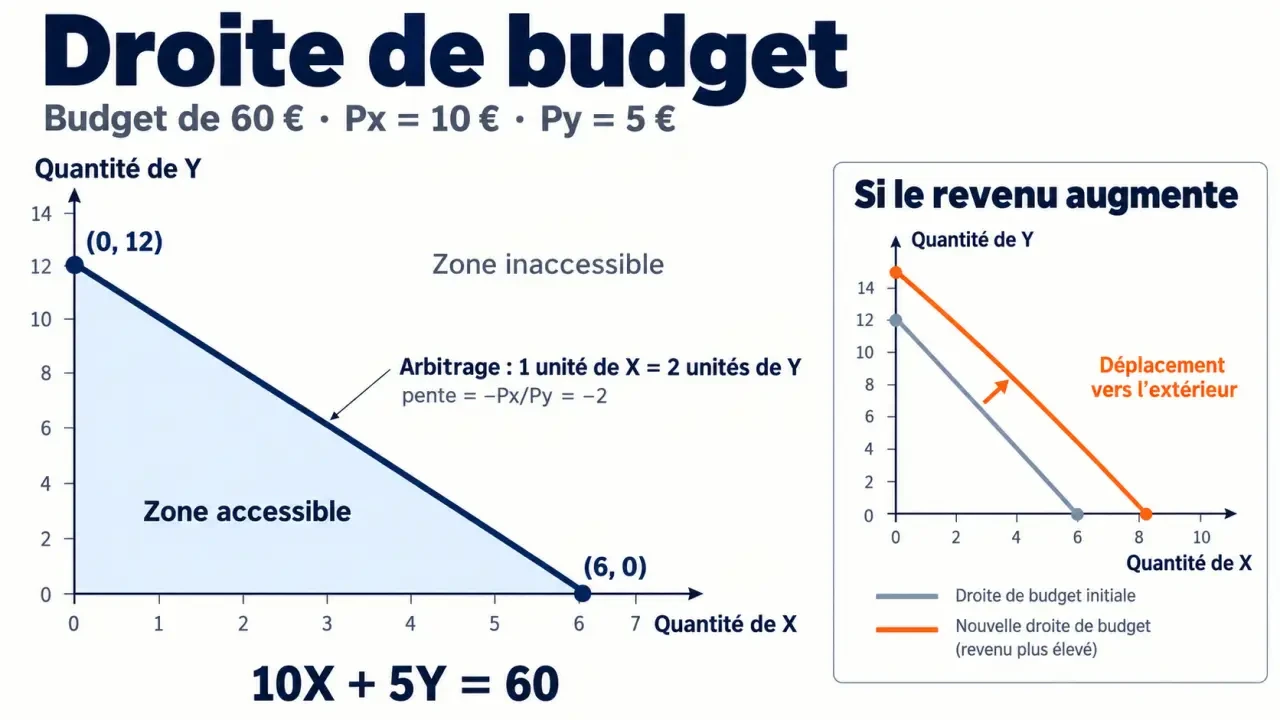
The right of budget graphically represents all combinations of two assets that use exactly the available budget. On a marker, the quantity of property X is placed on the horizontal axis and the quantity of property Y on the vertical axis. The baskets below the right are affordable; those above are not with the income in question.
A simple encrypted example
Suppose a budget of 60 €. Good X costs 10 € and property Y costs 5 €. If the entire budget is spent on X, it is possible to buy 6 units. If it is entirely dedicated to Y, it is possible to buy 12. The budget line therefore links the points corresponding to 6 units of X and 0 units of Y, then to 0 units of X and 12 units of Y.
| Cart envisaged | Total expenditure | Accessible with 60 € ? |
|---|---|---|
| 2 X units and 8 Y units | 2 × 10 € + 8 × 5 € = 60 € | Yes, on the right of budget |
| 3 X units and 4 Y units | 3 × 10 € + 4 × 5 € = 50 € | Yes, under the right |
| 4 X units and 5 Y units | 4 × 10 € + 5 × 5 € = 65 € | No, above the right |
The slope of this line reflects the relationship between prices. Here, an extra unit from X to 10 € obliges to renounce two units from Y to 5 €, if the budget remains unchanged. The graph makes this renunciation visible. It shows concretely the exchange between two possibilities of consumption, instead of letting it appear as a simple accounting operation.
What moves budget constraint in real life
The budgetary constraint is not frozen. It changes as disposable income, prices or purchase conditions change. Understanding these movements makes it possible to interpret daily situations such as inflation, wage increases, commercial promotion or unforeseen expenditure.
Official definition of disposable income · Discover the definition of INSEE and the components of income available to a household to consume and save.
- Income growth: the consumer can access more baskets of goods. The budget line moves outwards, without changing the slope if prices remain the same.
- Lower income: shopping opportunities are being reduced. The right is close to the origin of the marker.
- Increase in the price of a good: This property becomes relatively more expensive. The right rotates, as the maximum quantity of this product is reduced.
- Reduction, assistance or reimbursement: These elements can reduce the price actually paid and broaden the available choices.
In personal management, it is useful to reason with the income actually available after rent, refunds, insurance, energy and other regular expenses. This remaining to live constitutes the concrete basis for arbitration. For variable income, it is better to rely on a conservative estimate and then provide a margin for irregular spending rather than building the budget for the best month.
Why this concept goes beyond everyday shopping
Budgetary constraint is central because it links resources, prices and preferences. She explains why two people with similar needs can make different choices, and why price variation can change a basket even without changing taste.
The reasoning also applies to other economic actors. A company arbitrating between wages, raw materials, investment and cash within its resources. The State must finance its expenditure by means of revenue, borrowing or priority choices. The mechanisms are not exactly the same, but the idea remains: any decision mobilizes limited means and involves giving up.
Finally, budgetary constraint remains a model. It simplifies reality by assuming known prices and consistent decisions. However, purchases can be influenced by urgency, credit, habits or lack of information. This does not make the concept less useful: it provides a clear framework for identifying what actually limits choices, comparing available options and understanding the formation of a basket of goods.