


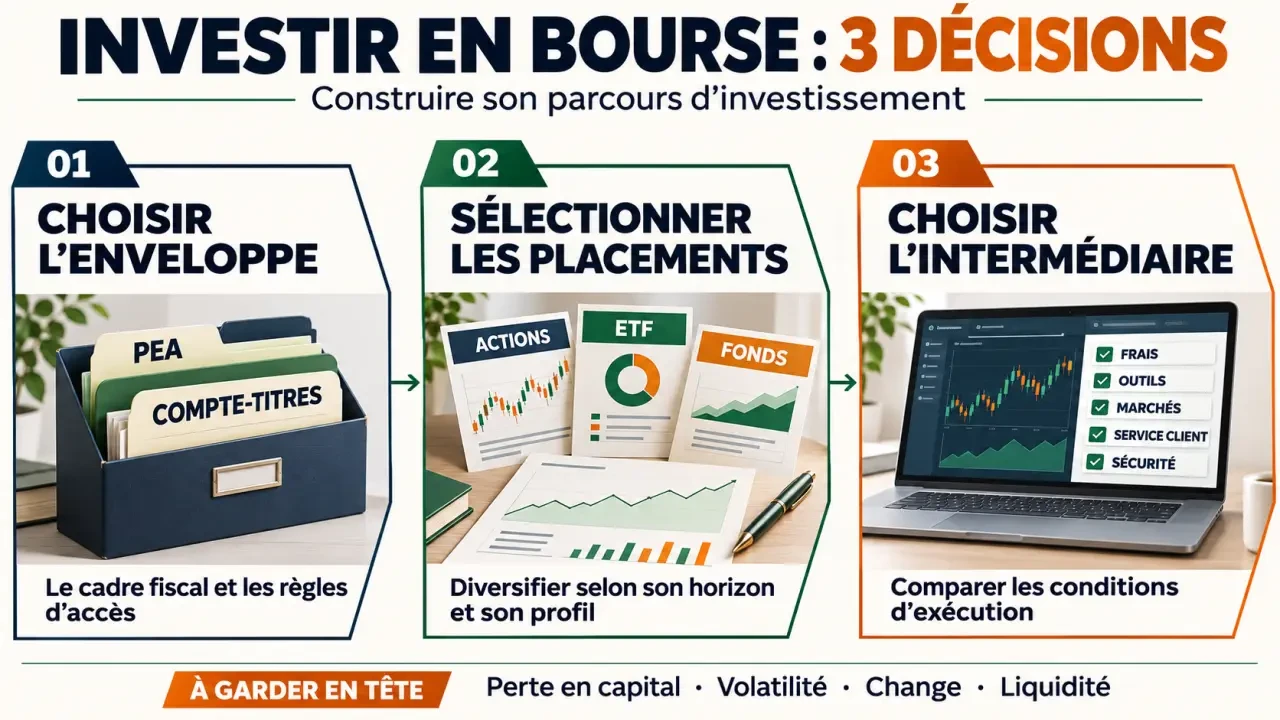
To invest in the stock exchange, three decisions must be distinguished: the account to be opened, the investments to be purchased and the intermediary who will execute the orders. The right choice depends on your horizon, your ability to bear losses and the time available to manage your portfolio. An attractive price is not enough: accessible products, total costs and accompaniment count as much.
Define the money you can actually invest
Investing in the Stock Exchange is about acquiring financial instruments that are evolving in market value. A share represents a share of the capital of a company; an obligation is a claim. You can also purchase shares of funds that combine multiple investments. The aim is to seek a valuation of capital or income, without guarantee of return or recovery of the investment.
Before choosing a broker, separate your precautionary savings from market money. A future expenditure should not depend on the sale of shares at a favourable time. A long horizon allows more to wait after a decline, but does not eliminate the risk.
Ask yourself three concrete questions: what will this money be used for, when could you need it, and how could you cope without selling in an emergency? Financial capacity to lose and emotional tolerance to fluctuations are two different things. Your strategy must respect both.
Then write a short personal rule that will act as a guardian: portfolio goal, amount available, timing of payments and circumstances justifying a sale. This framework prevents an alert on your phone from becoming an improvised decision. A market decline alone is not a change of project; a loss of income or an advance maturity may be lost.
Choose the envelope before selecting the investments
The account is the container; actions, ETFs and funds are its content. Opening a PEA does not automatically mean buying a diversified portfolio. Similarly, piloted management is a management mode, not necessarily a separate envelope.
| Solution | Use to consider | Points to be checked |
|---|---|---|
| PEA | Investing in eligible actions and funds with a specific tax framework | Eligibility of securities, conditions of opening, withdrawal rules and taxation |
| Common securities account | Access a wider range of markets and instruments | Proposed products, exchange fees and taxation of income and capital gains |
| PEA-SMEs | Exposure to eligible SMEs and intermediate enterprises | Merger, liquidity and characteristics of the companies held |
| Managed or profiled | Delegate decisions to a defined profile | Envelope used, mandate, allocation and cumulation of costs |
The EAP is accessible under conditions, including tax residence. BoursoBank also presents an AEP for people of 18-25 years the tax home of their parents, with a ceiling of 20 000 €. You must check the conditions applicable to your situation before opening.
To delegate, compare the mandate and not just its title. BoursoBank announces access to the VETC and profiled PEA from 100 €, and 4 profiles for the VETC, according to the terms of its offers. This entry amount does not provide information on the risk or total cost. An advisor can help clarify the choice, while in free management you remain responsible for decisions.
Build an understandable portfolio rather than accumulate products
Equity, ETF and Funds: Three Ways to Select Investments
Buying online shares involves studying companies and monitoring their situation. Some known securities do not necessarily constitute sufficient diversification: they may belong to the same sector or depend on the same economic factors.
Understanding ETFs before investing · Find out at the Autorité des marchés financiers how ETFs work, their benefits, their risks and the points to check before investing.
An ETF is a listed fund, often designed to track an index. It can give access to several companies with a single purchase, but its interest depends on the index followed, its costs and its concentration. A sectoral or country-specific ETF does not provide the same distribution as a widely diversified fund.
Investment funds include savings from several investors. Amundi highlights the role of managers in portfolio selection and adjustment. To compare funds, review their purpose, assets, costs and key information document. Past performance does not prejudge future performance.
Understanding risks before looking for more performance
Diversification distributes exposures but does not protect against a general decline in markets. These include foreign exchange risk for certain international exposures, issuer default risk and liquidity risk when an investment becomes difficult to sell.
turbos, warrants, options or futures require specific knowledge. Some mechanisms increase losses and may result in additional obligations. A wide range of products is not an invitation to use them all. Remove any instrument that you can't just explain the operation and possible losses.
Compare intermediaries on the cost of your actual use
To separate a bank and a broker, simulate your own practice: order amounts, frequency, target markets and duration of detention. A minimum of brokering may weigh heavily on small purchases, while exchange charges become important for some international transactions.
- On purchase and sale: brokerage, minimum in order, exchange and difference between buyer and seller price.
- During detention: custody fees, account keeping, potential subscription and internal fund charges.
- At the exit: transfer fees, closing conditions and possible costs related to securities transactions.
Direct Stock Exchange announces orders on shares and ETF from 0,99 €, 0 € inactivity costs and 0 € custody rights, with conditions and exclusions. BoursoBank announces 0 brokerage fees on a Boursomarket range, according to the conditions of the offer. These announcements are not directly comparable without examining the relevant instruments and other costs.
Also assess the readability of the interface, available orders, tax statements and assistance. Direct Exchange offers webinars and tools such as TradeBox. Invest Les Echos analysis can inform your thinking, but an editorial recommendation does not replace the assessment of your situation. Finally, check the intermediary's authorization before any payments are made.
Move from open to first controlled order
Opening usually involves proof of identity, domicile and information about your tax residence. The investor questionnaire is used to assess your knowledge and experience: answer sincerely rather than try to unlock all products.
- Validate contract and pricing, then supply the account as directed by the institution.
- Identify the investment precisely Name, ISIN code, currency, market and possible eligibility for AEP.
- Prepare order : quantity, type of order, duration of validity and estimated amount, including costs.
- Control execution : a transmitted order is not necessarily executed, or may only be partially executed.
A market order favours execution without guaranteeing the price. A limited price order sets your maximum purchase or minimum sale price, but may remain unexecuted. Keep sufficient provision for expenses.
If you already have an AEP, study its transfer rather than a rushed closure: the transfer will in principle keep its fiscal anteriority. Check fees, accepted securities and temporary restrictions on transactions. Finally, set a periodic appointment to review your allocation: monitoring your investment does not mean reacting to each variation.