
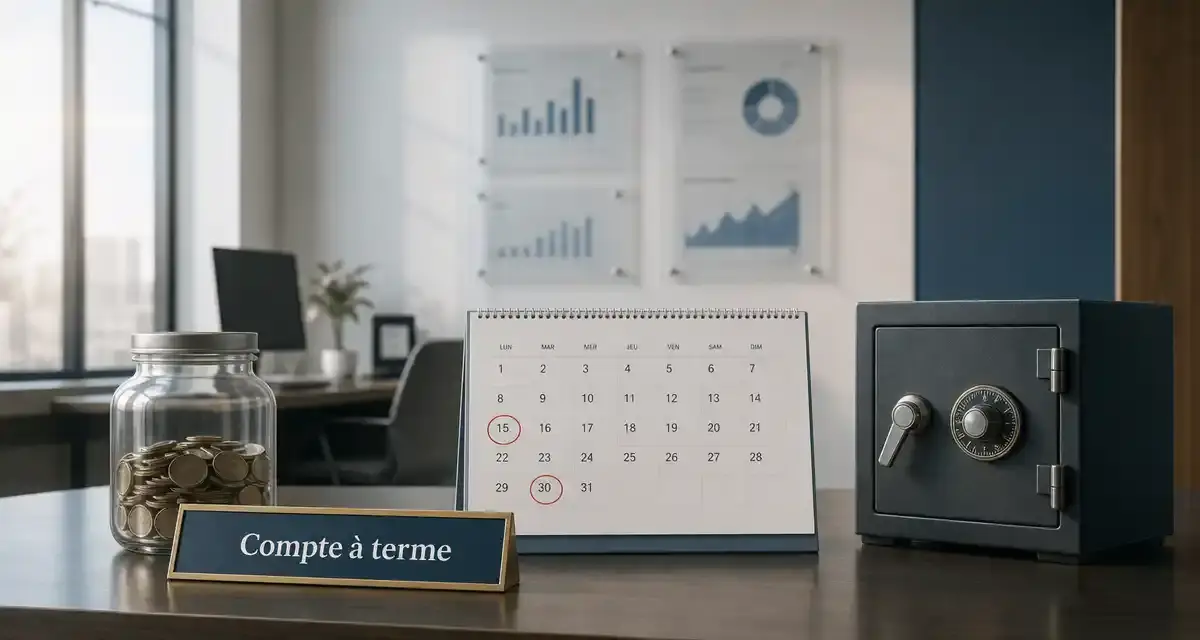

The futures account is a simple bank placement: you entrust an amount to a bank for a specified period in advance, in exchange for a remuneration known or supervised from the start. It is intended primarily for savers who want to secure part of their money without exposing them to markets, provided they accept a central rule: funds are not intended to be used at any time.
The principle: a blocked placement for a chosen duration
A futures account works as a contract between you and the bank. You pay a capital, often at one time, then you leave it locked up until the agreed deadline. This may be short, for example a few months, or longer, depending on the offers available and your project.
The central point remains the Blocking savings. In practice, the money placed should not match your security cash. It is better to keep apart from a reserve readily available for unforeseen events, then use the future account for an amount you already know about the time of use: real estate purchase to prepare, future tax, business project, transmission or waiting before another investment.
One Early withdrawal Sometimes it may be possible, but it usually results in a penalty, a lower rate or a loss of some interest. Before signing, read precisely the conditions of exit: notice period, remuneration in case of break, minimum amount retained and possible costs.
Yield: fixed, progressive or renewable rate
The remuneration of a futures account depends mainly on the duration chosen, the amount placed and the commercial policy of the bank. The longer the money remains immobilized, the more attractive the proposed rate can be, even if it is not automatic. Some offers show fixed rate for the whole duration; other progressive rate, which increases by steps if you keep the placement to the end.
The fixed rate reassures, because you know from the start how much your capital will produce before tax. The progressive rate requires more attention: it may seem attractive, but its real interest depends on your ability to hold to the final deadline. If you go out too early, the performance actually achieved may be much lower than that put forward.
To compare correctly, do not just look at the displayed rate. Check the exact duration, periodicity of payment of interest, minimum opening amount, renewal conditions and availability of customer service. The published comparatives and explanations on this website can also help to put a banking offer in a broader logic of savings, banking and financial products.
| Type of rate | Main asset | Point to be checked |
|---|---|---|
| Fixed | Readable performance at opening | Net rate after tax |
| Progressive | Increasing interest in duration | Early exit performance |
| Renewable | Possibility of placing at maturity | New rate applied to renewal |
Interest tax: reasoning in net return
Interest on a futures account is taxable. In France, they are in principle subject to the single flat-rate levy of 30%, consisting of 12.8% of income tax and 17.2% of social contributions. Depending on your tax situation, the option for the progressive income tax schedule can be explored, especially if your tax bracket is low.
This point greatly changes the reading of an offer. An attractive gross rate may become more ordinary once taxation is applied. To avoid bad surprises, always compare the net return, i.e. what will actually remain after taxes and social contributions. If the interest is paid at maturity, the tax shall take place at the time of collection; if paid periodically, it shall follow the schedule provided by the bank.
The futures account requires a clear decision: the money is locked in and the gain can be estimated in advance. So you choose not only a rate, but a balance between patience, liquidity and net return. This discipline can avoid letting a large amount of money sleep on a current account, without placing too much money on an inaccessible medium at the wrong time.
Benefits, limitations and criteria for choosing
The main benefit of the futures account is its visibility. You know the rules from the opening: duration, rates, capital invested, conditions of remuneration. It is a reassuring support for a prudent savings, especially when the objective is to preserve capital rather than to seek high performance.
Its limit is just as clear: liquidity. If you need flexibility, a regulated booklet or medium available at any time can be more suitable, even with a potentially lower yield. The futures account becomes relevant when you can segment your savings: a pocket available for emergencies, a pocket blocked for a dated goal.
Before choosing, consider these criteria in order:
- Duration : it must correspond to a real horizon, not a simple desire for yield.
- Gross rate and net rate : calculate the gain after tax.
- Release conditions Penalties, notice, loss of interest.
- Minimum amount Some offers require a high entrance ticket.
- Renewal Check if it is automatic and at what rate.
A good futures account is not necessarily the one with the highest rate. It's the one that fits your calendar, your need for security and your ability to immobilize a sum without weakening your daily life.