
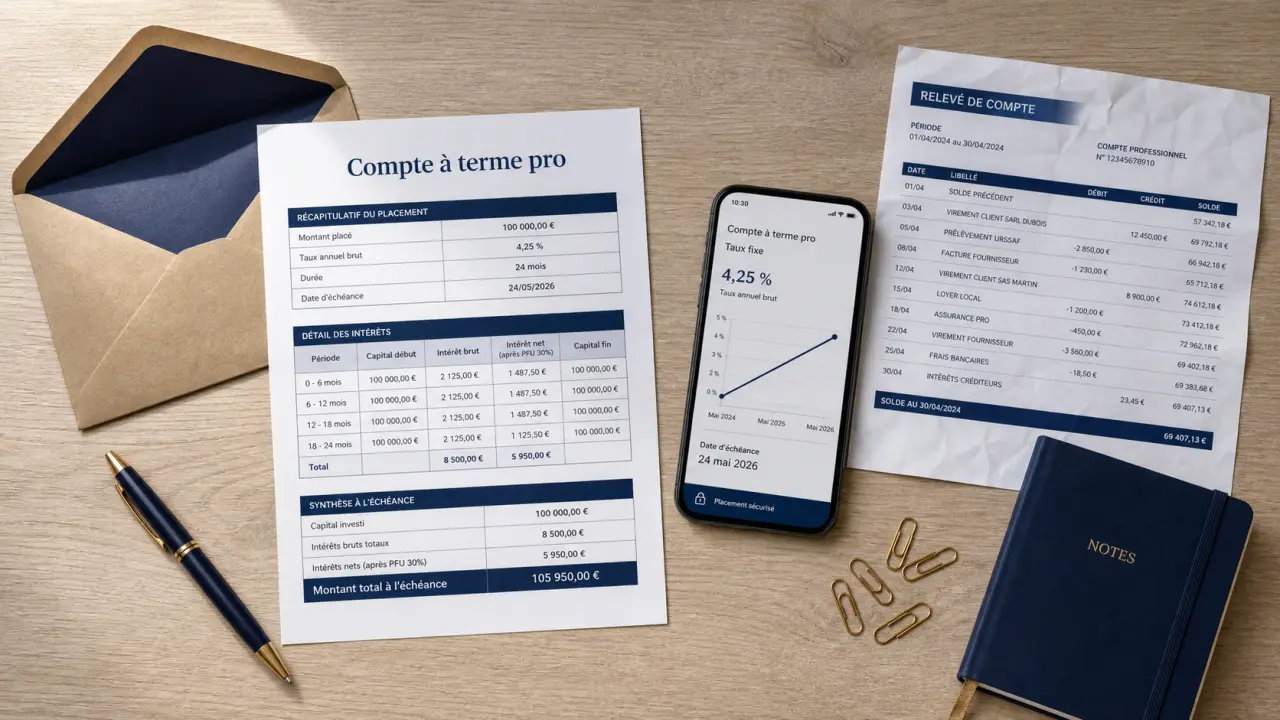

A futures account for business allows to place a surplus cash for a known duration, with a rate fixed in advance and guaranteed capital. This solution is appropriate when money is not to remain in the professional current account without being exposed to financial markets. The point to check is not only the displayed yield: you must also look at the blocking time, the need for liquidity, taxation and the actual business schedule.
The principle of the professional futures account
The professional futures account, also known as term deposit or CAT pro, is based on a simple mechanism: the company carries out a single payment to the subscription, for a defined period with the bank, in exchange for rate of pay known in advance or under contract. At maturity, it recovers its capital and interest in accordance with the terms and conditions laid down.
Gross Return Calculator (Term Account)
Use: Compare easily several offers of futures accounts by entering the same assumptions of capital, rate and duration to estimate the gross return generated.
Educational note: This calculation concerns a fixed-rate futures account. It does not take into account applicable taxation, possible early exit penalties, or progressive or revised rates. The results are provided for information purposes.
Unlike a stock exchange, the CTU does not target maximum performance. It responds to a need for visibility : know how much a fixed sum will earn, without daily volatility. This is why it is of particular interest to companies with a temporary cash flow: tax reserve, investment budget not yet used, cash from a strong trading season or funds to cover several months of expenses.
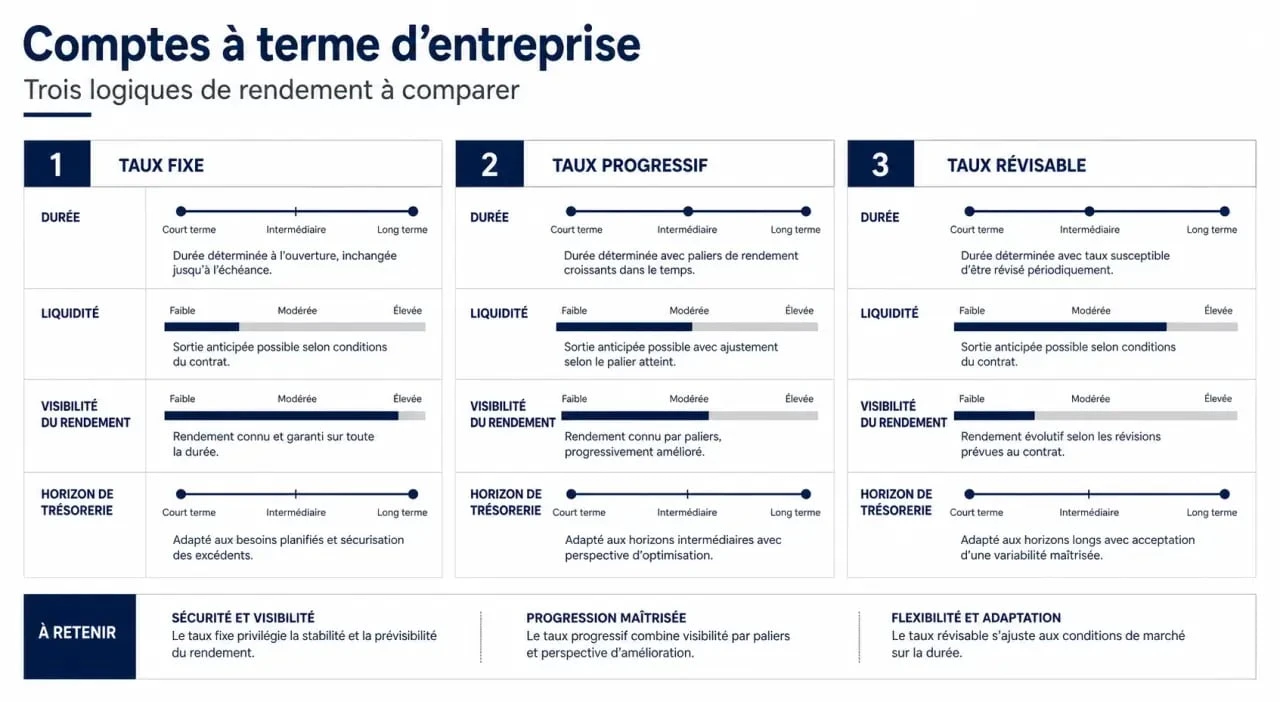
Fixed, progressive or revised rate: three different logics
The fixed rate forward account provides the simplest reading: the actuarial rate is set in advance and remains the same until maturity. The progressive rate increases in increments over time, which generally rewards the preservation of the placement to the end. The revised rate may evolve according to the terms of the contract, which brings more uncertainty, but sometimes also a little more flexibility.
The choice depends on the cash flow scenario. If the company knows that it will not need funds for 12, 24 or 36 months, a fixed or progressive rate can be consistent. If visibility is shorter, it is best to give priority to a reduced duration, or a solution with notice, even accepting a more modest return.
Compare offers: rate, duration, minimum amount and exit conditions
Comparing a business term account does not mean holding only the highest rate. The offer should be read as a set: Minimum amount, ceiling, duration, possible penalties, notice of withdrawal, frequency of payment of interest and conditions of opening. Two CATs with a similar rate can be very different if one imposes 200 000 € and the other 5,000 €.
| Actor or offer | Duration indicated | Gross rate indicated | Amount or material condition |
|---|---|---|---|
| Hamburg Commercial Bank | 2 years to 5 years | 2.40% to 2.85% | Deposits of 5,000 € 100 K€ |
| Younited Credit | 1 to 5 years | 2.30% to 2.80% | Deposits of 2,000 € 100 K€ |
| Direct placement.fr | 1 to 5 years | 1.55% to 2.40% | Deposits of 10,000 € 10 M€ |
| Swaive Pro | 6 months to 5 years | 2.05% to 2.65% | Minimum deposit of 200 K€ |
| Cashbee PRO | 6 months to 5 years | 1.80% to 2.60% | Minimum deposit of 35 K€ 150 K€ |
These benchmarks show an essential point: the best annualised rate, up to 2,85% in Hamburg Commercial Bank example, is not necessarily the best choice for all companies. A TPE that wants to place 20,000 € for six months will not watch the same offers as an SME capable of immobilizing 500 000 € For three years.
Advance offers: a useful flexibility, but to read precisely
Some banks offer term accounts with notice. For example, the CIC indicates a duration of 1 to 60 months and one 32-day notice for withdrawals without penalty on certain offers. The CAT Tempo Pro 3 months on notice has a fixed rate of 2.10% gross with a payment of 1 500 €. CAT Tempo Pro 6 months on notice 2.20% gross, with payment of 5 000 € and a ceiling of 75 000 €.
Progressive formulas may also be of interest to companies that accept longer immobilization. CATIP Pro's 18 months of advance notice displays 2,25% / 2,50% / 2,75%, with payment of 150 €. The interest is to make the remuneration levels coincide with the financial calendar: VAT payment, social maturities, investments or repayment of borrowing.
Benefits, limitations and risks not to be underestimated
The first advantage of the professional futures account is that capital guarantee for the whole duration. For a company, this security counts as much as return: an operating cash is not managed as a speculative portfolio. The second advantage is that readability. The Chief Financial Officer may incorporate the expected interest into his or her forecast, which facilitates the management of cash flow.
Reporting interest on a futures account to taxes · This official slip explains how to report interest earned on a futures account on your annual income tax return.
The CAT also helps to combat the Sleeping cash. An amount left on a business current account usually produces nothing, while a term deposit can generate financial income without management complexity. Openness and monitoring are often done from the banking customer area, with support from the professional advisor.
The main risk: needing funds too soon
The most important limit is liquidity. Early retirement may result in reduced pay, penalties or less favourable conditions. Even where notice exists, it must be included in the cash flow plan: 32 days may seem short, but become long if the company has to settle a strategic supplier or seize an immediate business opportunity.
A futures account must function as an organized investment, not as a sudden blockage. Well used, it helps the company prepare the next step: financing a machine, securing a job, waiting for an acquisition or smoothing a seasonal cycle. For this, it may be wise to split cash in several maturities rather than blocking the entire sum over a single term. This approach leaves a share of funds available in the short term and avoids demobilising any surplus at the same time.
Taxation and net return: looking beyond the gross rate
The rate reported by institutions is generally one of Gross rate. To know the real return, the company has to reason net after taxation. The interest collected is a financial product and is taxed according to the company's tax system: corporation tax for a company subject to the SI, or taxed according to the applicable system where the activity is an income tax.
The flat tax mainly concerns taxation of natural persons; Therefore, it should not be automatically applied to a commercial company. In practice, treatment depends on legal status, the taxation regime and the accounting of financial products. Before placing a large amount, it is preferable to ask the accountant for a net simulation, especially if the company compares a CAT with other cash media.
Simple example of reading performance
A company that places 100 000 € to 2.50% gross for a year can wait 2 500 € gross interest before taxation and any costs. This amount should not be interpreted in isolation: it is necessary to check whether interest is paid at maturity, funded, or served periodically. It is also necessary to compare the gain with the cost of unavailability of funds. If the company risks using an expensive line of credit due to lack of available cash, the investment may lose its economic interest.
Choose the right CAT according to the company profile
The right futures account is not universal. A microenterprise or a young company will mainly seek an accessible entry threshold, a short duration and a simple exit. One SMEs It will be possible to arbitrate between several maturities, particularly if it has a stable cash flow. A more structured company, with several hundred thousand euros available, will be able to compare offers reserved for large deposits, such as those requiring 35 K€, 150 K€ or 200 K€ minimum.
- Precautionary cash flow : focus on short durations, advance offers and availability.
- For a surplus identified over 12 to 24 months : compare fixed rates and deposit ceilings.
- For a long reserve : to study the progressive rates, provided that they can go up to maturity.
- For a large cash flow : negotiate with several institutions and ask for a clear simulation.
Commercial premiums must remain secondary. BoursoBank mentions, for example, a premium of 20 € for a payment of at least 300 €and a maximum premium of 60 € related to credit card transactions over 3 months. These benefits can improve the relationship, but they do not replace the analysis of the rate, duration and withdrawal conditions.
Before subscribing, the most reliable method is to list some cash outflows, to isolate the security reserve, and then to place only the surplus actually immobilisable. Then, compare at least three offers on the same assumptions: amount, duration, gross rate, taxation, exit penalty and time to recover funds. It is this discipline, more than the search for the most spectacular rate, that turns the professional account into a real financial management tool.