

One controlled accounting of a futures account remains essential for every company concerned with securing its management of treasuries without risking a tax anomaly. A simple error in the duration or selection of the account (512, 275, or 276) may distort the balance sheet.
This is why it is better to know when opening how to classify, record interests and ensure impeccable compliance, maximum visibility and quick response when checking or automating via SaaS software.
Several financial officials also say that early vigilance avoids many difficulties at the end of the financial year.
Accounting for a futures account – direct method to avoid error

Why open a futures account (CAT) in business? As soon as a share of cash has to be placed, the question arises immediately: « What account does CAT have to choose, depending on its duration and configuration? » To stay in the nails, it is better to follow the following rule:
If the CAT lasts ≤ 12 months, this is treated as a cash investment: go through the account 512 (Bank). If the duration exceeds 12 months, then it is a financial asset: use the accounts 275/276 (Term deposits/Other investments). This distinction alone avoids the majority of errors observed in small businesses.
The accounting then takes place in three stages: opening, recording of interest, closing of the investment.
The main sources such as Qonto, Propulse or Compta Online show that the writing scheme always depends on the duration of the CAT.
It is regularly recommended to ensure irreproachable compliance, smooth reading of the balance sheet, and increased tax security.
Here is the detailed approach, the practical examples, and immediate access to simulators and an interactive FAQ, as also suggested by the experts who are authoritative online.
| Duration of CAT | Account to be used |
|---|---|
| ≤ 12 months | 512 (Treasurery) |
| > 12 months | 275/276 (Financial mobility) |
What is a futures account? Clear definition for non-accountants
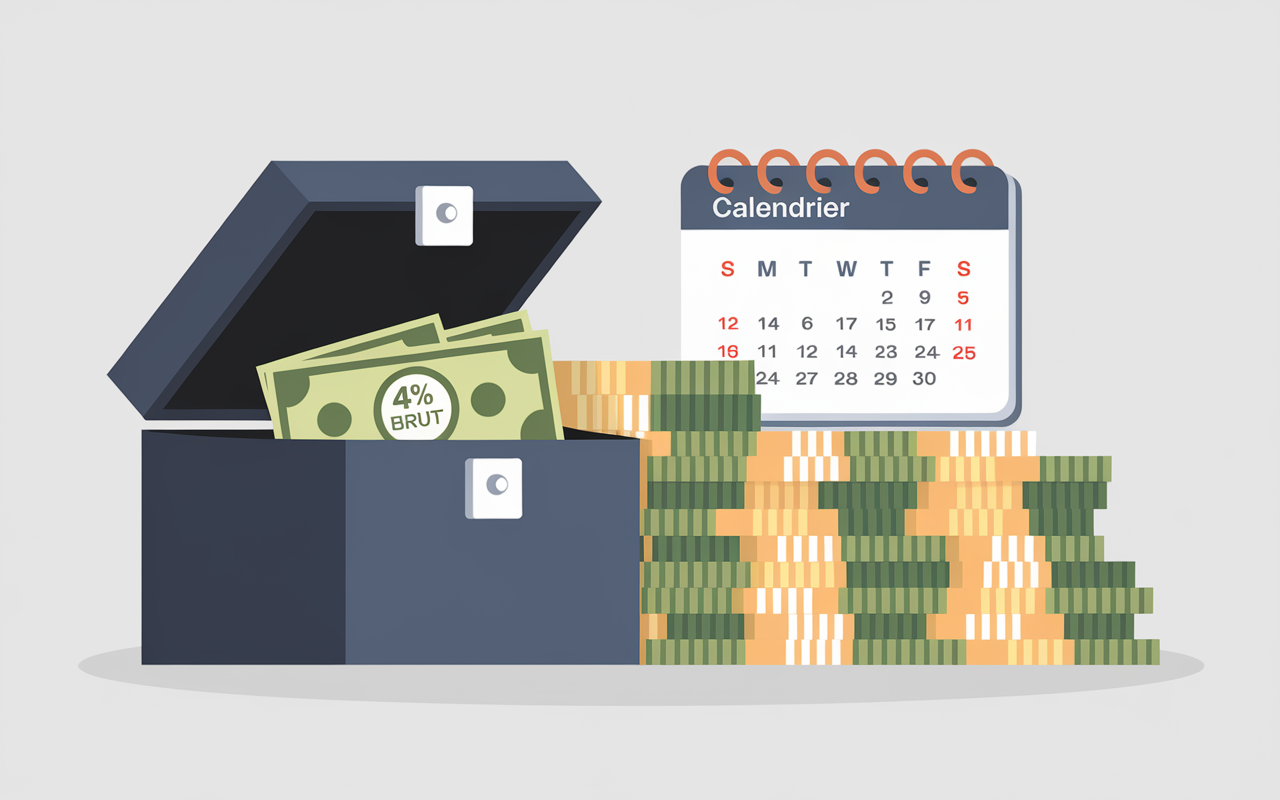
The futures account is a bank investment with a defined maturity, with funds blocked for a fixed duration that can vary between a few weeks and several years.
A contractual rate (up to 4 % gross in 2025 according to available offers), determined at the time of subscription.
The duration greatly modulates the type of management: for a CAT of one year or less, you remain relatively liquid, as on a booklet.
Beyond that, the placement is immobilized, so more rigid.
A management trainer notes that "the majority of TPEs prefer CATs from 3 to 6 months to avoid immobilizing their cash flow".
Traditional remunerations announce between 2,1 % and 4 % gross, depending on the bank and the amount invested.
Moreover, the FGDR protects up to 100 000 € per holder on this type of account.
We sometimes ask, "Is this a risky investment?"
In concrete terms, no, but a bad imputation is enough to distort the balance sheet.
One head of Propulse recalls that the real risk often lies in poorly informed accounting writing.
CAT: short term or long term?
The difference between short-term and long-term CAT is based on the blocking period, but also on the possibility of recovering the funds at no cost.
Some practical benchmarks:
- CAT ≤ 12 months: Cash placement (account 512), very accessible.
- CAT > 12 months: investment in financial capital (275/276), less flexible.
Another point to be monitored: some banking institutions adapt the conditions of refund according to the contractual duration.
Vigilance on these clauses can reduce errors in recording.
A simple omission of reclassification can cause a problem on the balance sheet, so it is better to include the due date in its calendar.
Good to know
I recommend that you systematically include the due date of the WCB in your calendar to avoid any reclassification oversight that might distort the balance sheet.
Short-term CAT accounting: precise methodology and example
CATs less than one year of age concern about between 55 and 65 per cent investments in TPE/SME (source Qonto).
This type of financial product remains "liquid" and is placed in cash.
When opening: a transfer from the current account (512) to the futures account, usually in a dedicated sub-account (like 512-xx).
To illustrate: 100,000 € Over 6 months at 3%, here is the classic accounting writing:
- Flow rate 512-xx (CAT): 100 000 € transferred
- Vote 512 (Current bank): 100 000 € Out
There is no need to create a capital account for an investment of less than 12 months.
The profit: simplifying transactions and avoiding unnecessary reclassifications, what one accountant regularly highlights as a productivity trick.
Some people question the location of the movements.
In most software (Qonto, Indy), the transfer from 512 to the CAT sub-account is enough: the category is automatically detected.
Assess interests periodically
Each quarter, or at maturity, it is better to record the interest generated.
Example per 100,000 € 3 per cent over 6 months: 1,500 € interest to be noted.
- Debit 512 (Bank): 1,500 € added
- Vote 768 (Other financial products): 1,500 € registered
Interest may be paid either at the close or over the quarters.
Some software automatically warns you when an interest is recorded convenient to avoid forgetfulness, especially during the closing period.
Long-term CAT accounting: the reflex to avoid the wrong class
When the investment lasts more than one year, it is a "financial asset".
We note that this is where the majority of errors occur in TPE, according to Compta Online.
At opening: it is better to transfer the amount to a capital account (275 "term deposits" or 276 "other investments").
To take the example of Propulse: 200,000 € over 2 years at 4%, i.e. 6 000 € interest over 9 months.
- Debit 275 (Term deposits)200 000 € affected
- Credit 512 (Bank)200 000 € disbursements
Do not use 512 over the entire duration; only the release or closing of funds will bring cash back.
Confusion with VMP (50x account) can lead to a significant error on the balance sheet.
A long-term CAT is never classified as a VMP unless there is an exception (variable rate, duration ≤ 3 months or immediate liquidity).
Closure and reclassification of the long-term CAT
When the investment comes to an end, it is necessary to return the money in treorerie, accompanied by the interest generated.
- Debit 512 (Bank)200 000 € + displaced interests
- Vote 275 (CAT) : 200 000 €, Credit 768 (Interest) by total
For interest not paid at the time of closing, the "cut-off" method requires that the amount be linked to the corresponding fiscal year.
An accountant regularly specifies that interest must be recorded even if the payment only occurs after the contract has been closed.
This may be confusing, but it is the legal rule.
Interest treatment and closure: regulatory security and impact on balance sheet
Interest management remains the number one watchdog point for TPEs and SMEs, especially when switching from one exercise to another.
Interest should be recorded as soon as its amount is defined, even if payment is made later.
According to Indy, the automated contract rate verification tool also avoids any risk of error.
Out of 100,000 € placed 6 months at 3% (e.g. Qonto), 1 500 € products must be recorded in the relevant financial year as shown on the balance sheet assets.
For a long term CAT type Propulse (200 000 € on 2 years, 6 000 € 9 month interest), same logic: connection over the period, entry in account 768.
For the impact on the balance sheet: cash initially declines, fixed or investment assets progress, and interest reinforces off-farm earnings according to the recording method.
Some professionals also report that this simple mechanics protects legibility and compliance.
In practice, each CAT movement must remain legible to avoid compliance concerns.
It can be assumed that the pointy organization, especially in SaaS software, saves time and a lot of serenity.
Special case: interest paid at end of period or early withdrawal
A withdrawal in advance of the expected date may result in a penalty, to be reported as a financial expense (account 6688). Example:
- Debit 6688 (CAT Penalty): amount of penalty
- Credit 512 (Bank): same amount
It should be noted that the penalty depends on the institution, sometimes until 1 % amount.
Consider mentioning this cost on the profit and loss account.
A trainer points out that, at the slightest doubt, contact with an accountant remains a prudent and reassuring option.
Case Management and Frequent Errors: Quick Check and Correction
Among the most common blunders: misclassify the long-term CAT into VMP (50x account), or omit to switch interest into cut-off at closing.
The option is to reclassify the CAT according to the correct duration, applying a clear writing scheme.
SaaS (Qonto, Indy) tools integrate automatic categorization and multi-CAT management with sub-accounts adapted to each situation.
Recently, an SME has allowed an extended CAT to pass without reclassification, which has distorted the closing balance sheet.
Thanks to Indy, the anomaly was corrected in a few moments thanks to the expert chat and the automated board.
An external audit usually recommends that investments be checked four times a year, especially at each closing and when tax year changes this board seems obvious, but it is regularly overlooked in the heat of action.
Practical tools and guides to automate your CAT writings
In 2025, a large majority of TPE/SME rely on a dedicated simulator (Qonto, Propulse), writing dashboards (downloadable models), and the integrated expert chat.
Satisfaction rates (Qonto 4,8/5 on Trustpilot, Propulse 4,5/5 on Google) attest to the seriousness and support provided by these solutions.
Another point is that each CAT investment can be tracked using a dynamic table, a specialized FAQ (multi-account management or independent investment), and automated in SaaS.
A checklist or file to download makes it impossible to forget a script when closing.
Some professionals admit that the use of PDF guides has simplified their multi-contract management.
You don't find the right model? Keobiz or Propulse PDF guides are free and suitable for use: short term CAT, long term, multi-contract or annual reclassification.
Finally, efficiency is generally increased with these resources, even for non-accountants.
| Tool | Utility |
|---|---|
| CAT simulator | Automatic calculation of interest |
| Interactive FAQ | Custom responses in real time |
| PDF Guides | Writing templates ready to copy for specific cases |
| SaaS dashboard | Multi-location monitoring, notifications and audit |
Little rhetorical question: have you thought about downloading your CAT guide? If it's not done, it's better to get it back and never hesitate about writing to use again.
Dynamic FAQ: 10 immediate answers to the most common futures questions
Below are the answers to common dilemmas recommended by recognized experts:
What's my short-term CAT gonna do?
For an investment ≤ 12 months, choose the 512 account (treasurery) or its dedicated sub-account if necessary.
What about a long-term CAT?
When the term exceeds one year, choose 275 (term deposits) or 276 (other investments).
You never pass the money into direct cash.
CAT = VMP?
No, with exception (immediate liquidity, duration ≤ 3 months). The majority of CTUs are out of VMP a Qonto manager reminds him during training.
How to record interest?
Debit 512 (Bank) and credit 768 (Interest income) based on the calculated amount (e.g.: 1 500 € per 100,000 € placed in 3 % 6 months).
What to do in case of early closure?
Note the financial penalty (6688), transfer to 512 and statement on the profit and loss account.
This seems to be the most recommended method.
Impacts on the balance sheet?
Declining cash on opening, capital assets or investments are increasing, the financial product feeds the result at closing.
One accountant mentioned that these transactions protect the balance sheet from anomalies.
Automation possible?
Yes, thanks to the main SaaS software and downloadable PDF guides, depending on your activity.
Protection in case of bank default?
The FGDR 100 000 € per holder and per establishment for each CAT (ACRA regulatory protection).
Interest related taxation?
Interest taxable on IS or IR depending on the company: the taxable basis is detected at cut-off by the software used.
How to correct a CAT rating error?
It is recommended that the CAT be reclassified according to the opening/closing steps, the assistance of the expert-accounting chat or the automated FAQ, and the verification via writing board and audit notification.
What to remember: It is best to choose the right account (512 or 275/276) depending on the duration, control interest and penalties during cut-off, automate or consult an expert in case of uncertainty this approach secures your investments and protects your balance sheet.