
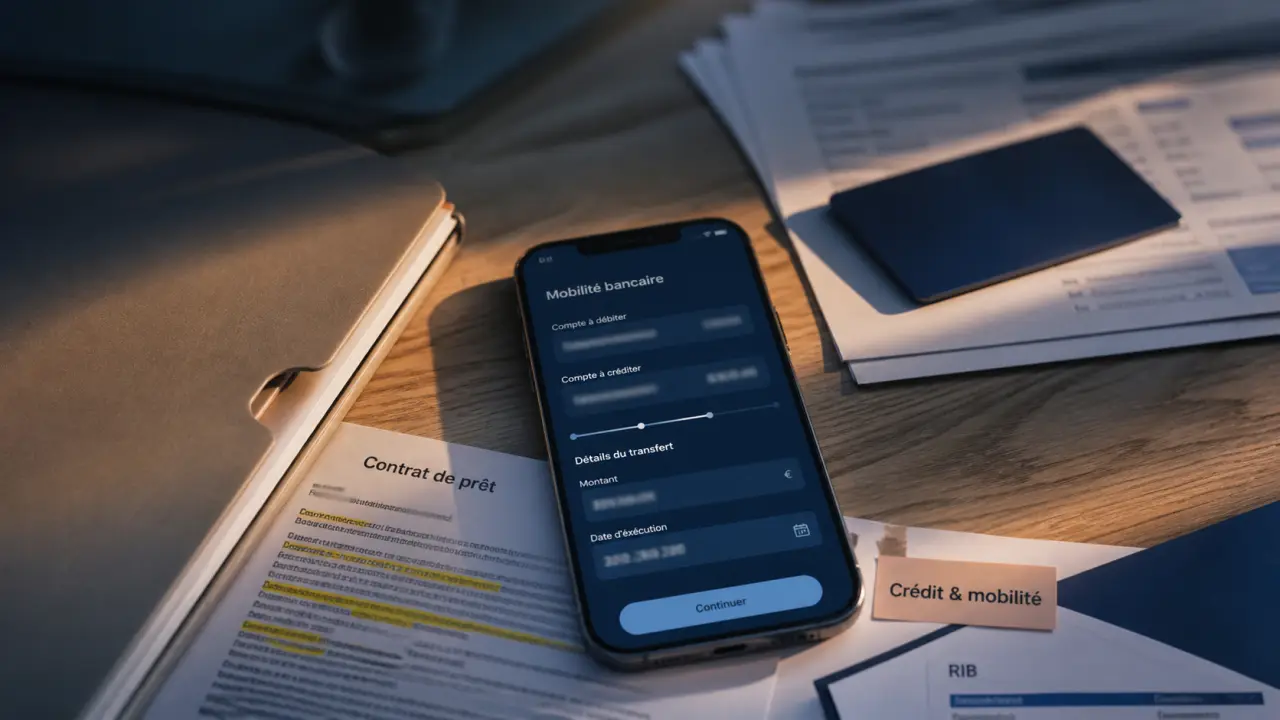

Yes, you can change bank even with an ongoing credit. The decisive point is not the opening of the new account, but what becomes of the loan: it can stay in the old bank, be redeemed, or be repaid in advance according to your contract and the financial interest of the transaction.
What you can change, and what does not follow automatically
Bank mobility has made the current account change much simpler. Since the Macron Act, which came into force in February 2017, your new bank can handle a large part of the process through the bank mobility mandate. She contacts the old bank, retrieves the list of recurring transfers and levies, and then informs the organisations concerned of your new bank details.
Impact calculator of a credit buyback
This result is indicative and depends on the exact conditions of your contract (IRA, insurance, ancillary costs).
Current loan
New project
Simulation results
Current monthly payments:
New monthly payment:
Current total cost:
New total cost:
This service mainly concerns the deposit account, with wages, subscriptions, taxes, energy, insurance, allowances or telephone operator. The general deadline is 22 working days to organize the transfer of recurring operations. Several million French have already used this banking mobility service.
Credit is not transferred as a levy
The often misunderstood point is simple: a Real estate loan, a personal loan or auto credit does not automatically transfer to the new bank. The credit agreement remains with the lending institution that granted you the funds. Change of bank therefore does not change your creditor.
In practice, you can very well open a new account elsewhere and keep the credit refund in the old bank. It will only be necessary to ensure that the monthly payment is always properly deducted, either from an account maintained in the old bank or, after agreement, from your new account.
The banking home, the point to read before leaving
Before any steps, review your loan offer and its special conditions. Some contracts provide for bank domicile clause, i.e. the obligation to pay your income to the bank account that granted the loan. This clause has often been used for real estate loans, especially when a preferential rate was granted in return.
Understanding banking mobility to change banks easily · Find out how bank mobility support simplifies bank change and what steps are being taken.
The order of 1 June 2017 and the framework applicable on 1 January 2018 reinforced the attention paid to these clauses. The general idea is that a residence requirement must be clearly foreseen and associated with a individualised advantage. If the clause is unclear, disproportionate or without identifiable consideration, it may be challenged. In case of doubt, ask your bank for a written explanation or have a professional review of the contract.
Leaving without checking can expose you to costs
If you stop paying your income when the contract makes it clear to you, the bank may consider you no longer complying with the terms of the loan. Depending on the clauses, this may result in loss of a tariff advantage, unfavourable renegotiation or fees. The risk is not automatic, but it deserves to be anticipated.
It is best to write to your advisor before the change to ask if the monthly payment can be made from your new account. This written trace limits misunderstandings and allows you to compare options without pressure.
Three possible scenarios to manage the current loan
The right choice depends on your goal: reduce your bank charges, get a better service, group your credits or enjoy a more interesting rate. Here are the main options to compare before changing banks with an ongoing loan.
| Option | Principle | To be monitored |
|---|---|---|
| Keep credit in the old bank | You open a new account elsewhere, but the loan remains repaid to the original institution. | Accountancy fees, domiciliation clause, sufficient monthly transfer. |
| Purchase credit | The new bank reimburses the old loan and offers you a new contract. | New rate, file fees, guarantee, borrower insurance, possible compensation. |
| Advance reimbursement | You pay the remaining capital due before closing the banking relationship. | Advance repayment allowances, cash available, loss of security savings. |
Keeping credit, often the simplest solution
This solution is suitable if your loan is already advantageous or if its outstanding capital is low. You keep a minimum account in the old bank for monthly debiting, then use your new bank for current transactions. The disadvantage is to keep two banking relationships, sometimes with account or card fees if you do not simplify your services.
Consider removing unnecessary means of payment in the old bank, such as credit card, authorized overdraft, account insurance or monthly packages. An account dedicated to the repayment of the loan alone may limit costs and omissions.
Purchase the loan, useful if the economy compensates the costs
The repurchase of credit requires the new bank to take over the existing loan. It's relevant if you get better terms: lower rates, cheaper borrower insurance, adjusted monthly payments or a combination of several credits. But the transaction must be calculated because it can generate costs: file, guarantee, new insurance, and sometimes advance reimbursement allowances, also called IRA.
A good comparison is not limited to the rate displayed. It must integrate the Total cost the new financing, the remaining duration, the amount of monthly payments, insurance and ancillary costs. A buyback may be interesting on a long, but not useful, real estate loan if the credit is coming to an end soon.
Before deciding, also look at the indirect effects. A lower monthly payment may relieve your budget, but a longer duration may increase the overall cost. Conversely, shorter redemption may be more demanding each month, while limiting interest paid. The correct calculation is to compare the remainder to be paid in each scenario, not only the decrease displayed on the monthly payment.
Practical steps to change without payment incident
Change must be organized in the right order. The classic error is to close the old account too quickly while a credit levy, undebited cheque or deferred payment remains in circulation. With an ongoing loan, prudence consists of working double for a few weeks.
- Review your loan contract : Identify the residence, the conditions for early repayment and the method of levying.
- Open the new account Wait until you have your RIB, your access and your active means of payment.
- Sign the bank mobility mandate If you want the new bank to transfer your recurring transactions.
- Notify the old bank for credit Ask if the monthly payment can be deducted from the new account or if an account should be kept.
- Maintain sufficient provision on the old account until confirmation of the proper operation of the levies.
- Close unnecessary services only card, package, overdraft, pay alerts, ancillary insurance.
Use a simulator before deciding
Before getting a credit purchased, use a simulator or ask for two written calculations: one scenario with the loan maintained in the old bank, another with the new one bought. Compare the remaining total cost, not just monthly. A lower monthly payment may seem attractive, but if the duration increases sharply, the overall cost may increase.
For a real estate loan, it is also useful to compare the borrower insurance. An insurance economy can sometimes make a change more attractive, even if the credit rate does not fall sharply.
Traps to avoid before signing with the new bank
Changing establishment can be an excellent decision, but only if the operation simplifies your situation instead of fragmenting it. The first trap is to accept an attractive banking offer without checking the fate of the existing credit. The second is to neglect the Invisible fresh Residual account maintenance, permanent transfer, file fees, guarantee fees or IRA.
- Never close the old account until the credit is secured.
- Ask for a written confirmation if the bank accepts a debit from an external account.
- Check to see if home income conditions a rate advantage.
- Compare the total cost of a purchase, including insurance.
- Keep a record of transactions transferred during the period of bank mobility.
The best approach is to separate two decisions. On the one hand, choose the bank best suited to your daily life. On the other hand, decide whether your credit should stay where it is, be renegotiated or be redeemed. This distinction avoids an imposed solution and leaves you with a real margin of negotiation with both institutions. In many cases, simply announcing a departure causes the old bank to review certain fees or propose a commercial adjustment.
In short, you don't have to repay your loan to change your bank. Above all, you must secure the continuity of monthly payments, check the terms of the contract and encrypt the alternatives. Once these points are clarified, the change becomes a manageable operation rather than an administrative puzzle.