


The death of a relative imposes a heavy administrative burden. For pensioners' families, the issue of the payment of death capital by social security is a recurring one. While this scheme is well known to active employees, its application to former workers meets strict temporal requirements. Understanding these mechanisms makes it possible to anticipate immediate financial needs, such as funeral expenses, while avoiding unnecessary steps with Sickness Insurance.
Retention of law: the condition for the retiree
The death capital of social security is not a lifetime universal benefit. In order for a pensioner to be paid up on the death of a pensioner, the pensioner must meet the following criteria: Maintenance of rights at the time of his departure from working life.
The critical three-month delay
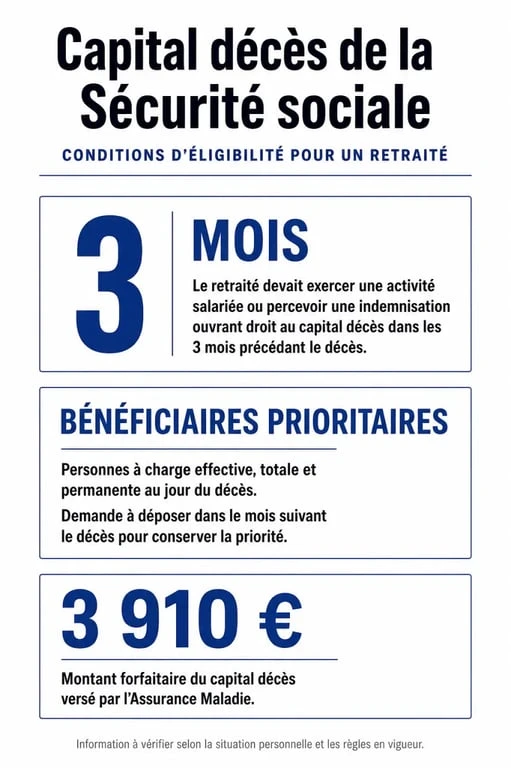
Sickness insurance pays the death capital if the deceased has died in three months after retirement. During this period, Social Security considers that the insured person still benefits from the coverage linked to his former salaried activity. After this 90-day period, the right to death capital is extinguished in favour of other schemes, such as reversion pension.
Exceptions: Disability and Annuity AT/MP
If the pensioner was holder, prior to his departure, of invalidity pension or an occupational injury (AT) or illness (MP) pension with an incapacity rate of at least 66.66%, the death capital remains accessible. In this case, social protection extends beyond the framework of active wage earners, providing a safety net for heirs.
Who are the beneficiaries and how is priority established?
The payment of death capital does not follow the traditional rules of notarial succession. Social Security has a specific priority to ensure that funds support those who were financially dependent on the deceased.
Official death capital application form · Access the administrative form required to claim the death capital payment following the loss of a close employee or official.
This order of priority helps Sickness Insurance to direct funds to people whose balance of life is most threatened by the disappearance of the pensioner. This approach focuses on the immediate need for heritage law, transforming financial assistance into a tool for Social stabilisation For the loved ones.
Beneficiaries « priorities »
Priority is given to those persons who were, on the day of death, at the actual, total and permanent load the pensioner. The order is as follows: the surviving spouse or ACAP partner, the children if no spouse is present, and the ascendants if no spouse or child is present.
These beneficiaries have one month period from death to assert their priority. After this period, the law persists, but priority disappears to the benefit of other potential beneficiaries.
Non-priority beneficiaries
If no person was actually dependent on the pensioner, or if the priority beneficiaries did not apply within the time limit, the capital may be paid to the non-priority beneficiaries. The order remains the same, but payment is no longer conditional on financial dependence. The two years to file with the CPAM.
Amount and method of payment
The calculation of the death capital is fixed. It no longer depends on the deceased's last salary, which simplifies readability for families, although the amount remains modest in the face of actual expenses.
| Status of deceased retired | Lump sum | Estimated payment period |
|---|---|---|
| Retired less than 3 months | 3 910 € | 2 to 4 weeks |
| Disability pensioner | 3 910 € | Variable |
| Holder of an AT/MP pension (>66%) | Variable | Specific treatment |
This capital is exempt from inheritance duties and is not subject to income tax. It is a net aid paid directly to the applicant's account, without notarial intervention, facilitating the settlement of urgent invoices related to the funeral.
The procedure for obtaining payment
Payment is not automatic. The relatives must make an active request to release the funds.
1. Gathering evidence
CPAM requires a complete file including: S3180 the original death certificate, a photocopy of your identity document, your BIR, any document proving the connection with the deceased (family book, birth certificate, CAPS contract) and, for priority, a certificate of honour of financial dependence.
2. Send Folder
Send the application to the Primary Sickness Insurance Fund (CPAM) on which the pensioner depended. If the deceased fell under the agricultural regime, contact the MSA. The recommended shipment with acknowledgement of receipt is advised to retain proof of the filing date, especially to meet the priority period of one month.
Alternatives to the death of social security
The majority of pensioners who have left work for more than three months are no longer covered by the death capital of the Social Security. However, other schemes provide financial support.
Reversion retreat
Unlike the death capital which is a single payment, the Reversion pension is a lasting help. It allows the surviving spouse to receive part of the deceased's pension, under age conditions (usually 55 years) and sometimes with resources depending on the plan. This aid can represent large sums over the long term.
Death insurance and funeral contracts
Many retirees have private insurance contracts. These insurances guarantee the payment of capital to the designated beneficiaries, without condition of delay after retirement. Before proceeding with the CPAM, check the deceased's documents or interview his bank: a death insurance contract is often signed to cover these costs.
Aid from supplementary funds
Seek the mutual health of the deceased. Many contracts include: funeral allowance or death capital. Supplementary pension funds also have social welfare funds to help modest families cover funeral expenses, even if the social security conditions are no longer met.