
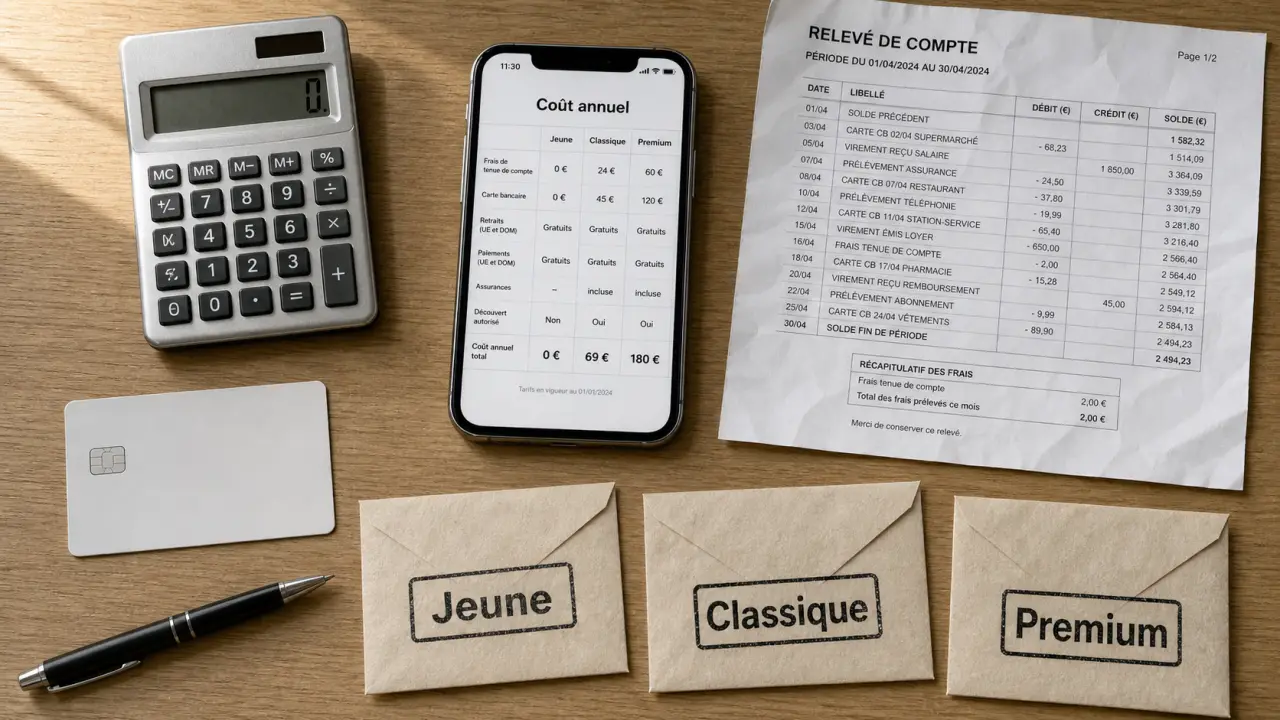

The cheapest bank depends mainly on your use. A customer who pays his card, makes a few transfers and stays in a simple frame will not see the same bill as a young person, a traveller, a professional or a person who is often short. To compare correctly, one must look at the actual annual cost, services included and charges that arise only in the event of a particular incident or use.
The ranking to be looked at as a priority: the annual cost per profile
The online banks The lowest cost comparisons clearly dominate. For a Classic profileMoneyVox reports a possible annual savings of 246 € by choosing a better placed bank. The gap quickly becomes visible as soon as the account is used for day-to-day transactions: bank cards, debits, transfers, withdrawals and some one-time incidents.
Easily compare official bank rates · Consult the public comparator to identify and compare the bank charges charged by institutions in your department.
| Profile | Banks or charges recorded | What to remember |
|---|---|---|
| Classic | 2.78 € Annual fee at BoursoBank and Fortuneo | Very competitive for simple daily use |
| Classic | 91.26 € Hello bank | More expensive than leaders, but often lower than some traditional banks |
| Classic | 130.70 € at Crédit Cooperative | Comparison with services, support and desired values |
| Young | 0 € at Fortuneo, BoursoBank, Revolut and Sumeria | Free is possible if use remains under the conditions provided |
| Young | 50 cents at Bunq | Almost zero cost, to be checked according to selected options |
These figures show a clear trend: the cheapest bank is often an online bank, but the result depends on the profile. BoursoBank is regularly presented as the cheapest bank since 17-18 years, with average annual bank charges announced around 10 €. Fortuneo is also one of the most competitive establishments, especially for classic and young profiles.
Why the displayed price is not enough
A bank account may seem free, and then become paid as soon as it leaves the framework: unused card, overdraft, non-euro area payment, debit rejection, newsletter or default activated option. Therefore, the useful comparison is to add up the recurring costs and the likely occasional costs. This total gives a fair picture of the banking budget over the year.
The fees to check before choosing
Before opening an account, look at the account fees, card prices, withdrawals, foreign payments, intervention fees, agios and rejection fees. Instant transfers have long deserved special attention, but since the 9 January 2025They are free in all French banks. Comparison is still useful, as differences persist on other tariff lines.
We also need to check the free conditions. Some free cards require a minimum number of payments, income level, stock or regular use. If these conditions are not met, the cheapest bank on paper may lose its interest. The right reflex is to read the prices with its own rate of consumption, not with a theoretical profile.
Weight of small fresh
A bank rate works like a set of coins that add up. A free card, an authorized overdraft, an SMS alert, an off-grid withdrawal and an operation abroad appear separate, but they make the same bill. A single frequent use can increase the total cost. That's why a serious comparison is not limited to the "bank card" line, it also reconstructs the costs that come back according to your habits.
Online banking, neobank or traditional banking: which is really cheaper?
The online banks are generally cheaper, as they have fewer physical agencies and more automation of current operations. They are suitable for stand-alone customers, comfortable with a mobile app and don't need to meet a counsellor often. In standard use, they often offer the best balance between prices and services.
The neobanks are often attractive to young people, travellers or people who want a simple and fast-to-use account. However, they do not always offer all the services of a complete bank: checkbook, credit, overdraft, savings products or heritage accompaniment may be missing or limited. Their interest therefore depends a lot on your actual use.
The traditional banks often stay more expensive on annual fees, but they can keep an interest for those who want an identified advisor, a local agency, a follow-up for a real estate credit, a complex property situation or a professional activity. The Panorabank Study of January 2024 indicated 225.20 € average bank charges in France. This level explains why many clients compare and plan to change.
Adapt choice to your real situation
The right reflex is to define your profile before looking at a ranking. Otherwise, you may choose a bank that is very well placed on paper, but not well suited to your daily use. The good comparison starts with your actual operations, not with the most visible offer.
Classic profile: aim for simplicity and low fixed costs
If you have a monthly salary, a few levies, a bank card, little overdraft and few transactions abroad, the cheapest banks are often the most relevant. In this case, the 2.78 € annual fees observed at BoursoBank and Fortuneo for a classic profile are a strong landmark. The essential is to keep low fixed charges and not to pay for unused services.
Young profile: free is realistic, but not automatic
For a student or an active young person, several actors descend to 0 € annual fees, including Fortuneo, BoursoBank, Revolut and Sumeria. The focus is on ceilings, withdrawals, foreign operations and absent services. A free offer can be very suitable to start with, but it becomes less convenient if you need an overdraft, credit or more complete accompaniment.
Premium, family or professional profile: compare beyond current account
A premium profile must include card insurance, ceilings, non-euro area payments and quality of customer service. A family will instead look at the accounts together, the additional cards and the costs of incident. A professional will have to check the fees, means of cashing, transfers, accounting access and the cost of associated services. For these profiles, the cheapest bank is not necessarily the one that displays 0 €, but the one which limits recurrent ancillary costs.
The right tools to find your cheapest bank
The most reliable is to use a comparator that allows to customize usages: number of withdrawals, type of card, overdraft, payments abroad, need agency or not. The public comparison of bank rates covers 150 establishmentseither 98 % of the market. It is a solid basis for checking official rates and comparing several offers on a single reading grid.
You can also use private comparators to get a more convenient reading of offers. However, keep a simple method: first compare the total annual cost, then read the conditions. A ranking does not replace your personal case. Before opening an account, check for inactivity charges, withdrawals, agios, intervention fees and foreign tariffs. It is often these lines that make the difference over a full year.
- List your actual uses over the last three months: card, withdrawals, transfers, overdraft, foreign.
- Compare at least three banks : an online bank, a neobank and your current bank.
- Calculate the annual cost, not just the price of the card.
- Check Free Terms Before you commit.
- Use banking mobility to make it easier to transfer recurring levies and transfers.
Changing banks is therefore not just a question of price displayed. It is a concrete decision: to reduce costs, to keep the services useful and to avoid bad surprises. For many profiles, BoursoBank, Fortuneo, Revolut or Sumeria can significantly reduce the bill. But the best bank is the one whose rate grid matches your actual usage, not a theoretical profile.