
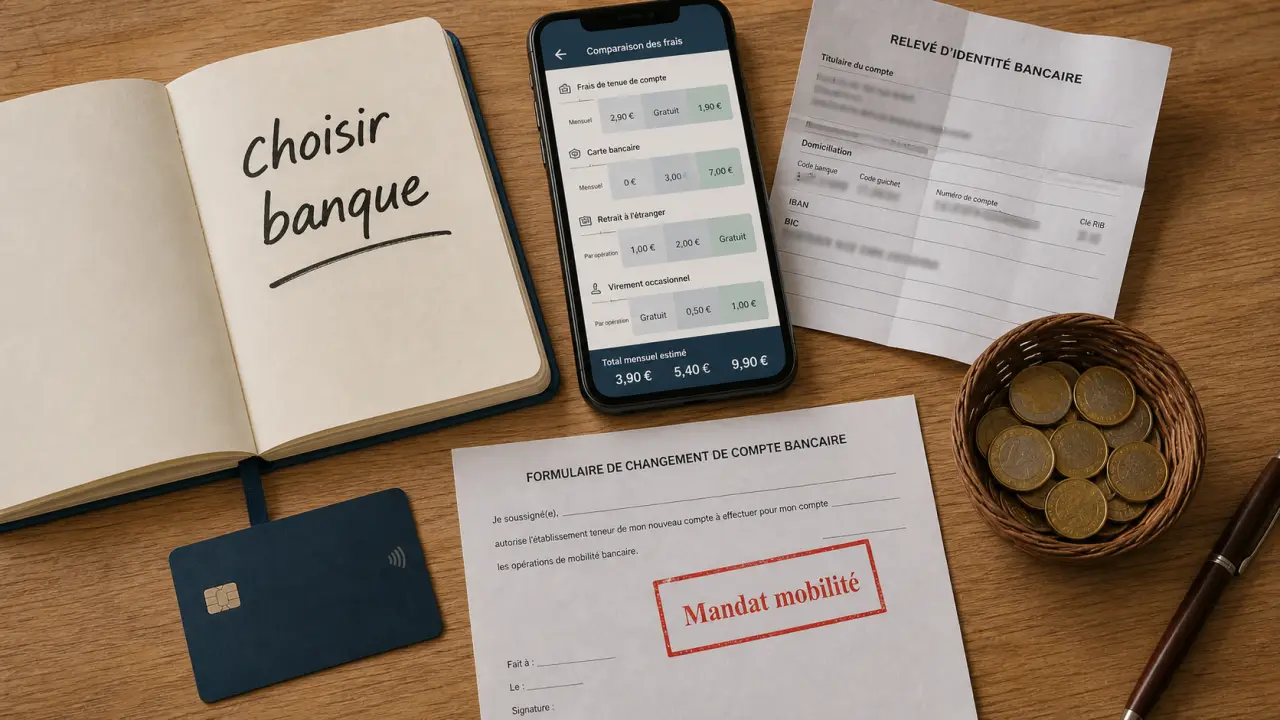

Changing banks is nothing unusual. If you wonder I want to change bank, which one to choose, the answer depends mainly on your current costs, how you manage your money and the projects you are planning.
The right choice is not the most visible bank, but the one that will cost you less, will remain simple to use and will follow your situation over time. To compare without dispersing, it is better to move forward with method.
Start by identifying the real reason for change
Before looking at the offers, clarify what is no longer right for you. The most frequent reasons revolve around rates, quality of service and moving, which represent about 60 % reasons for change. This step avoids signing elsewhere for a welcome bonus and then finding the same difficulties a few months later.
Everything about the free banking mobility service · Find out how to change banks easily with the bank mobility support service that supports all your administrative processes.
If your bank charges seem too high
Start by looking at your actual expenses over the last 12 months: account keeping, credit card, intervention commissions, off-grid withdrawals, instant transfers, foreign fees. An online bank can be very advantageous if you are autonomous and use little overdraft. On the other hand, if you need support for a credit or for a more complex situation, a traditional bank can remain more suitable despite a higher cost.
If customer service no longer works for you
A low rate does not always compensate for a bad experience. Response times, availability of counselor, quality of application, ease of opposition or change of ceiling, all count in daily life. If you don't support the phone, prefer a bank with effective secure messaging, responsive chat or wide contact slots. If you prefer face-to-face exchanges, the presence of an agency remains an important criterion.
If your personal situation has changed
A move, a couple, the arrival of a child, an independent passage or a real estate project can make your current bank less relevant. An offer suitable for a student does not necessarily meet the needs of a family with joint account, borrower insurance and scheduled savings. It is often at the time of a new project that change becomes the most useful.
Online bank, traditional or mutualist: which bank to choose according to your profile?
The real choice is not between « old » and « Modern ». It depends on the level of autonomy you want, the services you need and the banking relationship you expect. Banque en ligne, traditional bank or mutual bank each may be relevant, depending on your use.
| Profile | Often adapted option | Point to be checked |
|---|---|---|
| Young self-employed | Banque en ligne | Income conditions, card, fees abroad |
| Family with projects | Traditional or mutual bank | Real estate credit, joint account, insurance |
| Client often out of print | Bank with clear accompaniment | Agios, commissions, overdraft authorization |
| Regular traveler | Online bank or international offer | Payments and withdrawals outside the euro area |
| Senior or person not comfortable with digital | Bank with agency | Proximity, dedicated advisor, assistance |
Online banking to reduce costs and gain autonomy
Online banks attract ratestheir often cheaper maps and fluid applications. They are suitable for clients who consult their mobile accounts, make their own transfers and do not need an agency appointment. However, check the conditions of use of the card, the ceilings, the fees in case of inactivity and the quality of customer service. A very competitive offer on the current account can be less interesting if you travel often or if you use a lot of ancillary services.
The traditional bank for accompaniment and complex projects
A bank with agency keeps an interest if you want an identified contact person, especially for a real estate credit, renegotiation, succession, atypical employment status or heritage management. She can also reassure if you deposit cheques regularly or if you prefer to talk to someone face to face. The right reflex is to compare the tariff brochure with the services actually used, not with those you might ever use.
To choose with clarity, look at your bank on three simple lines: visible cost, daily comfort and future flexibility. The visible cost corresponds to the costs that appear on the statement. Everyday comfort is a clear application, a reactive advisor or easy steps. Future flexibility refers to the bank's ability to follow you if you borrow, go abroad, create an activity or change your lifestyle. An offer may seem correct today and become awkward as soon as your situation changes.
The concrete criteria to compare before opening an account
To avoid choosing on the basis of advertising or opening bonus, compare banks on observable criteria. Some comparators allow us to examine up to 160 establishments, which can help, provided you filter according to your profile and not on a general ranking.
- Current costs Account keeping, credit card, withdrawals, transfers, payment incidents.
- The map : immediate or delayed debit, ceilings, insurance, free conditions.
- Mobile application Ergonomics, notifications, expenditure categorization, security.
- Customer service : hours, telephone, courier, dedicated advisor or not.
- Credit offer : real estate, consumption, consolidation, flexible repayment.
- Savings : booklets, life insurance, PEA, arbitration or management fees.
- Uses abroad : payments, withdrawals, exchange rates, travel insurance.
Don't stop at the welcome offer
A bonus may be interesting, but it should not mask recurring costs. A free card under conditions can be expensive if you do not comply with the rules of use. Similarly, a very attractive bank for the current account may be less competitive for credit or savings. Calculate the probable annual cost, not just the first month gain. It is often this calculation that reveals the real difference between two close offers on paper.
Test the bank before making it your main account
If you hesitate, first open the new account without closing the old one right away. Use the card, test the app, contact customer service for a simple question, make some transfers. This overlap period ensures that the experience meets your expectations before transferring your income and levies. You limit the risk of finding too late a blocking point on a service you thought secondary.
Changing banks without stress through banking mobility
The bank mobility clearly simplifies the change. By signing a mobility warrant with your new bank, you can contact the old one to retrieve the list of recurring transactions: levies, transfers received, organizations that debit or credit your account regularly. The service is free of charge and the legal deadline is 22 days maximum.
What the new bank can do for you
It can notify organizations affected by your new bank details, such as an energy provider, a telephone operator, taxes, sickness insurance, the CAF or your employer if regular transfers are identified. Several million of the French have already benefited from this mechanism resulting from the Macron law, which makes it an approach now common. The main interest is to reduce forgetfulness and centralize the transfer of recurring transactions.
What you need to watch yourself
Bank mobility does not replace your vigilance. Certain registered card payments, digital subscriptions, transport platforms or international services are not always identified as conventional levies. Also think about undebited cheques: do not close the old account too quickly if you have recently issued a cheque or if a refund is expected. A manual check remains useful to avoid end-of-transition incidents.
- Open the new account and get your RIB.
- Sign the bank mobility warrant if you wish to be accompanied.
- Gradually transfer wages, aids, levies and subscriptions.
- Leave a provision on the old account for a few weeks.
- Request closure only when all operations are stabilized.
The right decision: a bank chosen for your real life
If you want to change bank, first choose according to your daily use, then according to your plans. An online bank is often consistent for an independent customer who seeks to reduce their costs. For a family, borrower or someone who wants a stable partner, a traditional, cooperative or mutual bank can offer more comfort. For a traveller or young mobile asset, foreign fees and application quality become a priority.
The best choice is the one you can simply sum up: this bank corresponds to my expenses, my way of managing my money and my projects. If an offer ticks these three boxes, the change is likely to be sustainable. Take the time to compare, test if necessary, then use bank mobility to switch without haste.