


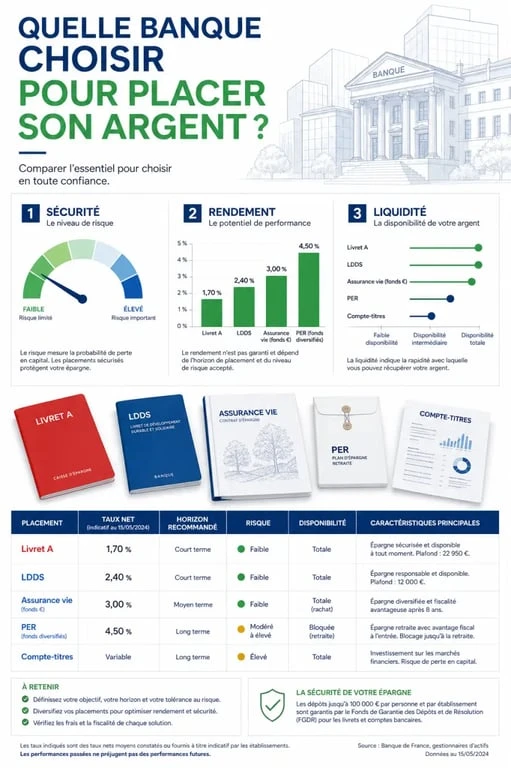
The right bank to invest money is not necessarily the one with the highest rate. The choice depends mainly on three points: the level of security sought, the length of time during which you can immobilize your savings and the amount of money you can save. actual costs which reduce yield. For precautionary savings, a regulated booklet may suffice. To prepare a real estate project, the ELP remains to be studied. To invest in the long term, life insurance, PER or securities account completely change the logic.
First compare investments, not just banks
Before choosing an establishment, the appropriate product must be identified. A bank can be very good for livrets, average on life insurance and not competitive to invest in stock exchange. Conversely, an online bank can offer low fees, but less heritage support than a traditional network.
Estimated savings
| Placement | Rate or yield | Ceiling | Taxation | Liquidity |
|---|---|---|---|---|
| Book A | 1,70% | 22 950€ | Tax exemption | Very available |
| LDDS | 1,70% | 12 000€ | Tax exemption | Very available |
| SARA | 2,70% | 10 000€ | Tax exemption | Very available |
| Goodvest Booklet | 2% | 5 million € | Taxable at 30% PFU | Available under conditions |
| PEL | 1,75% | 61 200€ | Taxable at 30% PFU | Less flexible |
| Life insurance | Guaranteed or variable according to supports | No comparable statutory ceiling | Long-term advantage | Repurchase possible |
| PER | Variable according to media | According to payments and tax framework | Entry tax | Blocked unless provided |
The rates indicated correspond to the rates in force on 1 January 2026 for the products concerned. They show a simple reality: regulated books protect cash well, but their ceiling limits their use for a larger asset. Beyond that, it is often necessary to combine several envelopes.
Regulated books: the basis for money available
Booklet A, LDDS and SARA are the first reflexes to secure a quickly accessible sum. Capital is available, interest is exempt from taxes and the operation of the proceeds is simple. SARA stands out at 2.70%, but is subject to eligibility conditions and capped at 10,000€.
ELP, life insurance, PER: longer horizons
ELP requests payment of 225€ at the opening, then 45€ per month minimum, with a minimum duration of 4 years. It can therefore be suitable for regular saving, especially around a real estate project. Life insurance is ideally designed over 8 years, especially to fully benefit from its tax framework. The RIP is more responsive to a retirement objective, with more limited liquidity.
Which really distinguishes a good bank to save
Two banks can offer the same Book A because the rate and ceiling are regulated. The difference is made elsewhere: quality of the customer space, simplicity of transfers, ancillary costs, range of life insurance, access to funds in euros, units of account, ETF, securities account or personalized advice.
Visible fees and discreet fees
To place his money, the fees to be monitored are not limited to the cost of keeping an account. On life insurance, look at payment fees, annual management fees, arbitration fees and the quality of available media. On a securities account or EAP, compare brokerage fees, any custody fees, and foreign stock exchange fees.
A saver can lose a lot of returns without being aware of it, not because of a misinvestment, but because of a series of costly small decisions: opening a contract loaded with fees, letting too much cash sleep on a current account, arbitrating too often, choosing complex media poorly understood, and then compensating for excessive risk taking. The right bank is the one that blocks this mechanics, with a clear interface, legible fees, useful alerts, understandable documents and an easy-to-read history of operations.
Accompaniment: useful if your goals multiply
For a precautionary saving of a few thousand euro, a simple and inexpensive bank can suffice. For a family that prepares children's studies, a real estate purchase and retirement, accompaniment takes on more value. A competent adviser must be able to explain the risk-to-risk ratio, taxation, availability of money and the consequences of early retirement.
Online bank or traditional bank: the right choice according to your profile
Online banking often attracts reduced costs, quick opening and efficient interfaces. The traditional bank retains an advantage for customers who want an identified contact person, particularly in the case of real estate credit, transmission, property management or complex family situations.
All about regulated savings books and accounts · Discover the features, ceilings and conditions of key savings books to optimize your investments safely.
For precautionary savings
The main criterion is immediate availability. A good bank should be able to easily feed a Booklet A, a LDDS or a SARA, program transfers and withdraw money without friction. No need to look for a sophisticated setup: the aim is to be able to cope with an unforeseen expense without selling a risky investment at the wrong time.
For long-term performance
If you are aiming for higher performance, you will have to accept a share of uncertainty. Multi-support life insurance, securities account, PEA or PER provide access to variable media. The right bank will then be the one offering a clear investment architecture: solid euro funds, diversified units of account, accessible ETFs, reasonable fees and net risk information.
For retirement or taxation
The RIP may be interesting if you are looking to reduce your taxable income while preparing for retirement. But it is not suitable for everyone, because the money is in principle blocked until the deadline, unless the release is foreseen. Life insurance remains more flexible to transmit, diversify and make partial withdrawals. Here, the bank must help you to arbitrate between immediate tax advantage and future availability.
Build a simple strategy before opening an investment
A good placement rarely starts with a promotional offer. It starts with a hierarchy: what must remain available, which can be placed a few years, which can really work over the long term. This method avoids comparing products that do not meet the same need.
- Step 1: keep a security reserve on Booklet A, LDDS or SARA if you are eligible.
- Step 2: define your projects at 3, 5, 8 years or more: real estate, studies, retirement, transmission.
- Step 3: compare actual contract fees, not just the rates displayed.
- Step 4: tax verification: exemption for regulated booklets, 30% PFU for certain taxable products, specific life insurance and RIP framework.
- Step 5: diversify between safety, availability and potential yield.
Multibanking may also be relevant. You can keep your current account in a bank, open competitive life insurance elsewhere, use an online bank to invest in the stock exchange and keep your regulated books in the most convenient establishment. The important thing is to keep a consolidated view of your heritage.
Concrete recommendations according to your objective
There is not one better bank for all savers. Instead, there is a better combination of bank, investment, horizon and acceptable level of risk.
| Objective | Placement to be preferred | Type of bank to be searched | Point of vigilance |
|---|---|---|---|
| Money available | Booklet A, LDDS, SARA | Single bank, quick transfers | Ceilings and eligibility for SARA |
| Real estate project | ELP, secure savings, prudent life insurance | Bank with good credit support | Minimum duration and taxation |
| Long-term yield | Life insurance, PEA, securities account | Discounted bank or broker | Risk of capital loss on variable media |
| Retirement | PER, life insurance | Establishment with Heritage Council | RIP blockage and exit taxation |
To choose, systematically request tariff documentation, withdrawal conditions, available media and net after-tax return where possible. If you hesitate between two banks, prefer the one that allows you to understand exactly where your money is going, how much it costs and under what conditions you can recover it.
In practice, the best decision is often to separate roles: a reliable daily bank, regulated safety booklets, well-priced life insurance for the medium-long term and, if your profile permits, an investment envelope to look for more yield. It is not the name of the bank that protects your savings, but the consistency between your goals, fees, liquidity and accepted risk.