
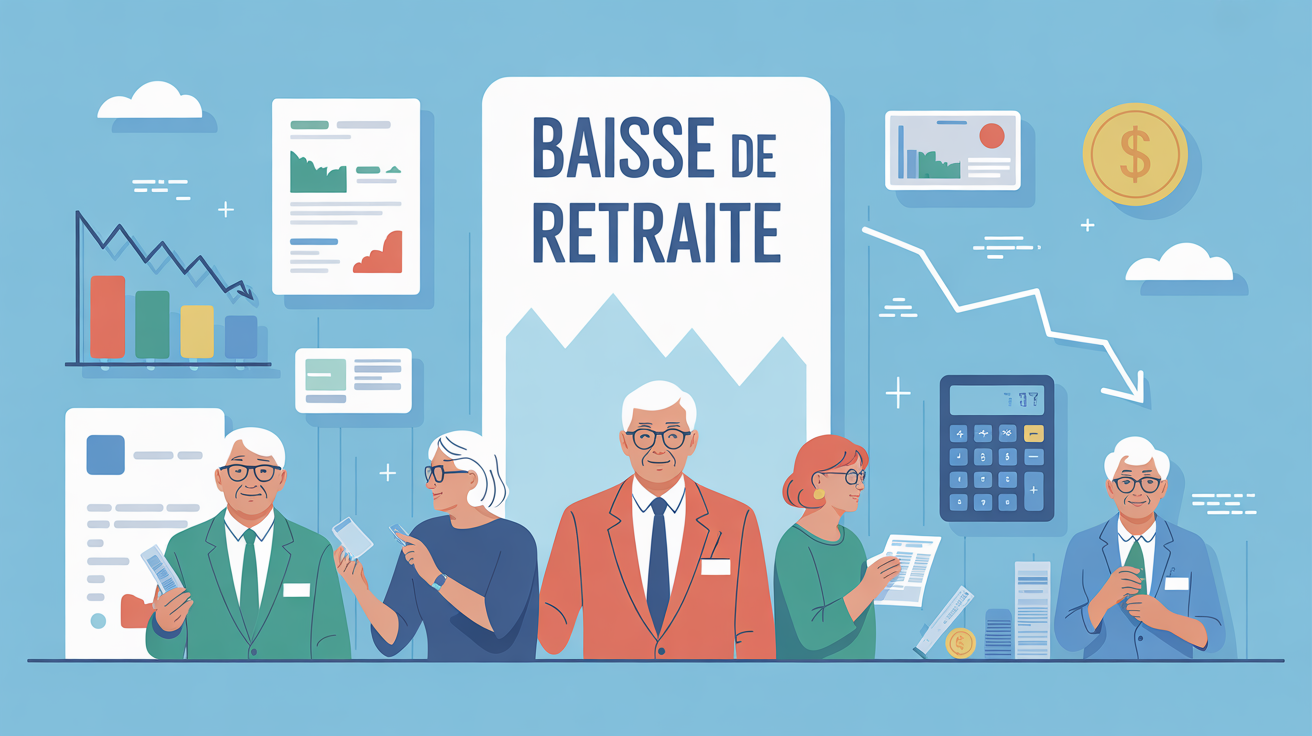

When decrease in retirement suddenly or unexpectedly occurs, many seek to understand where this variation comes from and to find a safe option without wasting time. Between changes in Net payable, adjustments to social levies, and threshold effects related to the Fiscal Reference Income, knowing the real mechanics helps clarify the situation and to act without being overwhelmed by worry.
Declining retirement – keys to understanding and reacting immediately

You see a decrease in the net amount of your pension, sometimes 30, 50 or even 70 euros, when a revalorisation seemed to have been acquired this year? This situation happens relatively frequently: in most cases, it is an effect of social or tax levies and not a real reduction in your gross pension. It is best to diagnose the origin of the decline, step by step, to determine if it is useful to intervene.
1. Gross against net: understand the essential difference
Most of the time, it is not your gross pension that declines, but the net amount pays after the withdrawal of contributions (CSG, CRDS, CASA) and sometimes from the drawdown at source. In 2024, many pensioners saw their pensions adjusted by 5.3% gross While seeing a drop in the net: a simple increase in CSG can absorb any increase.
Tina, a lyonnaise retiree, asked: "My basic pension has risen from 1,510 to 1,524 euros gross, and yet the net transfer has dropped by 48 euros!"
Remember: any rate changes or changes in your Reference Tax Income (RFR) may be sufficient to change the band and thus increase the deductions from your net pension.
Some pension professionals often explain in forums or appointments that these net changes are related to regulatory adjustments more than an individual decision.
2. Why can the decline seem brutal or unexpected?
Every beginning of the year, between January and March, this same phenomenon affects many pensioners: even when the revalorisation is announced, the net often declines because of a automatic CSG update or the termination of a temporary exemption. The figures for 2024 illustrate the situation: the CSG at the normal rate reached 8,3 %against 3,8 % for the reduced rate, which can result in the loss of several tens of euros each month.
The scale is clear: the RFR threshold for a total CSG exemption is 13 048 € (for 1 part). Sometimes, one euro enough to cross the threshold and radically change the amount paid.
"A counsellor will remind that a simple exceptional bonus can cause a change of tranche," shares a social centre trainer.
Why is retirement falling?
In the face of a decrease deemed unjustified or misunderstanding in the face of a declining payment , the same question comes back every year . We regularly focus on the promised increase (0.9% expected on January 1, 2026, after +5.3% in 2024), but the "real" net works differently.
Social levies and taxation: the main factor
A change in the CSG rate depending on the reference tax revenue explains the bulk of the declines in the net. If your RFR evolves or you cross a new band, the CSG, CRDS and CASA are automatically recalculated. It is worth noting that the CSG tranches have increased by +1,8 % in 2024 with inflation.
A concrete example: If your net pension is 1,500 €, and that your CSG rate goes from 3,8 % to 6,6 %, the decrease is almost equal to 42 € Every month.
One social worker recently mentioned: "Many seniors were not informed about automatic regularizations, hence the surprise at the transfer."
| Situation | Average impact per month |
|---|---|
| Change in tranche (CSG reduced rate → median rate) | -32 to -50 € |
| Retroactivity or regularization of sampling | -48 € |
| End of temporary exemption CRDS/CASA | -44 € |
Other common origins
There are also cases where the source levy on income tax (for those who become taxable) occurs, or there is a temporary gap between basic and supplementary pensions. Sometimes, a discrete revalorisation is not enough to compensate for the increase in levies, which gives the impression of a drop even when the crude increases.
In front of an unexpected line "additional sampling" on the survey, not panic: it is most often a regularization over several months, rarely an error.
Some retirees tell on the networks that this message got them some cold sweats...
How to control the amount of pension
A hesitation, a stress from a lower transfer? Simple tools exist to resolve doubt quickly – as pension advisors or caregivers use them on specialized forums.
Personal space and payment statement: the essential step
The first action is to access his personal space on the website of his caisse (CNAV, Agrec-Arrco, etc.) or download the pension statement. This document shows the gross amount, details of each levy (CSG, CRDS, CASA, source levy), and the final net.
Not to be forgotten: some surveys specify changes from year to year or report changes in rates (sometimes indicated by an asterisk or a "new rate" line). On Service-public.fr or Info-retirement, one can simulate the net corresponding to its updated RFR.
One advisor said on a day of accompaniment to CARSAT: "The simulation saves time, especially when you hesitate about the tax threshold."
Essential practical tools
Saving time is possible thanks to net amount calculators, template letters of challenge proposed on institutional sites, and telephone support. Every year, almost 35-45% applications received by the caisses during January and February concern this specific topic.
Here's what we can remember:
- ✅ Access to the personal space allows you to view every detail instantly.
- ✅ Comparing its RFR (on the tax notice) helps to identify whether a new tranche has been crossed.
- ✅ Official simulators help to understand the variation if it remains unexplained.
- ✅ For an error, each retirement web portal offers a claim form to fill out.
If you share a screenshot or your queries on Our Time or Generations forums Movement, expect about ten answers from elders who have experienced the same anecdote. Who never typed on the internet "My retirement has dropped by 44 €Is that normal?"
Supplementary pension vs basic pension: pay attention to disparities!
"My supplement did not move while the base fell" recurring question, as each body applies its own processes and separate sampling dates.
A gap between the two types of pensions is nothing unusual and usually settles within a pair of months.
Some experts, at Agrec-Arrco webinars, recall this difference: "The rhythm of the crates is never perfectly synchronized, it can disturb."
Dates of payment, modalities, scale: not all converge
The basic pension (CNAV, CARSAT...) is paid on the 9th of the month, the supplementary pension (Agirc-Arrco) around the 1st. Sometimes one adjusts before the other or only the supplement undergoes an increase in levies in the event of a change in the overall RFR.
It is best to compare: Agrec-Arrco.fr provides for each pensioner a table detailing the net and the breakdown of contributions. Everything is transparent... However, the amounts are not always aligned.
Good to know
I recommend that you keep in mind that your reduced or exempt duty may vary from one fund to another. This is why some find a net supplementary pension intact, while the basic pension decreases by 32 or 48 €.
One accompanying member of the social department said during a permanence: "The base and the complement are two worlds that do not merge, even with the same RFR."
CSG scales and thresholds updated each year
The scales change on 1 January, sometimes with threshold effects. Here is the most useful grid 2024:
| CSG Applicable | RFR threshold (1 part) / Year | Rates: |
|---|---|---|
| Exemption: | < 13 048 € | 0 % |
| CSG Reduced rate | up to 17,057 € | 3,8 % |
| CSG Median rate | up to 22,281 € | 6,6 % |
| CSG Full rate | > 22 281 € | 8,3 % |
Even a moderate increase in your RFR, sometimes through a tax adjustment, can result in all your pensions going up. It is not only a question of percentages, but above all a set of thresholds crossed without always seeing...
"Some pensioners discover the consequences of an inheritance or sale of property on their pension only at the time of the transfer," explains a CNAV agent at an annual interview.
How can we react to a decline deemed unjustified?
Loss of income? Uncertainty? It is best to check quickly, report or request an explanation.
According to social sector experts, the majority of disputes are resolved after consultation with the personal space and, if necessary, by sending a written request (model provided by the caisse) or by direct telephone contact.
Steps to control, challenge, defend his rights
It is often recommended to download the latest payment notice and your tax notice (full, unsummary). Check the rate, identify any adjustment, and analyze the breakdown of pensions (base, supplementary...) over 2 or 3 consecutive months to identify a temporary fluctuation.
Don't forget to attach supporting documents to any claim, detailing the variation (e.g. "Net down of 44 euros between January and February 2024, without change of situation").
A social action centre trainer shared: "The accuracy of the amounts greatly facilitates the processing of cases."
- ✅ Contact your caisse (by phone or via secure mail from the personal area).
- ✅ Then file a challenge form if the explanation is missing after 14 working days.
- ✅ Use the retired mediator if the error persists beyond a month.
- ✅ Avoid multiplying your requests on both boxes before you locate the exact variation.
Useful point: Each year, forums identify payment bugs. If the decline affects several people, solidarity often unlocks a resolution.
Model letters, simulators, institutional contacts
Almost all official sites offer templates of protest letters to print. It is also possible to request an online appointment or to call directly to Info Retraite or Agrec-Arrco: in general, the answer comes under 5 to 15 working days depending on the period.
The online simulator "Why did my retirement fall?" d a hundred thousand access every beginning of the year).
It would be unfortunate to remain alone in front of a payment sheet: a whole panel of teaching tools accompanies you.
FAQ, Testimonials and Experienced Cases
When one shares the same problem, reading a clear explanation or another's testimony gives what often seems a real relief. This block compiles quick answers and some excerpts from forums or cases actually encountered.
A pension fund professional recalled at a webinar: "Forum exchanges are sometimes more reassuring than official notices."
Frequently Asked Questions on Declining Pensions
- ✅ "Why did my retirement fall when it was upgraded?" In general, the gross increase is offset by an increase in contribution, notably the CSG.
- ✅ "Do they evolve together?" No, hence the frequent impression of selective or delayed decline.
- ✅ "Front error or normal sampling?" Compare your statements two months in a row taking into account the RFR. If the deviation remains inexplicable, seek the caisse as soon as possible.
Express testimony
Gérard, 74, Toulouse: "I thought it was a mistake because my pension in February had dropped by 70 €. After checking, I crossed the RFR threshold because of a small supplementary income. The caisse confirmed and advised to adapt my expenses to the future, stating that the rate will be automatically revalued next year."
Tools, contacts and human support
Do you feel a form of impotence? Consider asking for help on the forums or joining an advisor via Agrec-Arrco, Info Retraite, Service-public or a social action centre. Download a model letter, use online simulator, save your payment notices every month to keep a precise history.
Need a live advice? Just call the number of your caisse or go through the courier of your personal space.
Finally, no one is alone in the face of an "unwarranted drop": transparency of tools, self-help on forums and the speed of institutional responses limit anxiety and help find the right amount... or the expected explanation.