

LLuxembourg life insurance Attracts investors thanks to its reputation for security, but its regulatory advantages are coupled with real constraints: a high threshold of access, charges that can exceed the average, a tedious administration and the absence of a tax advantage for French residents. It is best to analyse upstream whether this product corresponds to your heritage, your taste for complexity and the nature of your needs, because in many situations, the French version is consistently more efficient in terms of simplicity and cost-benefit ratio.
Luxembourg life insurance benefits from a "premium" aura, but behind its regulatory guarantees (safety triangle, super privilege), there are several practical, fiscal and economic limits that deserve direct analysis. For a French tax resident or a heritage investor, the main obstacles are: the amount of high access (often from 150 000 €), administrative complexity, costs that may exceed French contracts and reporting obligations that complicate life. Add that this product does not provide any specific tax optimization for French residents; Therefore, its relevance depends on your heritage profile and your tolerance to administrative procedures and additional costs.
In short – who really benefits from Luxembourg life insurance and for what profiles can it be particularly restrictive? Let's take a closer look, section by section.
Summary of key points
- ✅ Luxembourg life insurance has a high financial entry threshold and significant administrative complexity.
- ✅ Additional costs are often higher and more opaque than for French contracts.
- ✅ For French tax residents, there are no specific tax benefits, and reporting obligations are binding.
Luxembourg life insurance: the real disadvantages from the start
Luxembourg life insurance benefits from a "premium" aura, but behind its regulatory guarantees (safety triangle, super privilege), there are several practical, fiscal and economic limits that deserve direct analysis. For a French tax resident or a heritage investor, the main obstacles are: the amount of high access (often from 150 000 €), administrative complexity, costs that may exceed French contracts and reporting obligations that complicate life. Add that this product does not provide any specific tax optimization for French residents; Therefore, its relevance depends on your heritage profile and your tolerance to administrative procedures and additional costs.
In short – who really benefits from Luxembourg life insurance and for what profiles can it be particularly restrictive? Let's take a closer look, section by section.
High entry ticket: first filter, rarely negotiable
Access to a Luxembourg life insurance is clearly not within reach: a financial barrier is imposed upon entry. While this target threshold for so-called "heritage" clients does not necessarily correspond to all the experienced investor profiles.
How much does it really take to open a contract? (comparative table)
Most of the French contracts are accessible from 1000 €, while the Luxembourg entry ticket frequently starts at 150 000 € – and can reach 250 000 € for some high-end offers.
| France | Luxembourg |
|---|---|
| 1 000 € 10 000 € (classic or online contract) | 150,000 € 250,000 € (Heritage contract) |
In practice, many establishments impose a threshold of 250 000 €, in particular to access dedicated internal funds (FID, FAS, FIC) or tailor-made management. Sometimes a young manager or a couple with a capital below this threshold has to give up instantly: it is often recommended not to force the opening in this case.
What cases of figures require this threshold? Why is it important?
For some intermediate profiles, wanting to transfer all its assets to "benefit from supposed security" may lead to unnecessary complexity costs. It is only from investments beyond 150 000 €, or 500 000 €, that the specific Luxembourg options (internal funds, multi-currency platforms, special allocations) begin to show their usefulness (without guaranteeing a better return). One trainer suggested that the question: "Is this entry ticket really worth the heritage transition?" deserves a rigorous diagnosis – and often the answer remains negative.
This threshold is frustrating, but often saving to avoid opening an inappropriate contract.
Costs sometimes higher, or more difficult to untangle
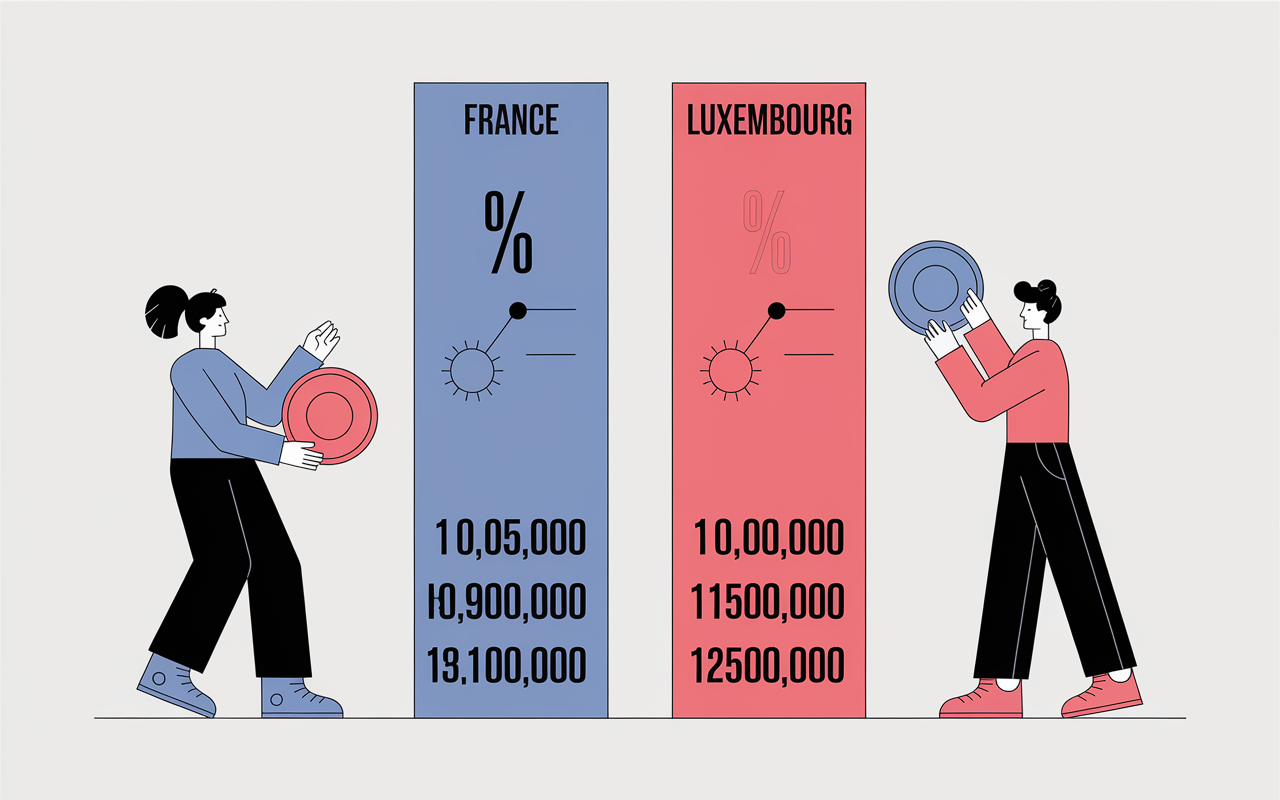
Simply comparing management costs is not enough: the structure of Luxembourg's ancillary costs is complex, and can quickly absorb the promise of a high-end contract. Some professionals believe that this data, rarely highlighted in the communication, deserves careful attention.
Management fees, depository banks, specific media: what to expect?
As a general rule, a Luxembourg contract offers annual management fees between 0.65% and 0.90%. On paper, this may seem to be less than most French contracts (often 0,95 %), but this comparison does not take into account several subtleties:
- The depositary bank may include its fees, or charge them separately: this often adds 0,10 % to 0,20 % according to the mandate chosen.
- The entry ticket sometimes increases if one opts for delegated management or specific internal funds.
- The costs of arbitration vary: 0 % to 1 % according to frequency and support, which is not always transparent.
For a heritage of 500 000 €a difference of 0,10 % Representative 500 € Every year. Over 20 years, the figures take on another dimension, far exceeding a few decimals of gross yield.
A table to better see the variance on management fees
| Contract | Management costs | Depositary costs (if any) | Entry ticket |
|---|---|---|---|
| France | 0,95 % | Included | From 1000 € |
| Luxembourg | 0,65–0,90 % | 0,10–0,20 %* | 150–250 000 € |
*To be checked in the pre-contractual notice, depending on the depositary or the sophistication of the chosen mandate.
Some clients find that asking for the written details of each fee level avoids bad surprises in the first year. It is noted that the apparent gain on day-to-day management can quickly disappear in the face of additional technical and administrative costs.
Complexity of subscription and reporting obligations: a heavier administrative mechanics
Moving from a French contract to a Luxembourg contract means accepting reinforced documentary formalism (KYC, proof of origin of funds, etc.). This administrative burden frequently cools down investors, even experienced. Moreover, an international adviser shared that she often sees files abandoned because of the amount of evidence requested, especially for multi-country assets.
Opening times and procedures: up to 8 working days (or more...)
In general, provision should be made for 4 to 8 working days to open a Luxembourg contract, while a French contract deals in 3 days. This is due to strict legal controls, the fight against money laundering and a tripartite organisation.
- Multiple proofs of assets are sometimes required, especially if you have funds spread over several countries.
- Handwritten signature remains common, although some actors tend to gradually digitize the procedure.
- Repeated exchanges are required (insurer, depositary bank, advisor) before final validation.
Opening in "24 h time" is not an option, unlike some French platforms 100% online. An anecdote: an expatriate entrepreneur having transferred 2 M€ had to wait 12 days the time that the source of its funds is validated by all the Luxembourg parties. Patience is therefore essential.
Reporting obligations: attention to French and expatriate tax residents
The ideas received persist: Luxembourg life insurance does not allow in no case avoid French taxation for a French tax resident. To this is added a specific reporting obligation (Form 3916):
- The Luxembourg contract is to be reported annually to the French tax administration.
- The value, date of opening, name of insurer, custodian and contract number must be indicated.
- Voluntary or accidental oblivion may lead to costly recovery risks.
For expats or binational couples, the situation becomes even more complex: every transition from country of residence implies a new conformity and sometimes an adjustment of the tax applicable to earnings. There is nothing to rule out that you have to manage a thorough administrative file every year, with the penalties that can follow in case of error.
Good to know
I recommend that you anticipate the administrative burden and the deadlines for subscription before choosing a Luxembourg life insurance, because these aspects can be heavier than expected.
Performance, Flexibility and Management: Realizing the Promises
On the performance front, the superiority of Luxembourg life insurance is not automatic. Some professionals in the sector point out that the returns of funds in Luxembourg euro are in recent years slightly below certain French funds.
Return on funds in euro: slight disadvantages, except for massive assets
Luxembourg euro funds generated on average 2,60 % in 2023/2024against 2,80 % for some French leaders, with comparable management. This difference is explained by a cautious approach and a selection of media often designed for large assets, less exposed to market movements. Some heritage managers note, moreover, that the conditions of the Luxembourg funds remain stricter, which may hinder the search for performance among average investors.
Comparison table – Euro Fund performance France/Luxembourg
| Support | Performance 2023/2024 |
|---|---|
| Euro Fund France | 2,80 % |
| Euro Fund Luxembourg | 2,60 % |
Another point to consider: dynamic media, dedicated funds or European/international actions available in Luxembourg contracts sometimes involve additional management costs, which end up reducing net long-term performance. Is this really the "more profitable" placement? Experience tends to prove the opposite if one seeks simplicity and regular returns.
Last point to note: segmentation and customization will be crucial, but they do not guarantee higher profitability for all profiles.
Flexibility of management and digitalisation: the promise far from being uniform
The digitalisation effort varies: some Luxembourg insurers offer modern platforms, while others still adopt a semi-paper mode, with many manual return trips. We have seen in consultation that the customer experience can turn into an alternation between forms to be signed and late replies, disconcerting for the regulars of the ultra-convivial French applications.
- "Direct" online management is not systematic: some arbitrations are conducted only via the adviser.
- Sometimes monitoring remains less responsive than on a 100% digital French app.
- Some media impose limits, especially for automatic arbitration or online taxation.
One customer said in an interview: "I felt like I was going back twenty years, with more papers to sign than alerts on my smartphone." This lag regularly surprises customers accustomed to a digital option.
Taxation: status quo (or even complexity) for most French residents
A common misunderstanding: to believe that Luxembourg life insurance gives access to advantageous taxation. In practice, this remains false in the vast majority of standard cases. Some experts in international management even stress the need for support, as Luxembourg's taxation applies only to very specific cases.
Country of residence, taxation and declarations: what does not change
For a French tax resident, the tax on redemptions or successions is strictly French (PFU, deductions, social contributions at 17.2% on winnings, etc.). Luxembourg-specific exemptions are therefore reserved for relatively specific profiles. It is better to know that the only possible economy concerns: the absence of social levies on certain foreign media (as long as the gains are not realized), but this opportunity remains complex and poorly accessible in classical management.
We regularly find that the promise of an advantage for "any nationality" is to be qualified: an expatriate can benefit from fiscal flexibility, provided that he/she is well-accompanied to avoid any false legal step or imprecise declaration (according to Bestrates, a simple error can cancel all the expected tax benefits).
Tax monitoring and transparency obligations: an annual complexity factor
All contracts open abroad involve more vigilance at the annual IFI or inheritance declaration, even for substantial family assets. A single oversight can pave the way for control and penalties: this suggests that it is better to anticipate its administrative tolerance before taking the step.
Good to know
I advise you to be accompanied for the annual tax return related to your Luxembourg life insurance in order to avoid any costly errors.
For whom is Luxembourg life insurance not suitable?
Deconstructing the myth of the "universal premium" contract amounts to identifying the right profiles. This sophisticated heritage product may have its place, but not for everyone and not systematically.
Profiles "to be avoided", or for whom the constraints weigh heavy
Here are some highlights from recent customer feedback and heritage case studies:
- Patrimonial under 150 000–250 000 €The contract is generally interest-free and costly.
- Customers prefer ultra-digitalized and fast management.
- Subscribers for whom administrative simplicity and declarative privilege (especially in France).
- Persons wishing to arbitrate or withdraw their funds quickly, without intermediary.
Key point: when the security promise exceeds the real needs, the Luxembourg contract does not offer any added value compared to a standard French contract or less complex delegated management. Many great francilian savers turn away after simulation, for lack of real need or tangible benefit.
For what purpose does the Luxembourg contract retain its strength?
Conversely, profiles with an international heritage, seeking protection against political, economic or regulatory risks, and those facing a complex marital or estate situation, appreciate the flexibility of this contract – provided that they accept administrative procedures and rely on a competent adviser. For these investors, "disadvantages" become a necessary passage to ensure legal and property security. A well-informed adviser recently pointed out that it is not uncommon for Luxembourg life insurance to be mobilised for protection against regulatory instability in certain countries.
One can wonder frankly: is this additional security worth, in your case, the costs and administrative management? Customer feedback is sometimes as decisive as performance.
Practical checklist: alert points before subscription
Before committing, this summary can be valuable: list your expectations, tolerance thresholds and administrative constraints with clarity. Some heritage experts explain that this approach avoids frustrations that often accompany poorly anticipated approaches.
Key questions to validate in order to reach the right decision
- Does your mobilizable capital exceed 150 000 € From the start?
- Can you justify and document the origin of your funds quickly?
- Do you have the habit or the means to delegate management to a consultant?
- Do you accept a procedure for subscription of 4 to 8 days, with many exchanges and revivals?
- Are you comfortable with annual reporting obligations to French or foreign tax administrations?
- Does the potential extra cost (a handful of more per year, or even more) seem justified for the safety or heritage engineering sought?
Keeping this checklist in mind makes the decision to opt for a Luxembourg contract, or to choose the French way, more rational and practical. This is also why informed customers avoid the "traps barely mentioned" in the sector's speeches.
Advanced FAQ on the disadvantages of Luxembourg life insurance
Need more lighting? Here are the most frequent questions in heritage consultations on this topic.
What are the real disadvantages experienced by Trustpilot customers?
Among 3,422 opinions (average score: 4,6/5), the main criticisms concern: the opening times, the cumbersome identification procedures (KYC), the difficulty of having clear explanations without jargon, and certain adjustments of costs between promise and reality. However, the security of placement is generally highly appreciated and rarely questioned.
Does a French tax resident benefit from a particular tax advantage?
No: there is no automatic optimization. The taxation applied to the buy-outs, the contract or the transmission, remains strictly French. The contract must be declared each year (form 3916) and the social contributions must be 17,2 % apply to realized earnings.
Can the ticket drop down or negotiate?
It's exceptional. The most flexible contracts can sometimes accept a ticket from 100 000 € in some cluster operations, but access to advanced management solutions most of the time requires a stock of 150,000 to 250,000 € minimum.
In case of international succession, does Luxembourg life insurance simplify the procedure?
In other words, it is not automatic: succession management depends heavily on tax treaties between the countries concerned, the method of management chosen and the property engineering implemented. A tax lawyer recommends to be cautious – the portability argument should be examined in detail according to each family situation.
Last point to note: Arbitrate objectively before any decision
Luxembourg life insurance offers strong regulatory guarantees and significant security thanks to the "safety triangle", but it also creates real constraints: high entry threshold, complex costs, demanding administration, and compulsory tax declaration. Its relevance really assesses at the crossroads of your assets, your estate goals, your administrative tolerance... and your ability to manage the complexity to benefit from the promised security. Experience shows that personalized simulation, explicit checklist and specialized accompaniment are the most effective tools to avoid the pitfalls behind the image of the "ultimate heritage product".
Need to clarify interest in your situation? Test the simulator, download the checklist before signing or make an appointment with a certified heritage expert. It would be a shame to be blind!