


To find cheap home insurance, first compare offers with equivalent guarantees and deductibles. Reducing the contribution by removing an unnecessary option is an economy; Removing the protection of a garage filled with tools can become a bad deal. The right contract protects your home and property while leaving a bearable remainder after a disaster.
The price depends on your home, not just the insurer
There is no single rate applicable to all houses. The address, the surface, the number of rooms, the use in principal or secondary residence and the history of claims are involved in the pricing. Local exposure to floods or burglaries may also affect the contribution.
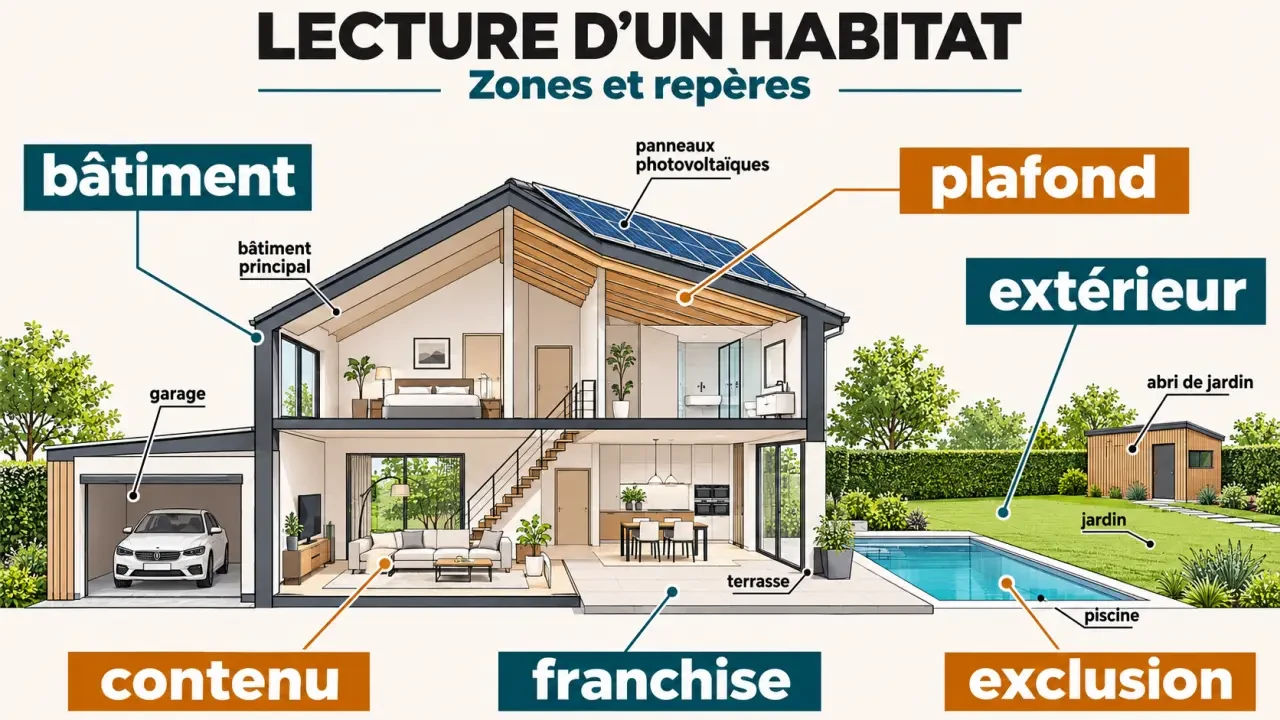
A house therefore does not always cost more than an apartment. On the other hand, its outbuildings, veranda, swimming pool or outdoor facilities can expand the property to be protected. The age of the building and the condition of electrical installations or plumbing may also be included in the risk assessment.
Declare precisely the building and its contents
For each quote, use the definition of parts and area requested by the insurer. Report garage, garden shed, solar panels and other equipment. Approximate reporting can produce an attractive price, but poorly adapted coverage.
The capital is the value of the property present in the dwelling, distinct from that of the building. Make an inventory piece by piece: furniture, appliances, clothing, computer, tools and leisure equipment. Keep invoices and photographs, then check the processing of valuables, often subject to specific limits.
Maintain protections that avoid major financial loss
Occupancy status determines needs and obligations. In France, the tenant of a dwelling rented as a principal residence must, with exceptions, ensure against rental risks. A co-owner must have liability insurance. For a non-ownership owner, home insurance is generally not mandatory, but the absence of a contract leaves the financial consequences of damages not otherwise covered to the owner.
A non-occupying owner must seek a formula suitable for a leased or vacant property, rather than an occupant's insurance policy. In all cases, the legal minimum does not necessarily constitute sufficient protection.
| Protection to be considered | Utility for a home | Point to be checked |
|---|---|---|
| Fire and water damage | Protecting the building and insured property | Covered events, leak detection and associated costs |
| Civil liability | Cover some damage to others | Insured persons and responsibilities covered |
| Theft and vandalism | Protecting property from planned events | Locks required, forced entry conditions and prolonged absences |
| Natural disasters | Intervention under the applicable regime | Recognition conditions and specific deductible |
| Icebreakers and electrical damage | Protect certain glazing and appliances | Elements covered, exclusions and ceilings |
Thinking about housing that has become uninhabitable
After a major fire, replacing furniture is not enough: you sometimes have to stay elsewhere. Review the relocation costs, their duration of care and emergency assistance. A slightly more expensive formula may be of more interest if it meets this concrete difficulty, without all advertised services necessarily being included without limit.
Check exteriors before deleting options
A declared dependency is not necessarily covered for all risks. The garage can be provided against fire without the same protection against theft as the house. Check separately the attached building, the assets stored and the closing conditions.
Reason as if you were travelling through a corridor between your stay and the ground floor: at each threshold, ask yourself if protection continues. Is the computer covered in the house, tooling in the garage, then the mower in the shelter? This reading by storage zones identifies the gaps in coverage that a simple list of guarantees does not reveal.
Garden, terrace furniture, fences, swimming pool and photovoltaic panels should not be presumed included. For each equipment, ask if an extension is necessary and what ceiling applies. As a contractual benchmark, the EAW announces a ceiling of 5,000 € for property located outside the territory in the option presented: this amount is neither universal nor transferable to another offer.
Conversely, discard the non-relevant options for your home. A warranty for mobile devices can also duplicate an existing contract. However, compare the beneficiaries, the circumstances covered and the deductibles before concluding that two protections are identical.
Adjust the franchise without exceeding your ability to pay
The deductible is the amount remaining at your expense under the terms of the contract after a covered claim. Increases can reduce the premium, but transfer part of the risk to your savings. Ask for two simulations with different franchises to measure the economy actually proposed.
The EAW illustrates this mechanism with a franchise of 140 € : for compensation for 650 €net compensation achieved 510 €under the conditions of his example. Do not assume that this deductible applies to all events: separate amounts may exist depending on the guarantee.
- Choose a leftover that you can finance without getting in trouble.
- Identify fixed, proportional deductibles and any minimum or maximum deductibles.
- Compare the total annual contribution, including fees, rather than the only monthly payment.
- Check if a discount is temporary and what rate then applies.
Do not artificially reduce the capital to get a lower price. Instead, check the method of compensation: old deducted, replacement with nine conditions, ceilings per category. High capital alone does not guarantee full repayment of each property.
Compare quotes on an identical basis before subscribing
Prepare a unique sheet with your status, address, surface, outbuildings, use of housing, furniture capital and required background. Provide the same information to each insurer or comparator: otherwise, price differentials may simply reflect different protections.
To divide the proposals, follow this order:
- Guarantees and goods covered: building, furniture, annexes and outdoor equipment.
- Compensation limits: ceilings, subceilings and treatment of old age.
- Stay on charge: deductible for each significant risk.
- Conditions: exclusions, anti-theft protection required and duration of absence allowed.
- Cost and service: Annual contributions, assistance and reporting of claims.
Prices « from » do not replace a personalized quote. Similarly, a good customer rating tells about experiences, not the exact coverage of your home. Read the general and special terms and conditions and have the ambiguous points confirmed in writing.
Before subscribing, check the effective date to avoid a coverage interruption. Then ask for a new comparison when there is a significant change: extension, purchase of equipment, rental or conversion to a secondary residence. The sustainable economy comes from a well-adjusted contract, no protection became insufficient.