


Your home insurance increases while you have not declared any claims? This can be explained by a general tariff revision, contractual indexation or an insured risk change. To find out if the new amount is correctly applied, compare your last two notice due, then ask for details of the changes. An increase does not oblige to accept without checking, or sacrifice its protection to pay less.
Measure your increase without confusing it with a national average
Start by comparing two annual all-tax contributions included, for the same duration and coverage. A monthly levy may include split charges; therefore, its evolution does not always reflect that of the annual rate.
Calculate the increase in your home insurance
Compare two annual contributions including all taxes to see the change in euros and percentages.
Results of comparison
Difference:
Change:
Both amounts must correspond to the same duration and equivalent guarantees. This indicative result does not replace the insurer's calculation or legal advice.
The calculation is simple: (new contribution - old contribution). For example, go from 250 € to 280 € represents 30 € This represents an increase of 12%. Then check if any warranties or fees have changed.
Barometers give benchmarks, not a ceiling applicable to your contract. Their results differ according to the housing studied, the guarantees used and the observation period.
| Benchmark for 2026 | Projected increase | Average annual premium |
|---|---|---|
| Lelynx.fr, relayed by 20 Minutes on 28 January | 9 % | 182 € |
| Insurland.com, relayed by TF1 Info on 20 July | About 13% | 310 € |
These amounts do not constitute a homogeneous series: the dates and perimeters are not identical. It would be misleading to deduce a precise acceleration of prices. Your best comparison point remains a quote established for the same housing and equivalent coverage.
Identify what actually increases in your contract
Collective costs, even without personal loss
Insurance is based on mutualisation: contributions finance the compensation of all insured persons. More expensive weather damage, fires or water damage can therefore affect prices, even if your home has suffered no damage.
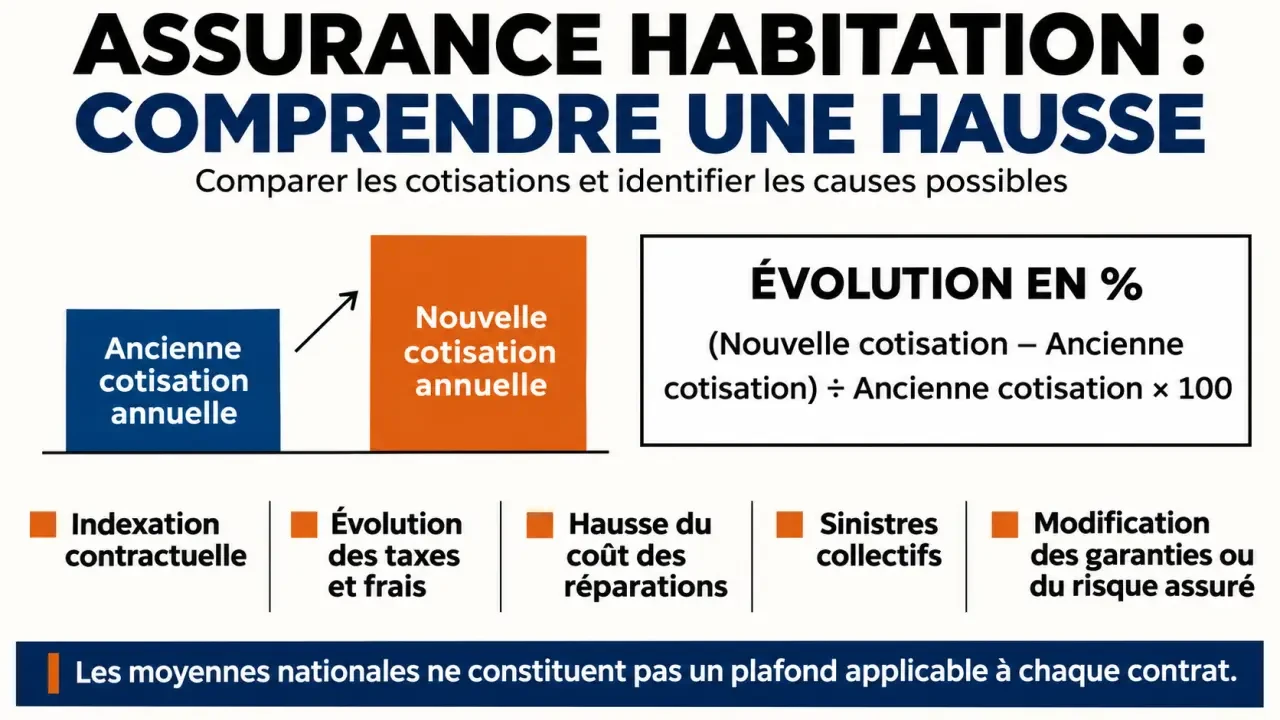
Repairs also play a role. TF1 Info reported an increase in 12.3% of the cost of repair services between the end of 2021 and the end of 2025. More expensive labour, materials and interventions increase the cost of a disaster. Taxes and contributions may also change the total amount paid, regardless of the basic tariff.
Indexing and housing-specific changes
Some contracts provide for indexation on a construction index, including the FFB index. Its application depends on the clause: check the chosen index, the values used and the elements concerned. An indexation increase is not necessarily the same as an additional trade revision.
Your situation can also explain the difference: enlargement, new dependency, raised movable capital or added guarantees. Localization is involved in the assessment of flood, drought or flight risks. A house and apartment also do not have the same surfaces or properties to cover.
Regional differences should therefore be interpreted with caution. The Assurland.com barometer relayed by TF1 Info announced a 20.2% increase in New Aquitaine compared to 3.4% in Corsica. This does not mean that every insured person in these regions experiences these variations, nor that the region with the lowest increase is the cheapest.
Check the notice of expiry and request a workable explanation
Gather the old notice of expiry, the new, the general conditions and the special conditions. See also recent amendments. The aim is to distinguish price, taxation and coverage.
- Amount: Compare the annual fee, taxes and any fees.
- Revision: look for an indexation or increase clause at maturity.
- Guarantees: Check options, compensation limits and deductibles.
- Reported risk: control surface, rooms, outbuildings, occupancy and furniture capital.
- Schedule: Keep the date of receipt of the notice and the announced effective date.
Think of your contribution as a mosaic: the total can increase as each component evolves differently. An additional guarantee, a recalibrated index and payment fees may be added without being clearly reflected in the levy. Reconstitute these different pieces allows you to negotiate the right position rather than ask indiscriminately for a discount on the whole.
Then send a specific written request: « Please provide details of the variation in my assessment, distinguishing between indexation, tariff revision, taxes, fees and warranty changes, and the corresponding clauses. » A general economic justification is not enough to verify the calculation applied to your contract.
Challenge or change of insurer without interrupting coverage
An increase is not automatically irregular, but it is not justified by its presence on the notice of expiry alone. If the calculation appears to be incorrect or the increase does not correspond to the contractual provisions, request a correction by attaching the relevant documents.
In case of persistent disagreement, enter the insurer's claims department. You may then consider the competent mediator according to the conditions of admissibility of the mediation. Keep exchanges and proofs of shipment. Do not just block sampling A dispute does not in itself suspend the obligation to pay.
The possibility of cancelling specifically for increase depends in particular on the reason and the terms of the contract. There is no universal refusal period applicable to any increase: check the details before sending your application.
For home insurance contracts for individuals covered by the termination scheme after one year, the Hamon Act allows changes at any time after the first year, without charge or penalty. Termination usually takes effect one month after the insurer receives notification. Where insurance is compulsory, in particular for a tenant subject to this obligation, the new insurer shall take steps to maintain continuity of coverage.
Reduce the bill by also comparing the remaining charge
Ask for several quotes with the same information and compare more than the fee displayed. A cheaper offer may include a higher deductible, a lower ceiling, or less favourable compensation after old age.
- Guarantees: keep those adapted to your status and housing; Consider options that have become useless.
- Capital: update its value with a realistic inventory, without artificially reducing it.
- Franchises: Choose an amount that your savings actually allow to absorb.
- Exclusions and ceilings: check in particular the valuables, dependencies and damage involved.
For illustration, save 40 € per year accepting 200 € The additional duty-free allowance assumes five years of savings to compensate for this additional cost on a particular claim. This calculation is not a forecast, but it makes arbitration concrete.
Report the preventive measures taken, without assuming that they are eligible for remission. Finally, ask your current insurer for an unchanged guarantee proposal. The right contract is not only the cheapest one today: it's the one you can afford to pay the fee and the rest tomorrow.