


A good one example of PEA portfolio is not a list of attractive actions. It must show a clear logic: what place ETFs should have, how many lines should be kept, what sectors should not be allowed to dominate and how to adapt the whole to its investment horizon. The aim is not to copy an identical model, but to have a concrete basis for building a coherent, diversified and fiscally effective Action Savings Plan.
Before choosing the titles: what the PEA really changes
The PEA allows investment mainly in European actions and in certain eligible ETFs, while benefiting from a favourable tax framework. The ceiling for payment of Traditional PEA is 150 000€. For a PEA-SMEs, it can reach 225 000€, taking into account the cumulation rules between envelopes.
PEA projection calculator
* Indicative simulation. Past performance does not prejudge future performance. Calculation based on monthly capitalization.
His main interest is seen with time: after 5 years, earnings are exempt from income tax, but remain subject to Social contributions of 17.2%. As a comparison, an ordinary securities account is often subject to taxation by 30% on earnings, except for special tax option. This difference can weigh heavily on a long-term strategy.
However, the AEP is not a performance guarantee. Shares and ETFs may decline, sometimes significantly. The tax envelope is interesting, but it does not replace the diversificationpatience and an allowance adapted to your risk tolerance.
Three examples of PEA portfolios according to your profile
The examples below are voluntarily simple. They are suitable for an investor who wants to start without multiplying the lines. Percentages are building benchmarks, to be adjusted according to your age, overall wealth, horizon and ability to accept volatility.
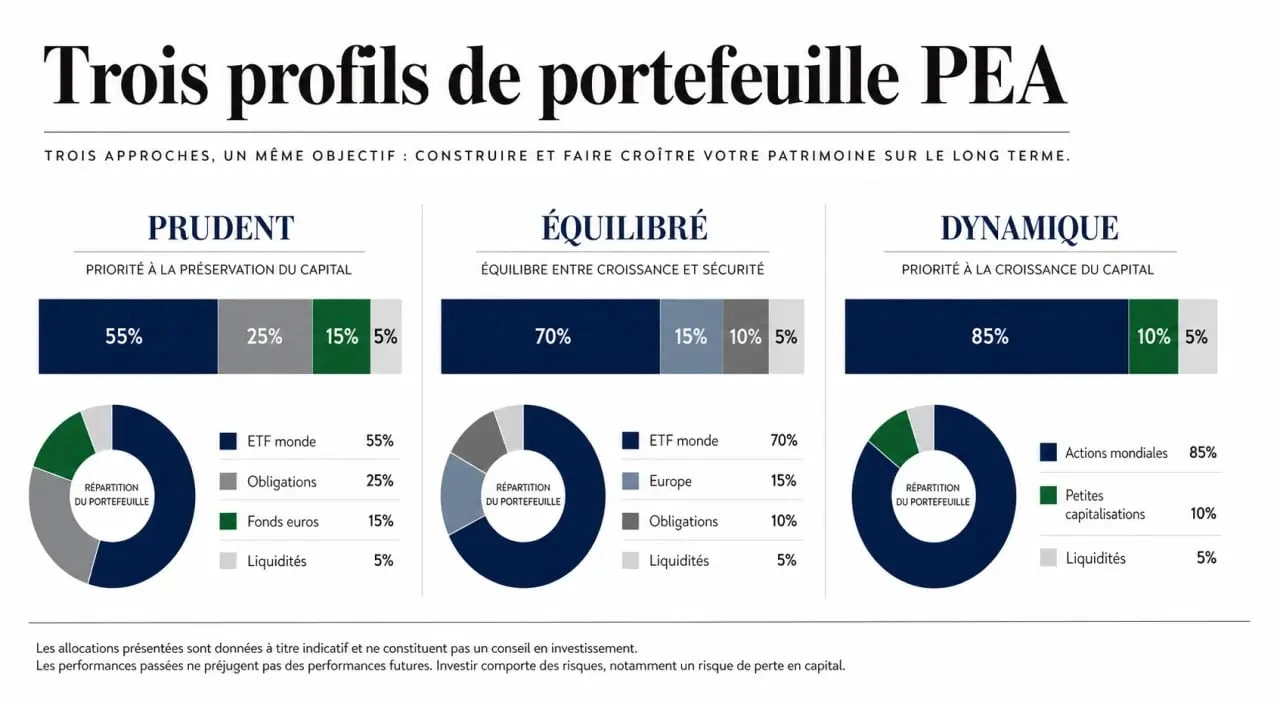
Prudent profile: priority to broad ETFs and simplicity
This model is suitable for someone who wants to invest in shares via the PEA, but without following each company closely. The idea is to focus on one or two eligible ETFs, in order to achieve a diversified exposure with few arbitrations and a simpler day-to-day management.
| Support | Indicative weight | Role in the portfolio |
|---|---|---|
| ETF actions | 50% | A diversified basis for large European companies |
| ETF eligible world PEA | 35% | Wider geographical opening via compatible ETF |
| Eligible defensive actions | 15% | Supplement on businesses deemed more resilient |
This portfolio limits the risk of poor individual choice. It does not remove market risk, but avoids overdependence on two or three companies. It can be fed gradually, for example each month, which reduces the pressure associated with the good time to invest.
Balanced profile: ETF as a foundation, actions in conviction
This second example introduces more individual actions. It is intended for an investor who agrees to read business results, follow a few sectors and rebalance his portfolio once or twice a year. The logic remains simple: a robust foundation, then some well-chosen convictions.
| Support | Indicative weight | Logic |
|---|---|---|
| ETF world or Europe eligible PEA | 60% | Diversification and passive management |
| Major quality actions | 25% | Profitable, international, well established enterprises |
| Increasing dividend or dividend shares | 10% | Search for regularity and financial discipline |
| Small thematic positions | 5% | Innovation, energy transition, health, industry |
The useful rule here is to cap each individual action. For example, avoid a single line exceeding 8% to 10% the portfolio reduces the risk that a specific bad news will destabilize the whole. The portfolio remains legible, and the decline in value does not call into question the whole strategy.
Dynamic profile: more actions, but a true discipline
A dynamic portfolio may aim for higher performance, but requires more method. It is not a question of stacking values in fashion: it requires a clear sectoral breakdown, precise purchasing criteria and an acceptable psychological loss. Without a framework, the risk of overconcentration increases rapidly.
| Support | Indicative weight | Point of vigilance |
|---|---|---|
| PEA eligible diversified ETF | 35% | Keep a stable base |
| Growth measures | 30% | Volatility often increased |
| Performance measures | 15% | Not only choose the dividend |
| Industrial values, health or consumption | 15% | Balancing performance engines |
| Liquidities in the PEA | 5% | Seizing opportunities without urgent sale |
This type of allocation may have significant performance differences. Average annual yields of 8.41% to 10.80% over 20 years sometimes seen in simulations or examples of ETF PEA portfolios, but they are not a promise. An example published by sinvest.fr also evokes a +39% performance since 2020, to place in its market and strategy context.
How to adapt an example to your case
Think about allocation before thinking about titles
The first decision is not « What action to buy? »but « What share of my PEA will be in ETF, individual shares and cash? ». This question structures everything else. A beginner investor can very well start with 80% or 100% It will then gradually add shares when it better understands the companies it buys.
Everything about the Share Savings Plan (SEP) · Discover the official card on the PEA, a regulated savings product to invest in a portfolio of shares of European companies.
Diversification works like a palette of colours: if you put only blue, the image seems coherent at first, then becomes monotonous and fragile as soon as the light changes. In a PEA, colours are geographical areas, sectors, enterprise sizes, management styles and indirect currencies. A good composition does not use all available shades, but it avoids that only one dominates to the point of removing others. This view of the portfolio helps to quickly identify excess luxury, technology, banks or small capitalizations.
Use simple criteria to select
For ETFs, look at the following index, fees, fund size, distribution or capitalization policy, and actual eligibility for the AEP. One Capitalising ETF can be practical in a long-term logic, as revenues are reinvested in the fund.
For shares, choose a few legible criteria: balance sheet strength, growth in turnover, profitability, competitive position, regularity of dividends if your objective is, and international exposure. Avoid buying only because an action has already gone up a lot or because it appears in a ranking. A simple criterion is better than a long list that ends up blurring the decision.
Taxation, performance and simulation: what to look at together
Gross performance attracts attention, but the net performance counts more. This is precisely where the PEA becomes interesting. After 5 years, the income tax exemption can create a significant gap with a CTO, often imposed on 30% on winnings. Over a long period of time, this tax advantage can enhance the effect of compound interest.
Let us take a simple simulation logic: a regular investment of 300€/month for 25 years with 9% annual illustrates the power of duration. The result will of course depend on the markets, the costs, the regularity of the payments and the periods of decline crossed. But this type of projection shows why it is often better to start with an imperfect but robust allocation than to stay for several years without investing in the ideal portfolio.
Follow-up must remain reasonable. For a majority ETF portfolio, a few minutes per month may be enough: check the payments, check the allowance differences and record the fees. For a portfolio rich in individual equities, we must add reading of financial publications and analysis of trend changes. Consistency counts more than obsessive follow-up.
Common mistakes to avoid before copying a PEA wallet
- Consolidate example and personalized recommendation: a model may be relevant to a 30-year-old investor and too risky for a person close to a liquidity need.
- Overweight your favourite sector: luxury, technology, energy or banks can dominate a portfolio without the investor reporting.
- Multiply lines too early: 25 poorly followed small positions are often less effective than 3 to 8 well understood lines.
- Neglect the costs: brokerage fees, ETF fees and accountancy fees reduce net performance.
- Change strategy with each drop: A PEA portfolio is built for several years, not to react to every market movement.
A good starting point is to write your personal rule: target percentage of ETF, maximum number of shares, maximum weight per line, rebalancing frequency and minimum placement horizon. This mini-chart avoids many impulsive decisions.
Finally, always compare the PEA with your other envelopes. CTO offers more geographic freedom and more support, but generally less favourable taxation. The PEA, on the other hand, imposes constraints on eligibility, but rewards patience. For a long-term investor who wants to expose himself to shares, there is often a central envelope, provided that he builds an understandable, diversified and tenable portfolio in agitated times.