


The Equity Savings Plan (EAP) is often seen as the foundation of the French investor. Between the income tax exemption after five years of holding and the possibility of making its capital grow on European markets, the tool is powerful. Yet success depends not on the envelope, but on the quality of the selected titles. In the face of thousands of listed companies, identify the better PEA action for your strategy asks to go beyond counter tips to build on rigorous financial indicators.
Why the selection of individual actions surpasses the « basket » classic
The EAP imposes a geographical constraint: actions must come from companies with their head offices in the European Union or the European Economic Area. If this limit seems restrictive, it actually offers a playground composed of world leaders in luxury, precision industry and technology. Unlike an ETF that blindly replicates a clue, the stock-picking makes it possible to remove fragile companies to keep only the strongest records.
Tax advantage as a performance accelerator
In an ordinary securities account, each dividend and each surplus-value shall be paid the Single Unified Package (SPF) levy of 30%. Under the EAP, no taxation applies as long as the money remains in the envelope. After five years, only social contributions (17.2%) are due on earnings on withdrawal. This differential creates an effect « snowball » This is due to the fact that there is a large amount of interest.
The quest for quality: Moat and Pricing Power
In order for a value to deserve the title of better PEA action, it must have two characteristics. First, a « Moat », or competitive bulwark, which protects its market shares. Next, a « Pricing Power », i.e. the ability to set its prices, which is essential in times of inflation. A company able to pass the increase in costs on to its customers without losing volume is an ideal candidate for the long term.
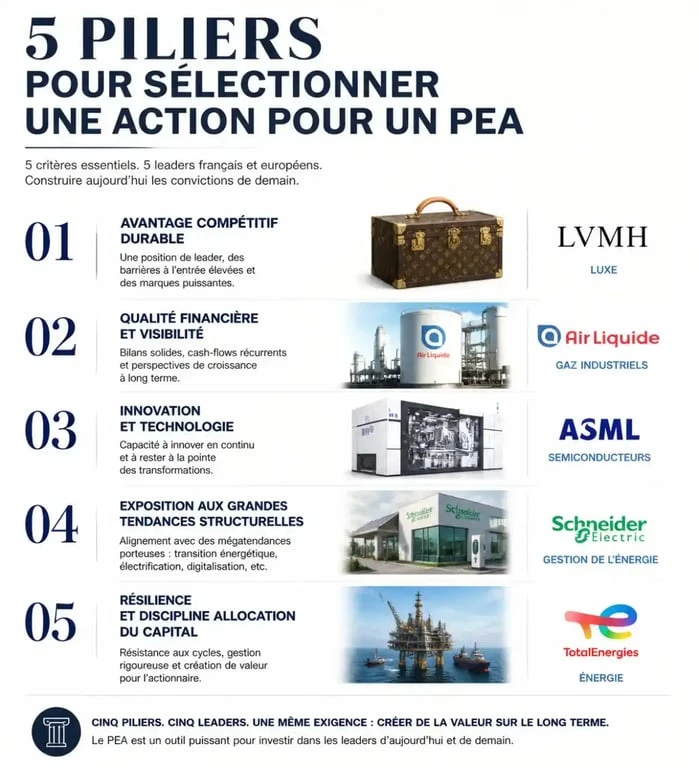
The 5 best PEA actions to watch for a balanced portfolio
This selection is based on a cross-analysis of historical growth, balance sheet strength and cash flow recurrence. These values are fundamental pillars for any investor.
| Enterprise | Sector | Main asset | Profile |
|---|---|---|---|
| LVMH | Luxury | Global leadership | Growth |
| Air Liquide | Industrial gases | Visibility income | Portfolio fund |
| ASML | Semiconductors | Technology monopoly | Technology growth |
| Schneider Electric | Energy management | Electricity | Industry |
| TotalEnergy | Energy | High yield | Dividend |
LVMH : The luxury giant
Often cited as the cornerstone of a PEA, the company led by Bernard Arnault has exemplary resilience. With a portfolio of more than 75 houses, the group benefits from geographical and sectoral diversification. Its ability to maintain high operating margins, even in times of economic slowdown, makes it a robust growth value.
Air Liquide : The regularity of ownership
Air Liquide is valued for its predictability. The group operates on long-term contracts with industrialists, which gives it exceptional visibility on its revenues. Its policy of allocating free shares and increasing the dividend for shareholders to the nominative makes it an effective capitalization tool over two decades.
ASML: The tech engine
Based in the Netherlands, ASML owns a quasi-monopoly on ultra-violet lithography (EUV) machines, which are essential for making the most advanced chips. Without ASML, artificial intelligence and modern smartphones would not exist. Although more volatile, its strategic positioning within the global technology value chain is unparalleled in Europe.
The decisive selection criterion: financial sealing
When looking for the best PEA action, we often focus on turnover. Yet security lies in the structure of the balance sheet. A crucial point is the relationship between net debt and self-financing capacity. A company may show insolent growth, but if it is unable to cover its interest with its operating cash flow, it becomes vulnerable when rates rise. The investor has to verify that the company generates actual cash flow. It is this financial tightness that guarantees the payment of the dividend and the sustainability of future investments.
Methodology: How to analyze an action before investing
Don't just follow a list. Learning to read some key indicators will allow you to arbitrate your portfolio with confidence.
PER and PEG
The PER indicates how many times you pay the net profit. A RIP of 25 means that you pay 25 euros for 1 euro profit. However, a high RIP is not necessarily a sign of overvaluation if growth follows. This is where the PEG (Price/Earnings to Growth) comes in. If PEG is close to 1, the valuation is consistent with the expected growth. If it exceeds 2, you may be paying too much growth.
ROE and ROIC: Measuring Effectiveness
The Return on Equity (ROE) measures the profitability of equity. A company with a ROE of more than 15% consistently demonstrates excellent management. The ROIC (Return on Invested Capital) goes further by including debt: it shows whether the company really creates value with the money it invests. The best PEA actions maintain a high ROIC over several business cycles.
Sustainability of the dividend
Many investors make the mistake of looking at only the return. A 10% return is often the sign of a company in difficulty whose price has collapsed. It is best to focus on a 3% return that increases by 10% each year, supported by an increase in profits. Check it out « Payout Ratio » If the company returns more than 80% of its profits, it has no more room to invest or face a hard blow.
Management strategy: Diversification and investment horizon
Even if you find an excellent action, never put all your eggs in the same basket. A line should ideally not exceed 10% of your total portfolio.
Sectoral diversification is essential. Not only do they have technological or banking values. Mix defensive values, such as basic health or consumption, with cyclical values, such as industry or luxury. The PEA is a marathon. Since the tax advantage is acquired only after five years, your investment horizon must be at least that time to smooth the volatility. Finally, focus on programmed investment (DCA). Instead of trying to « timer » the market, invest a fixed sum each month. This allows to buy more securities when prices fall and less when they are expensive, thus optimizing your average cost price.
In conclusion, the best PEA action is not the one that promises to double in three months, but the one that combines a solid entry barrier, sound financial management and a capacity to go through crises without sacrificing its economic model. By combining giants like LVMH or Air Liquide with a rigorous cash flow analysis, you are transforming your PEA into a machine to generate wealth over the long term.