
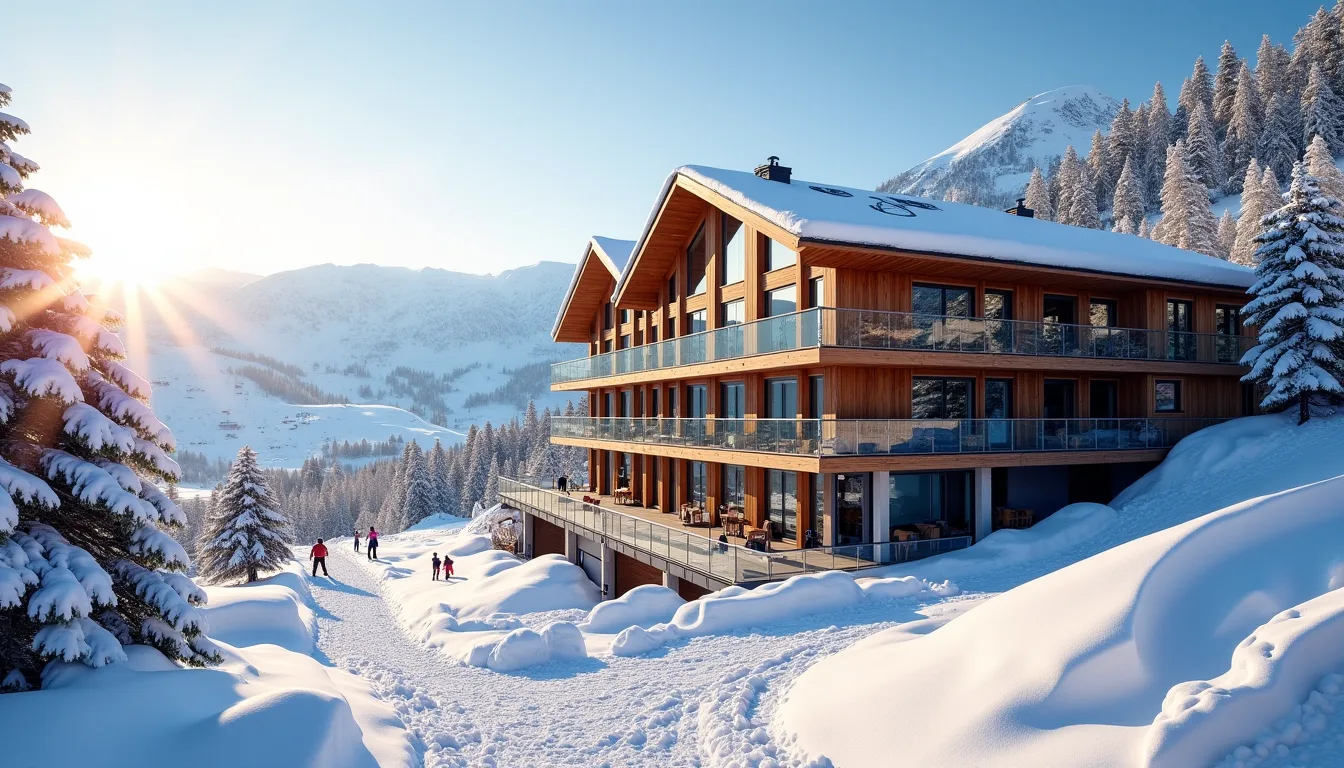

The acquisition of a real estate, especially as part of a new station programme, is a stimulating step, but it is accompanied by many financial considerations that go well beyond the price shown. Many people want buy a new apartment in the Alps, attracted by the charm of the mountains, the quality of modern buildings and the rental potential. However, in order to carry out such a project, it is essential to control all ancillary costs, from the particularities of VAT to the various banking implications.
Anticipating these costs builds a realistic budget and avoids unpleasant surprises. A new dwelling worth 200 000 euros, for example, can cost about 17 000 euros extra, including VAT and notary fees. These figures underline the importance of knowing exactly what each item of expenditure is to approach your investment with serenity.
This article guides you through the financial subtleties of buying a new apartment in a resort, detailing the notary fees, applicable VAT plans, and the crucial banking points to consider. We will also discuss other expenses that should not be overlooked in order to provide you with a comprehensive and transparent vision of your project.
Notary fees: an optimized expenditure item in the nine
When you sign an authentic sales document, the presence of a notary is mandatory. This legal professional secures the transaction and advises you. Notary fees, often called « Acquisition costs », represent a significant part of the overall budget, but they are much more advantageous in new than in the old. For a new dwelling, these costs are generally between 2% and 3% of the purchase price, compared with 7% to 8% for an old property.
This difference is explained by the composition of the costs. In the nine, transfer fees (taxes paid to the State and local authorities) are considerably reduced or even non-existent for certain types of property. Notary fees consist of several elements:
- The notary's emoluments: This is his remuneration for completing the formalities and drafting the act. Their amounts are regulated.
- Registration fees (or transfer fees): These are taxes collected by the notary on behalf of the State and local authorities. In the nine, these duties are reduced.
- Disbursement: These amounts correspond to the expenses advanced by the notary on behalf of his client (cost of town planning documents, cadastre extracts, etc.).
- VAT on emoluments: The remuneration of the notary is subject to VAT.
For a new apartment of 200 000 euros, notary fees could thus be around 6 000 euros. This estimate highlights the financial interest of investing in the new, where some taxes are reduced, facilitating access to property.
Understanding VAT and its specificities for new real estate in stations
The Value Added Tax (VAT) is a major component of the price of a new apartment. The standard rate of real estate VAT is 20% in France. This tax is directly integrated into the selling price displayed by the promoter. For a property of 200 000 euros, this represents a VAT of 40 000 euros (a tax-free price of 160 000 euros), a significant amount to be included in your budget.
However, the acquisition of a new station apartment offers specific opportunities for VAT, especially for rental investors. If your property is for short-term furnished rental with services (which is often referred to as hotel accommodation), you can, under certain conditions, recover the VAT paid on the purchase price. This arrangement, which is governed by the taxation of the Renter in Non-Professional Furnished (LMNP) or Professional (LMP), requires the provision of at least three of the following four services: reception, provision of household linen, regular cleaning of premises and breakfast.
The 20% VAT recovery represents a considerable financial advantage, significantly reducing the initial investment cost. This mechanism is particularly attractive in mountain resorts, where the demand for furnished rentals with services is strong, allowing to reconcile heritage investment and tax optimization. It is advisable to approach a specialist accountant to validate your eligibility and assist you in the administrative process.

Bank charges: beyond the simple interest rate
The acquisition of real estate credit generates a series of bank charges which it is essential to anticipate. These costs add to the capital borrowed and interest, and can vary considerably from institution to institution. An accurate estimate of your borrowing capacity and a comparison of real estate credit offers are the first steps of your project.
Among the main bank charges are:
- Case fees: Invoiced by the bank for studying and editing your loan. They are usually between EUR 300 and EUR 1,000, but may be negotiated or offered in some cases.
- Borrowing interest: This is the main cost of your credit, paying the bank for the capital it lends you. Their amount depends on the interest rate, the duration of the loan and the amount borrowed.
- Guarantee fees: In order to protect against a possible default, the bank requires a guarantee. This can be a mortgage (notary fees and associated taxes) or bank surety (fees paid to a guarantee body). These costs are calculated as a percentage of the amount borrowed.
- The cost of borrowing insurance: This insurance covers repayment of the loan in the event of death, disability or incapacity for work. Its cost, calculated as a percentage of the capital borrowed or monthly payments, can vary greatly depending on your profile (age, health, occupation) and the choice of the insurer. It is possible to choose a different insurance than that proposed by the bank (delegation of insurance) to potentially reduce this cost.
« The first fee is the case fee, which is usually between 300 € and 1000 €. »
These costs, although variable, may represent a significant part of your budget. A detailed loan simulation and a comparative study of the various bank offers are essential to optimize your financing and choose the solution best suited to your situation.
Anticipating other acquisition and ownership expenses
Beyond notary fees, VAT and bank costs, other expenses deserve to be anticipated to ensure the sustainability of your station investment. These budget items concern both the acquisition and the life of the property.
First, the property tax. As an owner, you will be liable for this annual fee. However, new housing may benefit from a total or partial exemption from property tax for the first two years following completion of the work. This exemption is not automatic and requires a tax return.
Then the co-ownership charges. An apartment in a resort, often part of a residence, involves regular charges for the maintenance of common areas (collective heating, lift, snow removal, swimming pool, guardhouse, etc.). Their amount may vary significantly depending on the services offered by the residence and the size of your lot. Ask for an accurate estimate of these expenses before purchase.
Also think about insurance. In addition to borrower insurance, home insurance is mandatory to cover the risks associated with your property (fire, water damage, theft). If you are renting your apartment, unpaid rent insurance or non-occupancy property insurance (NOI) can be a good way to protect yourself.
Finally, if you opt for a furnished rental, you will need a budget for the furnishing and decoration of your apartment. Mountain resorts often require a certain standard to attract a demanding clientele, which can represent a substantial initial investment.
The process of acquiring a new apartment in the station: key steps
The purchase of a new apartment, especially at the station, follows a precise path, marked by important steps. Each phase requires attention and preparation to ensure a successful transaction.
The starting point is to precisely define your borrowing capacity. This involves assessing your income, your expenses, your personal contribution and comparing the different offers of real estate credit. Once this financial framework has been established, the search for the ideal good can begin. The choice of station location (proximity of tracks, shops, view), the services offered by the real estate program and the reputation of the developer are decisive criteria.
After selecting your future apartment, you sign a booking agreement with the developer. This document formalizes your commitment and specifies the characteristics of the property, the sale price and the forecast schedule. You then have a 10-day withdrawal period, during which you can cancel your purchase without justification. This is an essential time to refine your thinking and finalise your funding.
Then comes the signature of the authentic deed of sale at the notary, which seals definitively the acquisition. Then, as the work progresses, you will make instalment payments, called « fund-raising », according to a timetable defined in the sales contract. These payments are strictly regulated by law to protect the buyer.
The last major step is the delivery of the property. At this reception, you inspect the apartment in detail with the developer to report any non-compliance or lack of construction. Once any reserves have been lifted, you will receive the keys and become fully owner of your new apartment in the resort.
Here is an overview of the main costs to consider for a new apartment:
| Category of expenses | Description | Estimated (as % of HT price) |
|---|---|---|
| Notary fees | Emoluments, reduced registration fees, disbursements | 2 to 3 % |
| VAT | Value Added Tax (included in displayed price) | 20 % (potentially recoverable) |
| Bank file fees | Cost of building loan | 0.5 % to 1 % (or package) |
| Guarantee costs | Mortgage or bank guarantee | 0.5 % to 1.5 % |
| Borrowing insurance | Coverage for death, disability, disability | 0,1 % to 0,5 % per year of the initial capital |
| Condominium charges | Maintenance of common parts, services | Variable by residence and services |
| Property tax | Annual local tax (can be exempted for the first 2 years) | Variable according to municipality |
Investing in mountains: a rewarding heritage strategy
The acquisition of a new apartment in a station is much more than just a real estate transaction; It is a real life project and a heritage strategy. Mountain resorts offer an exceptional setting, combining the natural beauty of alpine landscapes with modern infrastructure, conducive to relaxation and rental investment.
The attractiveness of ski and hiking resorts ensures a robust seasonal rental demand, allowing owners to generate additional revenues. In addition, investment in the new ensures housing to the latest construction standards, offering comfort, energy efficiency and reassuring manufacturer guarantees. It is the assurance of a perennial good, whose value is likely to appreciate over time.
For those consideringbuy a new apartment in the resort, relying on experts from the Alpine market can greatly simplify the approach. These professionals know the specifics of the different stations, the real estate programs in progress, and can direct you towards the opportunities that best match your expectations and budget. They help you navigate between the different options, from apartments to chalets, to realize your mountain dream.
In short, although the purchase of a new apartment in a station implies a rigorous anticipation of ancillary costs – notary, VAT, bank costs and other expenses – the long-term benefits, both in terms of quality of life and investment potential, make it an attractive option. Good financial preparation and informed support are the keys to a successful project.